
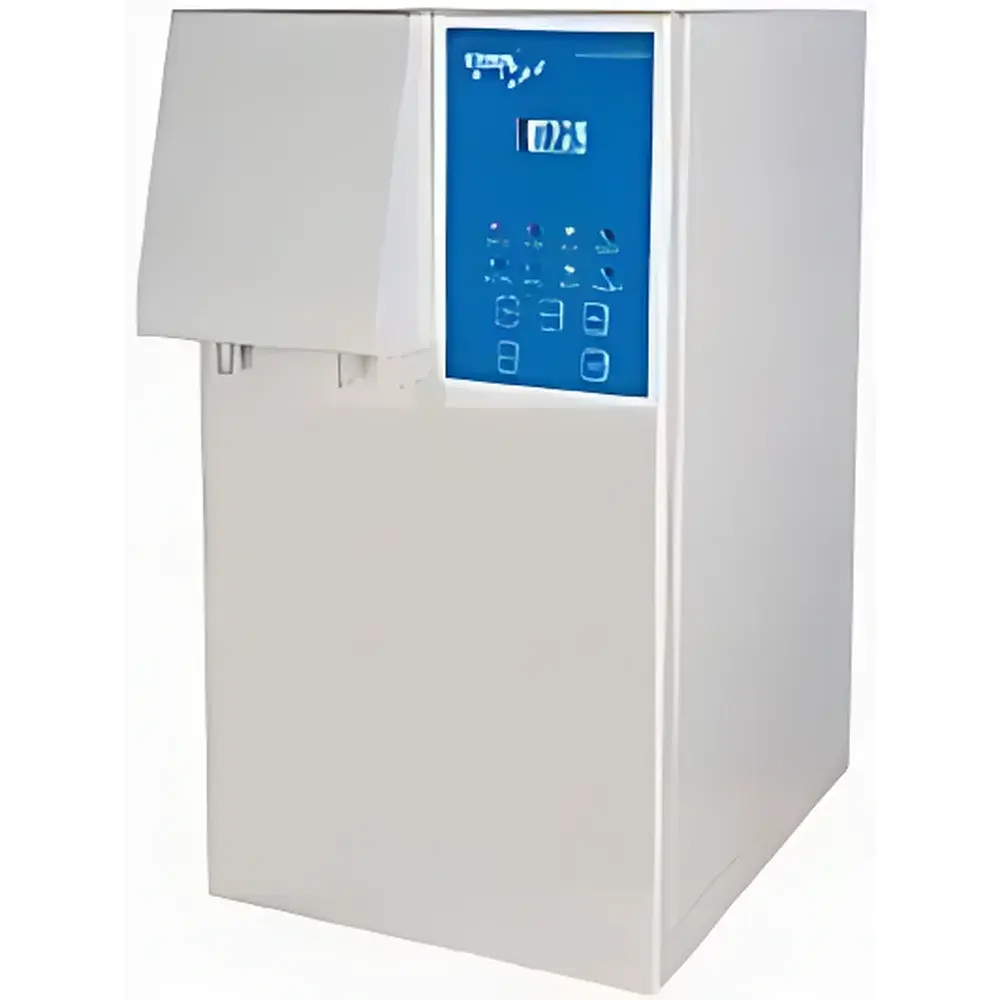
Molelement 1810v Ultra Pure Water System
| Origin | Shanghai, China |
|---|---|
| Manufacturer Type | Authorized Distributor |
| Origin Category | Domestic (China) |
| Model | Molelement 1810v |
| Pricing | Available Upon Request |
| Feed Water | Distilled or RO Water (5–40 °C) |
| Continuous Flow Rate | 1.5 L/min |
| Production Rate | 10 L/h |
| Resistivity | 18.25 MΩ·cm @ 25 °C |
| TOC | <10 ppb |
| Silica Rejection | >99.9% |
| UV Absorbance (254 nm, 1 cm) | ≤0.001 |
| Particles (>0.22 µm) | <1 /mL |
| Heavy Metals | <0.01 ppm (max) |
| Cation Limits (ppb) | Fe <2, Cu <2, Al <3, Ni <1, Zn <5, Cr <1, Na <20, K <20 |
| Anion Limits (ppb) | Cl⁻ <10, NO₂⁻ <20, NO₃⁻ <20, SO₄²⁻ <10 |
| Compliant With | GB/T 6682–1992 Grade I, ASTM D1193–2020 Type I, NCCLS/CLSI EP21-A |
Overview
The Molelement 1810v Ultra Pure Water System is an integrated, multi-stage laboratory water purification platform engineered for continuous production of Type I ultrapure water compliant with ISO 3696:1987, ASTM D1193–2020 Type I, and GB/T 6682–1992 Grade I specifications. It operates on a feed-water input of pre-purified source water—either distilled water or reverse osmosis (RO) permeate—and employs a cascaded purification architecture combining depth filtration, activated carbon adsorption, high-rejection RO membrane separation, dual-stage deionization via mixed-bed ion exchange resins, and final submicron terminal filtration. The system utilizes a dedicated DC-driven ultra-pure water delivery pump to maintain stable laminar flow at up to 1.5 L/min without pressure fluctuation or pulsation, minimizing risk of back-contamination and ensuring consistent electrochemical stability across extended operation cycles. Its design prioritizes long-term reproducibility in trace-level analytical workflows where ionic, organic, particulate, and microbial contaminants must be reduced below detection thresholds of modern instrumentation.
Key Features
- Integrated dual-stage purification path: Pre-filtration (5 µm sediment + granular activated carbon) → high-efficiency RO membrane (≥99% salt rejection) → recirculating deionization loop with regenerable mixed-bed resin cartridge → 0.22 µm hydrophilic PES terminal filter
- Real-time resistivity monitoring with temperature compensation (±0.1 °C), calibrated to NIST-traceable standards, displayed on a backlit LCD interface
- Low-energy DC circulation pump enabling silent, vibration-free operation and eliminating mechanical stress on sensitive downstream components
- Modular ultra-purification pack incorporating proprietary molecular-selective ion exchange media optimized for extended service life and minimized regeneration frequency
- Full-system leak detection with automatic shutdown and audible alarm; integrated UV lamp (185/254 nm) in recirculation loop for TOC reduction and microbial control
- Stainless steel 316L reservoir with welded construction, electropolished interior surface (Ra < 0.4 µm), and inert nitrogen blanketing option for critical applications
Sample Compatibility & Compliance
The Molelement 1810v delivers water suitable for direct use in high-sensitivity analytical platforms requiring ultra-low background interference—including but not limited to ICP-MS, GF-AAS, HPLC-MS, IC, GC-MS, and single-cell proteomics sample preparation. Its output meets stringent acceptance criteria defined in USP , EP 2.2.44, and JP 17 for purified water used in pharmaceutical analytical method validation. All wetted materials comply with FDA 21 CFR 177.2420 and USP Class VI biocompatibility requirements. The system supports GLP/GMP-aligned operation through optional audit trail logging, user access levels (admin/operator), and electronic signature capability per 21 CFR Part 11 when paired with certified software modules.
Software & Data Management
While the base configuration features standalone hardware control, optional Ethernet-enabled data acquisition firmware provides remote status monitoring, historical resistivity/TOC trend logging (up to 30 days), and automated calibration certificate generation. Export formats include CSV and PDF with embedded digital signatures. All event logs—including cartridge replacement alerts, alarm history, and manual override records—are time-stamped and tamper-evident. Integration with LIMS via MODBUS TCP or OPC UA protocols is supported for centralized lab infrastructure management.
Applications
- Preparation of mobile phases and standards for HPLC, UHPLC, and LC-MS
- Blank matrix formulation for trace metal analysis by ICP-OES and ICP-MS
- Diluent and rinse solution in atomic spectroscopy (AAS, AES)
- Electrolyte formulation for electrochemical sensors and fuel cell R&D
- Cleaning of optical components, quartz cuvettes, and semiconductor wafers
- Cell culture media supplementation and reagent-grade buffer preparation under ISO 13485 environments
FAQ
What feed water quality is required to achieve specified ultrapure output?
Distilled water or RO permeate with conductivity <5 µS/cm and silica <0.1 mg/L is recommended. Feed water exceeding these limits may reduce resin lifetime and compromise TOC performance.
Can the system be validated per IQ/OQ/PQ protocols?
Yes—comprehensive validation documentation packages, including test scripts, acceptance criteria templates, and raw data worksheets aligned with ASTM E2500 and EU Annex 15, are available upon request.
Is the terminal filter sterilizable in place (SIP)?
The 0.22 µm PES filter is non-autoclavable but replaceable under aseptic conditions; optional sterile-grade housings with gamma-irradiated pre-assembled cartridges are offered for ISO 5 cleanroom integration.
How often must the ultra-purification pack be replaced?
Under typical usage (8 h/day, 5 L/day total draw), service intervals range from 6–12 months depending on feed water quality and daily throughput—monitored automatically via integrated resistivity decay algorithms.
Does the system support remote diagnostics and predictive maintenance?
With optional connectivity module, cloud-based health monitoring provides early warnings for pump efficiency drift, resin saturation trends, and UV lamp intensity decay—enabling scheduled interventions before specification drift occurs.



