
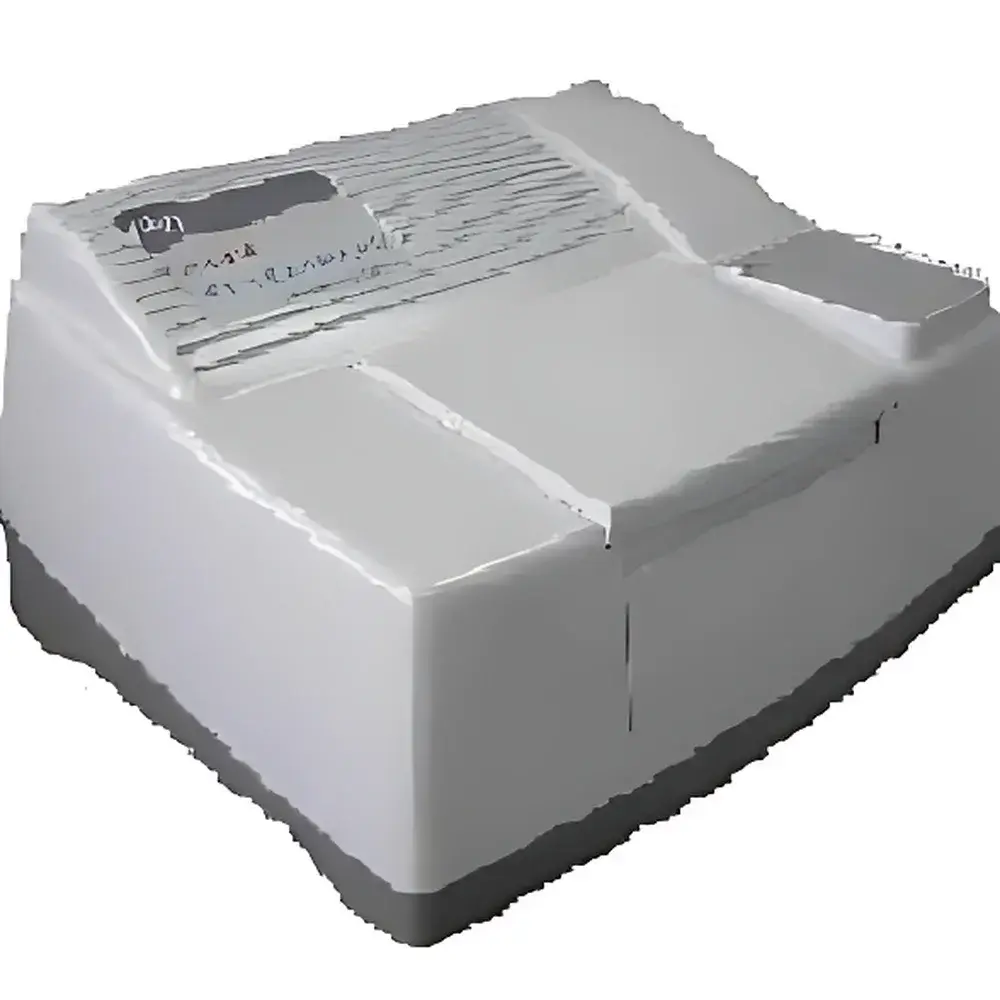
Gangdong FTIR-650 Fourier Transform Infrared Spectrometer
| Brand | Gangdong |
|---|---|
| Origin | Beijing, China |
| Manufacturer Type | Authorized Distributor |
| Country of Origin | China |
| Model | FTIR-650 |
| Pricing | Available Upon Request |
| Optical System | Michelson Interferometer with KBr Beamsplitter |
| Detector | DTGS (Deuterated Triglycine Sulfate) |
| Spectral Range | 4000–400 cm⁻¹ (standard), extendable to 7800–375 cm⁻¹ |
| Spectral Resolution | 0.5 cm⁻¹ (user-selectable down to 0.25 cm⁻¹) |
| Signal-to-Noise Ratio | >15,000:1 (at 4 cm⁻¹, 1 min scan, peak height) |
| Scan Speed | 0.2–2.0 cm/s (interferometer mirror velocity) |
| Aperture | Adjustable iris (2–10 mm) |
| Data Format | Standard JCAMP-DX v5.0 compliant |
| Compliance | Certified per JJG 812–2019 (China National Metrology Verification Regulation), Meets ISO/IEC 17025 requirements for spectral calibration traceability |
Overview
The Gangdong FTIR-650 Fourier Transform Infrared Spectrometer is a benchtop analytical instrument engineered for high-fidelity molecular identification and quantitative analysis across research, quality control, and regulatory environments. Based on the Michelson interferometer architecture, it acquires full-spectrum infrared data through interferometric modulation of broadband IR radiation—enabling simultaneous detection across the entire mid-infrared region without mechanical wavelength scanning. This fundamental design delivers inherent advantages over dispersive instruments, including multiplex (Fellgett), throughput (Jacquinot), and Connes (wavelength accuracy) benefits. The system integrates a proprietary voice-coil linear motor-driven moving mirror mechanism—designed and manufactured in-house by Gangdong Technology—ensuring precise, repeatable, and wear-free interferogram acquisition. Its optical path is sealed and purged-ready (optional dry-air or N₂ purge interface), minimizing atmospheric CO₂ and H₂O interference. Calibration is traceable to NIST-traceable reference standards, and spectral accuracy complies with JJG 812–2019, supporting alignment with international metrological frameworks such as ISO/IEC 17025.
Key Features
- High-speed acquisition: Full 4000–400 cm⁻¹ spectrum in ≤30 seconds (4 cm⁻¹ resolution, 16 scans), significantly reducing analysis cycle time versus grating-based systems.
- Exceptional signal-to-noise ratio: >15,000:1 (peak height, 4 cm⁻¹, 60-second acquisition), enabling reliable detection of low-concentration functional groups and subtle spectral shifts.
- Jacquinot advantage realized: No entrance/exit slits; optical throughput is ~100× higher than comparable grating spectrometers—critical for microsampling, ATR, and weakly absorbing samples.
- Broad spectral coverage: Standard configuration supports 4000–400 cm⁻¹; optional beamsplitters and detectors extend usable range to 7800–375 cm⁻¹, accommodating overtones and combination bands.
- High spectral fidelity: Factory-calibrated resolution of 0.5 cm⁻¹ (user-adjustable from 0.25 to 8 cm⁻¹); wavelength accuracy ±0.02 cm⁻¹ (verified via polystyrene film standard).
- Low stray light performance: <0.3% (measured at 1800 cm⁻¹ using ASTM E1421 method), ensuring baseline integrity for quantitative deconvolution and derivative spectroscopy.
- Compact, service-efficient platform: Dimensions 483 × 356 × 432 mm; mass 14 kg—facilitating integration into fume hoods, gloveboxes, or shared instrumentation suites without structural reinforcement.
Sample Compatibility & Compliance
The FTIR-650 accommodates diverse sample forms—including transmission pellets (KBr, CsI), liquid cells (CaF₂, BaF₂ windows), reflectance accessories (ATR, DRIFTS), and gas cells (path lengths 0.1–10 m)—via standardized 25 mm optical mounts and universal beam-height alignment. All hardware interfaces comply with ISO 17025 clause 6.4 (equipment suitability) and support GLP/GMP documentation workflows. Software includes audit-trail-enabled user access controls, electronic signature capability (per FDA 21 CFR Part 11 Annex A guidance), and configurable report templates aligned with USP , EP 2.2.24, and ASTM E1421. Instrument verification follows IQ/OQ protocols validated against certified reference materials (e.g., SRM 1921b polystyrene film, NIST-traceable).
Software & Data Management
Operated via Gangdong’s proprietary SpectraManager™ v3.x software (Windows 10/11 64-bit), the system provides intuitive workflow navigation—from real-time interferogram monitoring and phase correction to advanced spectral processing (baseline correction, vector normalization, second-derivative transformation, peak integration). Libraries include >3,500 reference spectra (Sadtler, Polymer, Pharmaceutical, Forensic collections), searchable by structure, functional group, or CAS number. Data export supports JCAMP-DX v5.0, ASCII, CSV, and OPUS-compatible formats. Batch processing, macro scripting (VBScript), and API integration (COM/DCOM) enable automation within LIMS and MES environments. All raw interferograms and processed spectra are stored with embedded metadata (operator ID, timestamp, instrument serial, acquisition parameters).
Applications
The FTIR-650 serves as a primary analytical tool in regulated and non-regulated laboratories. In pharmaceutical development, it verifies API identity, detects polymorphic transitions, and quantifies excipient compatibility. Petrochemical labs use it for hydrocarbon fingerprinting, oxidation stability assessment (carbonyl index), and sulfur speciation. Environmental testing includes microplastic identification (FTIR imaging mode compatible), soil organic matter characterization, and airborne particulate analysis. Materials science applications span polymer degradation kinetics, thin-film thickness estimation (using interference fringes), and surface functionalization verification. Forensic units apply it to fiber, paint chip, and explosive residue analysis per SWGMAT guidelines.
FAQ
What is the recommended maintenance schedule for the FTIR-650?
Routine optical alignment verification is advised every 6 months; desiccant cartridge replacement every 3 months (or when indicator color changes); and annual calibration using certified polystyrene film (SRM 1921b).
Can the FTIR-650 be integrated with an automated sampling system?
Yes—via RS-232, USB CDC, or Ethernet TCP/IP, the instrument supports third-party autosamplers (e.g., Harrick, Specac) and custom robotic platforms using open command syntax.
Is spectral library matching compliant with pharmacopeial requirements?
Yes—matching algorithms follow USP similarity thresholds (e.g., correlation coefficient ≥0.995 for identity confirmation) and include confidence scoring based on residual error distribution.
Does the system support hyphenated techniques such as TGA-FTIR?
Yes—the FTIR-650 features a dedicated gas-phase inlet port (Swagelok 1/8″ compression fitting) and real-time spectral acquisition trigger input for synchronized coupling with thermal analyzers.
How is data integrity ensured during long-term archival?
All spectral files include SHA-256 checksums, digital signatures, and immutable metadata logs. Optional encrypted storage modules comply with ISO 27001 Annex A.8.2.3 for protected health information (PHI) or intellectual property handling.






