
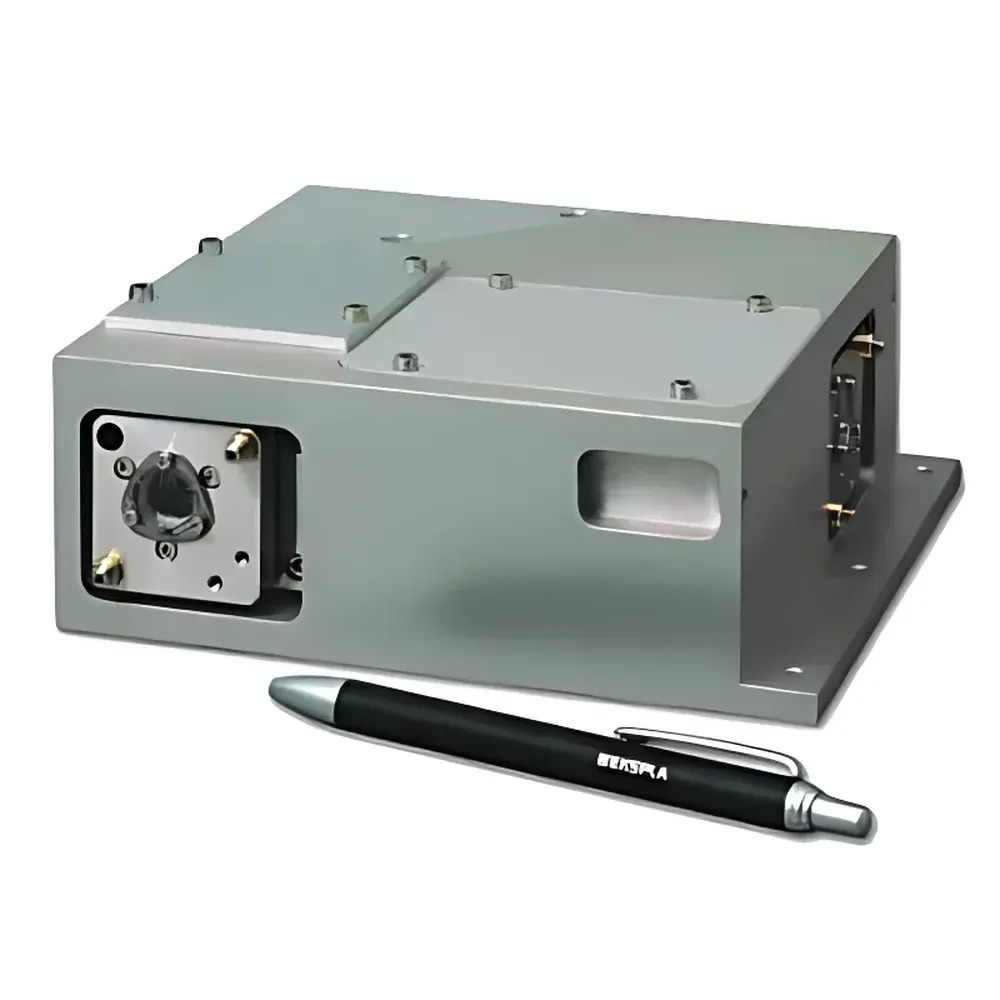
Ekspla NLaser Series Nanosecond Pulsed Nd:YAG Laser Systems
| Brand | Ekspla |
|---|---|
| Origin | Lithuania |
| Model | NL200 / NL220 / NL300 / NL310 / NL300D / NL15100 |
| Pulse Energy | 4 mJ–1.6 J @ 1064 nm |
| Repetition Rate | 10 Hz–100 kHz |
| Pulse Width | 2.8–6.5 ns |
| Wavelength Options | 1064 / 532 / 355 / 266 / 213 nm |
| Beam Mode | TEM₀₀ (select models) |
| Q-Switching | Electro-Optic (EO) |
| Pumping | Diode-Pumped Solid-State (DPSS) |
| Harmonic Generation | Up to 4th harmonic (2ω–4ω) |
| Energy Stability | < ±1.0% RMS (typ.) |
| Warm-up Time | < 5 min (NL300D) |
Overview
The Ekspla NLaser Series comprises a family of diode-pumped, electro-optically Q-switched nanosecond pulsed Nd:YAG laser systems engineered for high-reliability operation in demanding scientific and industrial environments. Based on proven solid-state laser architecture, these instruments generate precisely controlled, high-peak-power pulses via stimulated emission in a neodymium-doped yttrium aluminum garnet (Nd:YAG) crystal, with pulse durations ranging from 2.8 ns to 6.5 ns depending on model and operating configuration. The core design leverages robust thermal management, low-noise power supplies, and hermetically sealed resonator cavities to ensure long-term stability and minimal drift under continuous duty cycles. Unlike flashlamp-pumped alternatives, the diode-pumping architecture delivers superior wall-plug efficiency, reduced thermal lensing, and extended diode lifetime—critical for applications requiring sustained pulse-to-pulse consistency over thousands of shots. The series supports fundamental output at 1064 nm and offers integrated or external harmonic generation modules to deliver stable, collimated beams at 532 nm (2ω), 355 nm (3ω), 266 nm (4ω), and 213 nm (5ω), enabling broad spectral coverage across UV–NIR domains.
Key Features
- Electro-optic (EO) Q-switching for precise temporal control and high extinction ratio (>10⁴)
- Diode-pumped solid-state (DPSS) architecture ensuring low heat load, high beam quality (M² 10⁹ shot lifetime
- Modular harmonic generation: internal or external doubling/tripling/fourth-harmonic modules with >60% conversion efficiency at 532 nm and >35% at 355 nm (typ.)
- Programmable repetition rate: continuously adjustable from single-shot to 100 kHz (NL15100), with fine-resolution step control (e.g., 0.1 Hz increments in low-rep-rate models)
- Integrated digital controller with Ethernet/RS-232 interface, supporting remote parameter setting, real-time monitoring, and synchronization via TTL/CMOS trigger inputs
- Short warm-up time (<5 minutes to full specification stability), essential for time-resolved diagnostics such as particle image velocimetry (PIV) and laser-induced breakdown spectroscopy (LIBS)
- Compliance with IEC 60825-1:2014 Class 4 laser safety requirements; integrated interlock circuits and key-controlled enable logic for laboratory integration
Sample Compatibility & Compliance
The NLaser Series is compatible with a wide range of optical components and experimental platforms—including PIV camera systems, time-of-flight mass spectrometers, ablation chambers, and optical parametric oscillator (OPO) pump stages—without requiring custom beam conditioning. All models meet CE marking requirements and conform to ISO 11146-1:2019 for beam parameter measurement, ISO 13694:2001 for laser-induced damage threshold (LIDT) characterization, and ASTM F1979–21 for laser safety classification documentation. For regulated environments (e.g., pharmaceutical process validation or aerospace materials testing), the systems support GLP/GMP-aligned operation through optional audit-trail-enabled firmware (IEC 62304-compliant software architecture) and 21 CFR Part 11–compatible logging when paired with Ekspla’s LaseSoft™ acquisition suite.
Software & Data Management
Control and diagnostics are managed via Ekspla’s LaseSoft™ v5.x platform—a Windows-based application providing intuitive GUI-driven configuration of pulse energy, repetition rate, delay timing, harmonic selection, and EO Q-switch voltage ramp profiles. The software supports automated calibration routines, real-time energy monitoring with statistical reporting (mean, std. dev., min/max over user-defined burst sequences), and export of timestamped datasets in CSV, HDF5, and MATLAB-compatible formats. Remote operation is enabled through TCP/IP socket communication, allowing seamless integration into LabVIEW, Python (PySerial/PyVISA), or MATLAB instrument control frameworks. Optional hardware add-ons include analog energy meters with 16-bit ADC resolution and external shutter synchronization modules compliant with IEEE 1588 Precision Time Protocol (PTP) for multi-laser array coordination.
Applications
- Spectroscopy: Pump-probe transient absorption, resonance Raman, and laser-induced fluorescence (LIF) requiring sub-ns temporal resolution and wavelength flexibility
- OPO Pumping: High-energy, narrow-linewidth pumping of tunable optical parametric oscillators for mid-IR generation (3–12 µm)
- Laser Ablation & Deposition: Nanosecond-pulsed material removal and thin-film growth (e.g., PLD of perovskites or superconducting oxides) with controllable fluence and stoichiometric transfer
- Remote Sensing: Differential absorption lidar (DIAL) and elastic backscatter lidar utilizing dual-wavelength (e.g., 355/532 nm) configurations for aerosol profiling
- Industrial Micromachining: High-precision marking, drilling, and surface texturing of metals, ceramics, and polymers with minimal heat-affected zone (HAZ)
- Fluid Dynamics: Dual-pulse PIV illumination (NL300D variant) with programmable inter-pulse delays from 100 ns to 10 ms and jitter < 2 ns (rms)
- UV Lithography & Inspection: Mask alignment and defect review using stable 266 nm or 213 nm output with spatial uniformity < ±2.5% across 10 mm × 10 mm field
FAQ
What is the typical pulse-to-pulse energy stability for the NL300 model at 1064 nm?
Energy stability is specified as ≤ ±1.0% RMS over 1,000 consecutive pulses at 10 Hz, measured with a calibrated thermopile sensor traceable to NIST standards.
Can the NLaser systems be synchronized with external equipment such as ICCD cameras or delay generators?
Yes—all models provide TTL-compatible sync outputs (Q-switch trigger, pulse pick-off, harmonic-ready signals) and accept external trigger inputs with adjustable delay (0–10 s, 1 ns resolution) and jitter < 500 ps (rms).
Is harmonic generation included as standard or optional?
Fundamental 1064 nm output is standard; second-harmonic (532 nm) modules are integrated in most models; third- and fourth-harmonic options are available as factory-installed or field-upgradable accessories.
What cooling method is required for continuous operation?
NL200/NL220 use air-cooling with forced convection; NL300/NL310 require recirculating chiller (18–22°C, flow rate ≥2 L/min); NL15100 employs closed-loop liquid cooling with integrated temperature stabilization (±0.1°C).
Does Ekspla provide OEM integration support for embedding these lasers into larger instrumentation platforms?
Yes—Ekspla offers mechanical, electrical, and software integration kits including mounting flanges, power supply interfaces, SDKs (C/C++, .NET, Python), and custom firmware development under NDA for OEM partners.




