
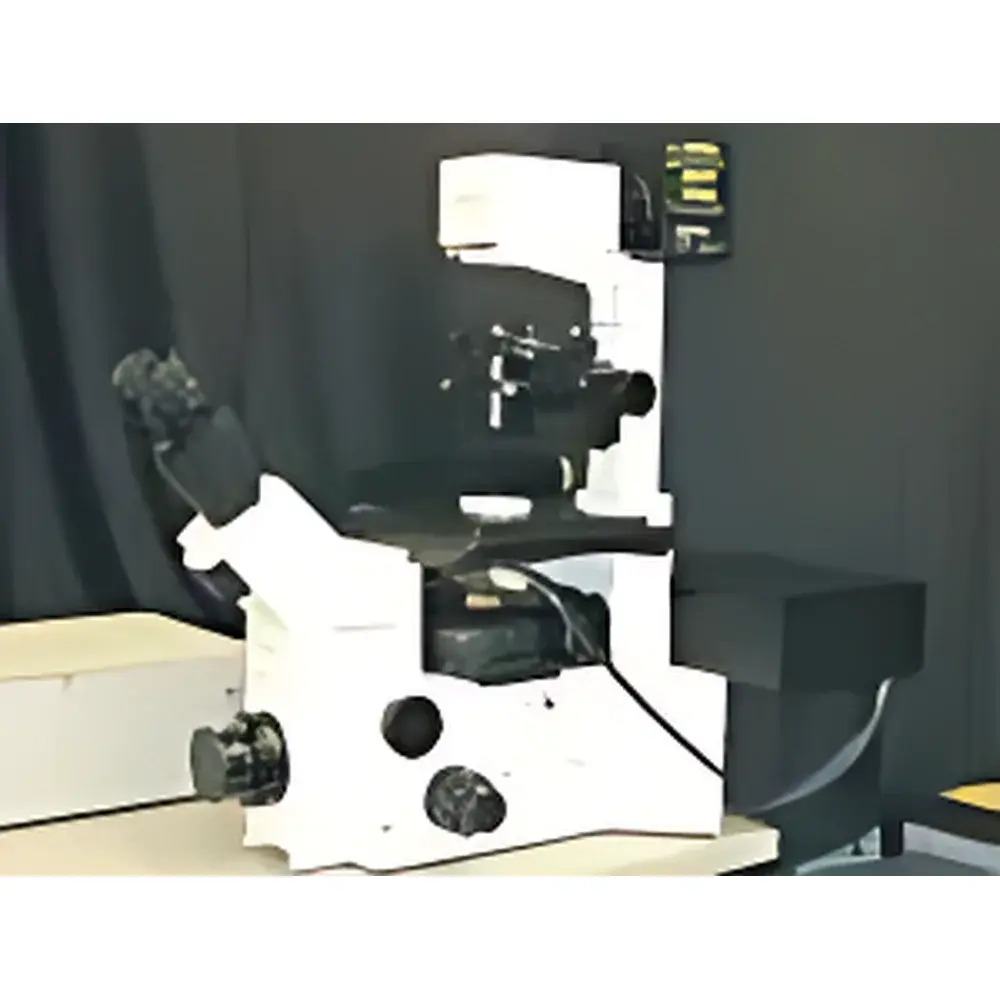
JenLab femt-O-cut Near-Infrared Femtosecond Laser Nanoscale Biomicromachining System
| Brand | JenLab |
|---|---|
| Origin | Germany |
| Model | femt-O-cut |
| Laser Wavelength | 710–990 nm |
| Pulse Duration | < 100 fs |
| Repetition Rate | 80 MHz |
| Avg. Output Power | 1.5 W |
| Numerical Aperture (NA) | 1.3 |
| Lateral Resolution | < 1 µm |
| Axial Resolution | < 2 µm |
| 3D Processing Depth | Up to 100 µm |
| Minimum Feature Size | < 70 nm (FWHM) |
| Scanning Range | 350 × 350 µm (XY), 200 µm (Z) |
| Piezo Z-Stage Precision | 40 nm |
Overview
The JenLab femt-O-cut Near-Infrared Femtosecond Laser Nanoscale Biomicromachining System is an integrated platform engineered for high-precision, non-invasive 3D nanofabrication and functional imaging in transparent and semi-transparent biological and dielectric materials. It operates on the physical principle of nonlinear multiphoton absorption—specifically, multiphoton ionization and plasma-mediated ablation—enabled by tightly focused near-infrared (NIR) femtosecond laser pulses (710–990 nm, <100 fs, 80 MHz). Unlike linearly absorbed UV lasers, which are confined to surface modification, the femt-O-cut achieves true volumetric processing within bulk media due to the threshold-dependent, spatially confined nature of nonlinear excitation. This enables sub-diffraction-limit machining (<70 nm FWHM), minimal collateral thermal or mechanical damage, and precise intracellular and intratissue interventions—critical for applications in single-cell biophysics, chromosome engineering, and optical waveguide inscription.
Key Features
- Ultrafast NIR laser source with pulse duration <100 fs, average power up to 1.5 W, and tunable wavelength across 710–990 nm
- High-NA (1.3) oil-immersion objective enabling diffraction-limited focusing and peak intensities exceeding several TW/cm² in sub-femtoliter volumes
- Motorized variable attenuator for precise control of pulse energy (sub-nJ to nJ range)
- Galvanometric scanning system supporting full-field, ROI, line, and single-point (drilling/ablation) modes with <1 µm lateral and <2 µm axial positioning accuracy
- Piezo-driven Z-stage with 40 nm step resolution for dynamic focal depth control during 3D writing or tomographic interrogation
- Integrated high-sensitivity CCD camera for real-time, label-free, non-invasive tomographic imaging—used both for target selection and in situ process monitoring
- Modular architecture compatible with standard inverted research microscopes, facilitating seamless integration into existing lab infrastructure
Sample Compatibility & Compliance
The femt-O-cut is validated for use with a broad spectrum of optically transparent or semi-transparent specimens, including live mammalian cells (e.g., CHO, HeLa), isolated chromosomes, corneal tissue sections, fused silica, borosilicate glass, polymers (e.g., PMMA, SU-8), and crystalline semiconductors (e.g., silicon). Its non-thermal, nonlinear interaction mechanism ensures minimal photodamage outside the focal volume—making it suitable for GLP-compliant cell manipulation workflows and preclinical ex vivo tissue engineering studies. While not a medical device per se, its operational parameters align with ISO 13857 (safety of laser products) and IEC 60825-1:2014 standards. For regulated environments, data acquisition and instrument control logs can be configured to support audit trails compliant with FDA 21 CFR Part 11 when interfaced with validated third-party laboratory information management systems (LIMS).
Software & Data Management
Control and visualization are managed via JenLab’s proprietary femtoScan software suite, running on Windows-based industrial PCs. The software provides synchronized laser pulse triggering, galvo/piezo motion sequencing, real-time CCD image acquisition, and overlay-based targeting. All scan parameters—including pulse energy, repetition rate, dwell time, ROI coordinates, and Z-stack profiles—are stored in structured XML metadata alongside timestamped imaging frames. Export formats include TIFF (16-bit), HDF5 (for quantitative intensity/time-series analysis), and CSV (for coordinate and parameter logging). Optional MATLAB and Python SDKs enable custom algorithm integration—for instance, automated cell segmentation followed by targeted ablation scripting—supporting reproducible, publication-ready experimental pipelines.
Applications
- Optical transfection: Transient nanoporation of cell membranes for plasmid (e.g., GFP) delivery with single-cell specificity
- Chromosome surgery: Sub-micrometer incision and isolation of defined chromosomal fragments for functional genomics studies
- Single-cell dissection: Isolation of individual cells from tissue slices without enzymatic digestion or mechanical disruption
- 3D photonic device fabrication: Direct-write optical waveguides, couplers, and microresonators in glass and polymer substrates
- Corneal lamellar surgery: Precise stromal incision for ex vivo refractive modeling and keratoplasty protocol development
- Intracellular organelle ablation: Targeted removal of mitochondria, lysosomes, or nuclei to assess functional redundancy and signaling cascades
- Laser-induced intercellular junction cleavage: Controlled disruption of tight junctions or gap junctions to study epithelial barrier dynamics
FAQ
What types of biological samples are compatible with the femt-O-cut?
Live adherent and suspension cells, fixed or fresh tissue sections (e.g., cornea, brain), isolated chromosomes, and extracellular matrices—provided they exhibit sufficient NIR transparency at 710–990 nm.
Can the system perform real-time imaging during laser processing?
Yes—integrated CCD imaging enables simultaneous, non-invasive tomographic visualization before, during, and after ablation, with no requirement for fluorescent labeling.
Is the femt-O-cut suitable for GMP-regulated production environments?
While primarily designed for R&D, its deterministic, parameter-locked operation and exportable audit logs support qualification under GMP Annex 11 when deployed with validated software configurations and change-controlled documentation.
What maintenance is required for long-term stability?
Annual calibration of galvo scanners and piezo stages is recommended; laser source service intervals follow JenLab’s OEM schedule (typically every 12–18 months); water-cooling unit filters require quarterly inspection.
Does the system support multi-user access with role-based permissions?
Native software supports user accounts with configurable access levels (e.g., operator, engineer, administrator); full audit trail generation requires integration with external LIMS or ELN platforms.





