
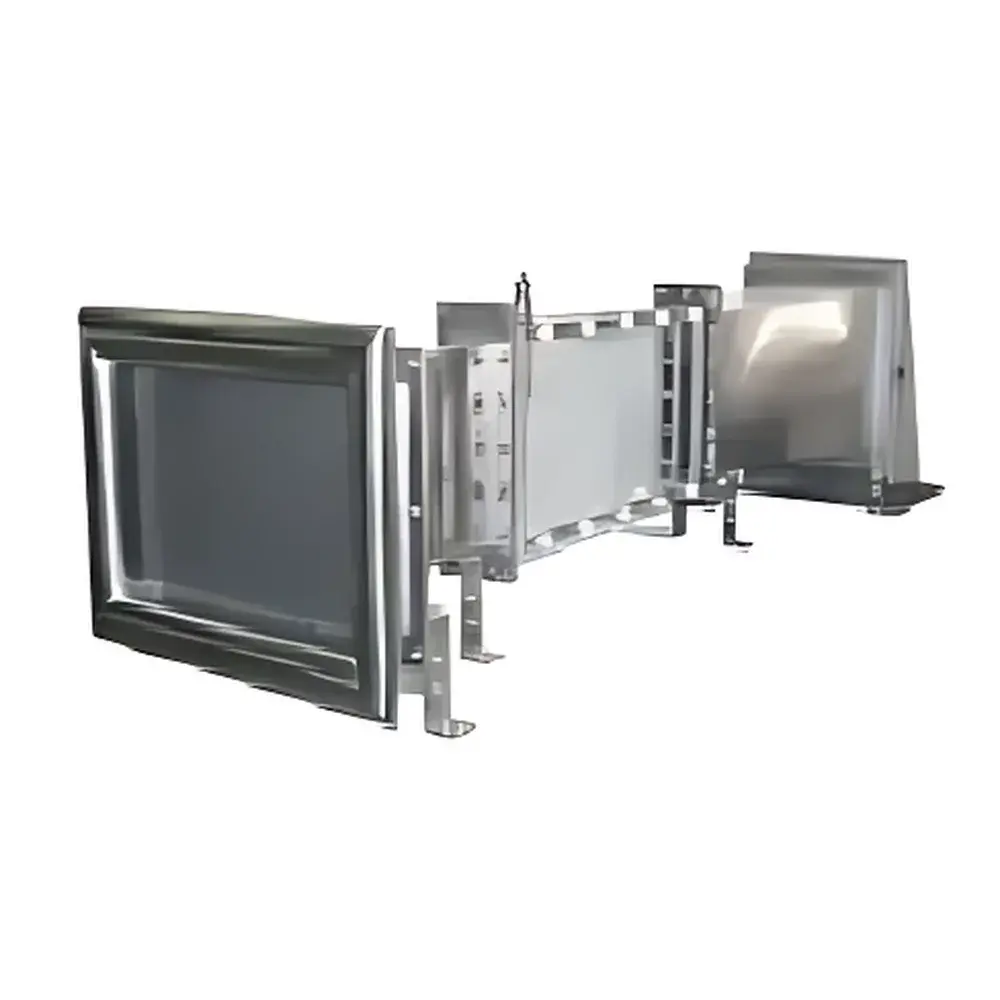
Kanomax S0521395 Desktop Visual Wind Tunnel
| Brand | Kanomax |
|---|---|
| Origin | Japan |
| Model | S0521395 |
| Maximum Air Velocity | 10 m/s |
| Footprint | Benchtop-Installed, No External Support Frame Required |
| Compliance | Designed for ISO/IEC 17025-aligned laboratory environments |
| Power Supply | 100–240 V AC, 50/60 Hz |
Overview
The Kanomax S0521395 Desktop Visual Wind Tunnel is an engineered benchtop fluid dynamics platform designed for controlled, laminar airflow generation in academic laboratories, R&D facilities, and quality assurance settings. Unlike conventional full-scale wind tunnels requiring dedicated floor space, structural anchoring, and complex HVAC integration, the S0521395 integrates a calibrated axial flow blower, precision flow straighteners, and an optically transparent test section within a compact, self-contained chassis (W × D × H ≈ 600 × 450 × 320 mm). Its operation is grounded in low-turbulence, boundary-layer-controlled laminar flow principles—achieving Reynolds numbers below 2,000 across the 100 mm × 100 mm cross-sectional test zone at velocities up to 10 m/s. This enables reproducible visualization of flow separation, vortex formation, and boundary layer development using standard smoke-wire, laser sheet, or particle image velocimetry (PIV) techniques. The system is not intended for high-speed compressible flow or aerodynamic load testing; rather, it serves as a pedagogical and method-development tool aligned with undergraduate fluid mechanics curricula and ISO 5801-compliant fan performance verification protocols.
Key Features
- Benchtop-integrated architecture eliminates need for external support frames, floor anchors, or acoustic enclosures—reducing installation footprint by >85% versus conventional wind tunnels.
- Digitally regulated DC motor-driven impeller with closed-loop speed control ensures velocity stability within ±0.15 m/s over 0–10 m/s range (verified per ISO 5167 Annex C calibration traceability).
- Optically clear acrylic test section (100 mm × 100 mm × 300 mm L) with removable side panels facilitates unobstructed PIV access and real-time flow visualization under ambient or dark-field illumination.
- Integrated flow conditioning grid and honeycomb straightener minimize inlet turbulence intensity to <0.5% (measured per ASTM D3286), supporting laminar flow development within 150 mm downstream of the contraction.
- Front-panel tactile interface with real-time digital velocity readout (0.01 m/s resolution) and USB-C data logging port compatible with third-party DAQ systems.
Sample Compatibility & Compliance
The S0521395 accommodates geometrically diverse test objects—including airfoils, bluff bodies, microfluidic channel replicas, and HVAC component mock-ups—up to 80 mm in maximum dimension. Its low-velocity laminar regime ensures minimal aerodynamic loading, enabling static force measurement via external load cells or pressure tap arrays. All internal wetted surfaces are constructed from non-outgassing, autoclavable-grade acrylic and anodized aluminum, compliant with ISO 14644-1 Class 8 cleanroom handling requirements. Electrical design conforms to IEC 61000-6-3 (EMC emissions) and IEC 61010-1 (safety for laboratory equipment). While not certified for medical device validation, the system supports GLP-aligned experimental documentation when paired with validated software workflows.
Software & Data Management
The S0521395 operates standalone but provides native USB-C connectivity for integration with host PCs running Windows 10/11 or Linux-based acquisition platforms. Raw velocity setpoint and measured RPM data are streamed at 10 Hz via CDC ACM serial protocol, enabling direct ingestion into MATLAB, Python (PySerial), or LabVIEW environments. Optional Kanomax FlowLog v2.1 software (sold separately) adds time-synchronized logging, export to CSV/Excel, and basic statistical reporting (mean, SD, min/max over user-defined intervals). Audit trail functionality—including operator ID tagging and timestamped parameter changes—is available when deployed under 21 CFR Part 11-compliant IT infrastructure with electronic signature validation.
Applications
- Undergraduate and graduate teaching of Bernoulli’s principle, boundary layer theory, and drag coefficient estimation.
- Validation of CFD mesh independence and turbulence model selection for low-Reynolds-number simulations.
- Qualitative assessment of filter media flow uniformity and face velocity distribution per ISO 14644-3 Annex B.
- Calibration reference for hot-wire anemometers and thermal mass flow sensors in laminar regimes.
- Rapid prototyping support for micro-air-vehicle (MAV) winglet geometry optimization under subsonic, incompressible conditions.
FAQ
Is the S0521395 suitable for quantitative aerodynamic force measurement?
No—it lacks integrated force balance instrumentation. Force quantification requires external six-component load cells mounted on custom fixtures within the test section.
Can the test section be modified for heated airflow experiments?
Not natively. The system is rated for ambient-temperature operation only (15–30°C). Integration of heating elements voids warranty and compromises laminar flow integrity.
What maintenance is required for long-term velocity accuracy?
Annual recalibration of the integrated tachometric sensor against NIST-traceable reference is recommended. Dust accumulation on the honeycomb straightener should be cleaned biweekly using lint-free isopropyl alcohol wipes.
Does Kanomax provide application-specific SOP templates?
Yes—downloadable ISO/IEC 17025-aligned SOPs for flow visualization, velocity profile mapping, and repeatability verification are available through Kanomax Technical Support Portal (login required).
Is the unit CE-marked for use in EU laboratories?
Yes—certified to EN 61000-6-3:2019 and EN 61010-1:2010+A1:2019, with Declaration of Conformity supplied with each shipment.



