
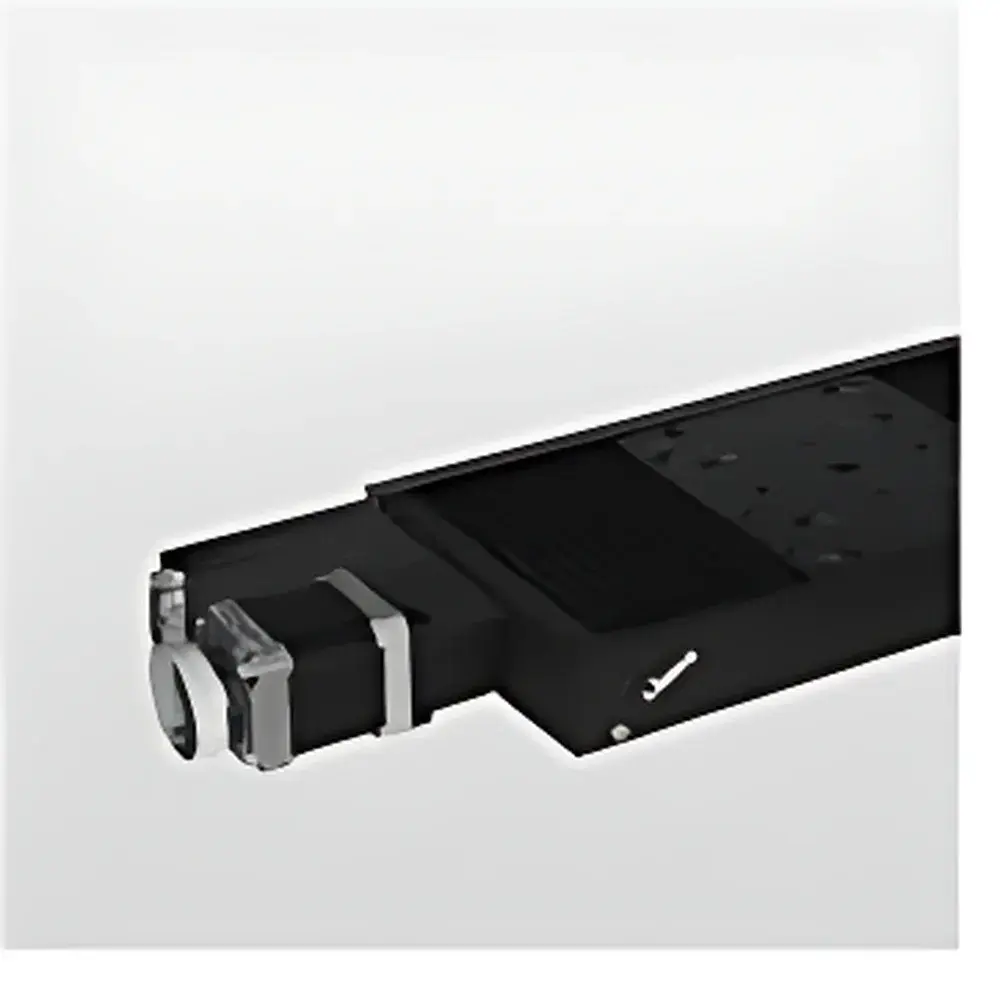
OWIS LIMES122 High-Precision Motorized Linear Translation Stage
| Brand | OWIS |
|---|---|
| Origin | Germany |
| Model | LIMES122 |
| Type | Motorized Linear Translation Stage |
| Drive Options | Stepper Motor / DC Servo Motor |
| Travel Options | 50 / 80 / 155 / 195 / 260 mm |
| Max. Speed | 25 mm/s |
| Max. Load Capacity | 150 N |
| Max. Driving Force | 60 N |
| Lead Screw Pitch | 1 mm |
| Bidirectional Repeatability | < 2 µm |
| Positional Accuracy | < 16 µm per 100 mm |
| Tilt Error (Pitch & Yaw) | < 75 µrad |
| Vertical & Horizontal Straightness Deviation | < 2 µm |
| Max. Motor Voltage | 40 V (stepper) / 24 V (servo) |
| Holding Voltage | 3.2 V |
| Max. Motor Current | 1.8 A (stepper) / 3.3 A (servo) |
| Steps per Revolution | 200 (stepper) / 2000 (servo) |
| Optional Encoders | Incremental Optical Encoder (±3 µm/m accuracy, 0.1 µm resolution) |
| Optional Brake | Electromagnetic Holding Brake |
Overview
The OWIS LIMES122 is a high-precision motorized linear translation stage engineered for demanding optical alignment, interferometry, metrology, and automated microscopy applications. Built upon OWIS’ proprietary preloaded spherical screw drive architecture and precision-ground linear guideways, the LIMES122 eliminates backlash while maintaining exceptional stiffness, load capacity, and long-term positional stability. Its core design adheres to fundamental principles of mechanical metrology—minimizing Abbe error through coaxial actuation, suppressing thermal drift via low-coefficient aluminum construction, and ensuring kinematic repeatability through dual-bearing preloading and hardened steel rail integration. The stage operates under ambient laboratory conditions (20 °C, stable humidity), with performance specifications traceable to ISO 230-2 (Test Code for Machine Tools – Determination of Accuracy) and aligned with common requirements in ISO/IEC 17025-accredited calibration laboratories.
Key Features
- High-rigidity anodized aluminum base with proprietary matte black electroplated surface finish—optimized for low outgassing, ESD control, and minimal stray light reflection in vacuum-compatible and cleanroom environments.
- Selectable travel lengths: 50 mm, 80 mm, 155 mm, 195 mm, and 260 mm—enabling scalable integration into multi-axis goniometers, fiber coupling rigs, or custom optical breadboard systems.
- Bidirectional repeatability better than ±2 µm—achieved through preloaded spherical ball screws and dual angular-contact ball bearings that eliminate axial play and hysteresis across full stroke.
- Integrated Hall-effect, mechanical, and inductive limit switches—providing redundant end-of-travel detection compliant with IEC 61800-5-2 functional safety guidelines for motion control systems.
- Modular motor interface supporting both 2-phase stepper (200 steps/rev) and brushless DC servo (2000 steps/rev) configurations—ensuring compatibility with standard motion controllers (e.g., Thorlabs KDC101, Newport ESP301, or NI PXI-based platforms).
- Optional electromagnetic brake (fail-safe, spring-applied) for vertical or high-inertia mounting orientations—meeting EN 60204-1 emergency stop requirements.
Sample Compatibility & Compliance
The LIMES122 is designed for integration into optical tables, vibration-isolated platforms, and OEM instrumentation chassis. Its non-magnetic aluminum structure and absence of ferrous fasteners ensure compatibility with MRI-adjacent setups and electron-beam lithography tools. All mechanical interfaces conform to standard M4 and M6 tapped holes on 25 mm pitch grids, enabling direct mounting to OWIS MT, UMT, and OM series carriers. The stage complies with RoHS 2011/65/EU and REACH (EC) No. 1907/2006 directives. When equipped with optional incremental optical encoders (±3 µm/m linearity, 0.1 µm resolution), it supports closed-loop positioning suitable for GLP/GMP-aligned process validation where traceable position logging is required per FDA 21 CFR Part 11 Annex 11.
Software & Data Management
OWIS provides native drivers for LabVIEW™ (NI-VISA compatible), MATLAB® Instrument Control Toolbox, and Python (PyVISA + serial/USB protocols). Firmware supports ASCII command sets (e.g., “POS?”, “MOV 12.45”) with programmable acceleration profiles and real-time status polling (position, velocity, error flags). Encoder-equipped variants output quadrature A/B/Z signals compatible with industry-standard counter cards (e.g., National Instruments PCIe-6612) and support time-stamped trajectory logging at up to 10 kHz sampling—enabling post-hoc analysis of dynamic settling behavior and jitter metrics in alignment sequences.
Applications
- Precision laser beam steering and cavity length tuning in ultrafast oscillator setups
- Fiber-to-chip coupling automation requiring sub-micron lateral alignment repeatability
- Interferometric displacement calibration against HeNe wavelength standards (632.8 nm)
- Automated wafer inspection stages in semiconductor metrology tools
- Multi-axis nanopositioning subsystems when stacked with OWIS RLS or RRS rotation stages
- Environmental testing fixtures where thermal expansion compensation is implemented via software-based lookup tables calibrated across −10 °C to +40 °C ranges
FAQ
What is the difference between stepper and servo motor versions in terms of control interface?
Both variants use identical RS-232/USB communication protocols and accept the same ASCII command set; however, the servo version requires external current-loop tuning and supports analog velocity commands, whereas the stepper version operates in open-loop step/direction mode.
Can the LIMES122 be operated in vacuum environments?
Yes—the standard version is rated for ≤10⁻⁴ mbar; for ultra-high vacuum (UHV) applications down to 10⁻⁹ mbar, OWIS offers vacuum-compatible variants with stainless-steel hardware, dry-lubricated guideways, and ceramic-insulated motors.
Is encoder feedback mandatory for achieving the stated ±2 µm repeatability?
No—repeatability is mechanically guaranteed by the preloaded screw and bearing system; encoders enhance absolute accuracy and enable closed-loop correction but are not required for repeatable relative motion.
How is thermal drift compensated during extended operation?
The aluminum body’s CTE (23.1 × 10⁻⁶/K) is mitigated via symmetric thermal mass distribution and low-power motor drive schemes; for critical applications, OWIS recommends integrating external temperature sensors and applying linear compensation in host software using published thermal coefficient data.
Does OWIS provide calibration certificates with NIST-traceable uncertainty statements?
Yes—upon request, certified calibration reports (ISO/IEC 17025 accredited) are available for positional accuracy, straightness, and bidirectional repeatability, including expanded uncertainty (k=2) evaluated per GUM (JCGM 100:2008).




