
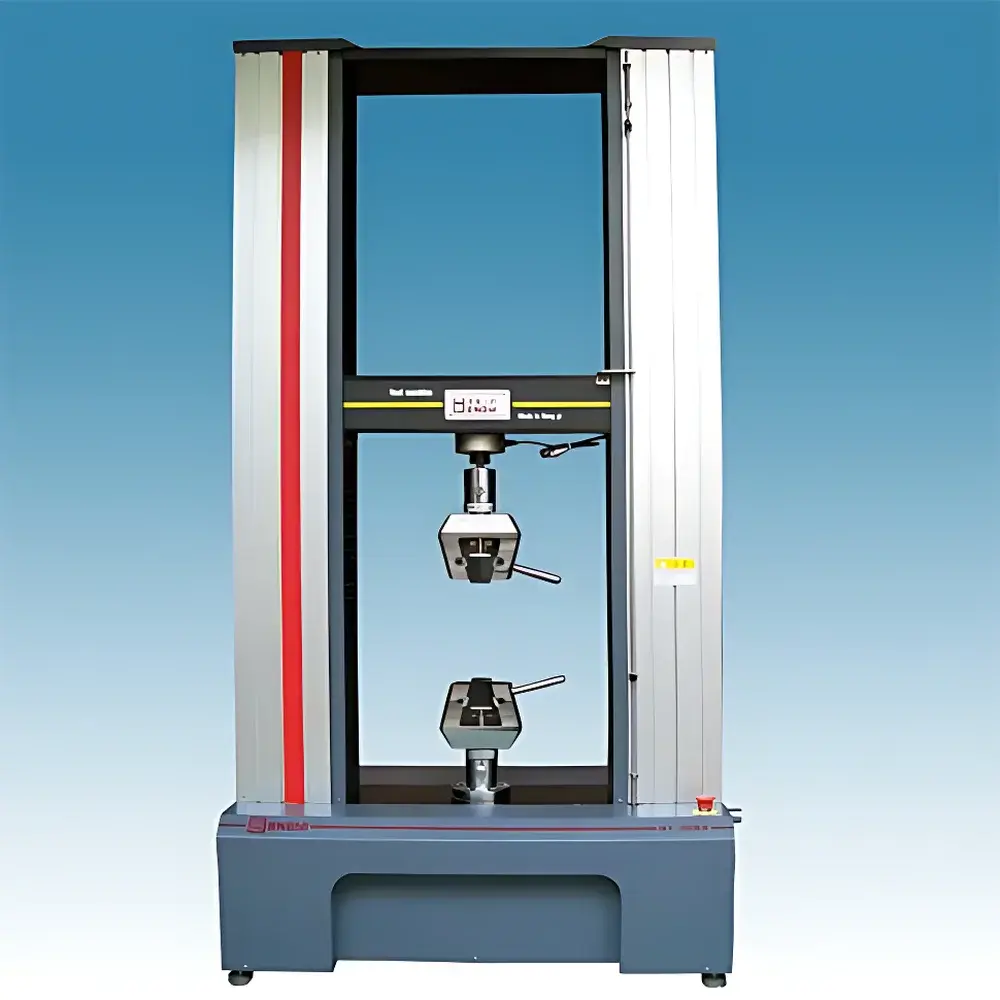
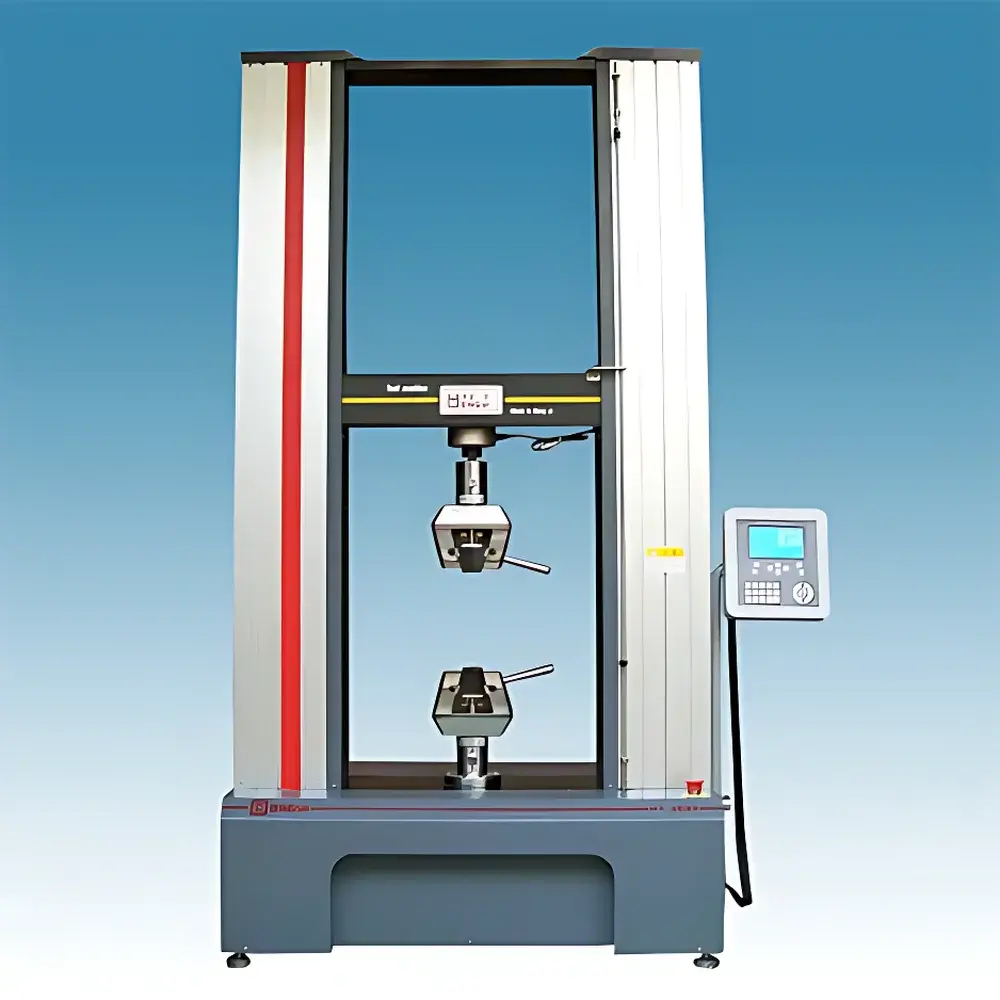
Hengyi HY-10080 Universal Tensile Testing Machine for Welded Metal Joints
| Brand | Hengyi |
|---|---|
| Origin | Shanghai, China |
| Manufacturer Type | Direct Manufacturer |
| Product Category | Domestic |
| Model | HY-10080WERRFF |
| Max Test Load | 100 kN |
| Force Measurement Range | 0.001–100% FS |
| Force Accuracy | ±0.5% of reading |
| Crosshead Travel | 800 mm |
| Displacement Resolution | 0.001 mm (full-scale 800 mm) |
| Test Speed Range | 0.001–500 mm/min |
| Speed Accuracy | ±0.5% of set value |
| Strain Measurement Accuracy | ±0.5% of reading |
| Stress/Strain Control Modes | Yes |
| Load Cell Options | Multiple interchangeable cells (1 N to 100 kN) |
| Effective Test Width | 600 mm (expandable) |
| Power Supply | 220 V AC, 2000 W |
| Machine Weight | 1250 kg |
| Dimensions (W×D×H) | 1000 × 680 × 2200 mm |
Overview
The Hengyi HY-10080 is a high-capacity, dual-column universal tensile testing machine engineered for precise static mechanical characterization of welded metal joints, structural components, and engineering alloys under controlled uniaxial loading conditions. Based on servo-controlled electromechanical actuation and compliant with ISO 6892-1, ASTM E8/E21, and GB/T 228.1 standards, the system delivers repeatable force-displacement data essential for weld integrity validation, material certification, and process qualification in automotive, aerospace, and heavy fabrication industries. Its rigid龙门 (gantry) frame architecture—constructed from high-strength steel with precision-ground guide columns—minimizes deflection and ensures axial alignment within ±0.1 mm over full stroke, critical for accurate measurement of yield offset, ultimate tensile strength (UTS), and post-yield elongation in heterogeneous weld zones.
Key Features
- 100 kN maximum load capacity with optional multi-range load cells (1 N to 100 kN), enabling seamless transition from fine-wire micro-welds to thick-section butt joints without hardware reconfiguration.
- High-resolution force measurement system with ±0.5% accuracy across full scale and 500,000-count internal resolution—no range switching required, eliminating step errors during dynamic loading transitions.
- Programmable crosshead speed from 0.001 to 500 mm/min, calibrated to ±0.5% of set value; supports strain-rate-sensitive tests per ISO 6892-2 (e.g., creep rupture, stress relaxation).
- Three closed-loop control modes: force, displacement, and strain—switchable in real time during test execution for complex protocols such as load-hold, displacement ramp, or strain-controlled cyclic fatigue pre-conditioning.
- Dual-speed motorized crosshead with jog functionality and electronic limit switches prevents over-travel damage; automatic return-to-start and programmable end-of-test positioning enhance throughput in high-volume QA labs.
- Integrated overload protection triggers at 110% of selected load cell capacity; self-diagnostic firmware continuously monitors drive current, encoder feedback, and amplifier voltage to preemptively flag anomalies before test corruption occurs.
Sample Compatibility & Compliance
The HY-10080 accommodates standard tensile specimens (ISO 6892-1 Type 1B, ASTM E8 dog-bone, GB/T 228.1 P1/P2), as well as custom geometries including lap-shear, T-peel, and transverse weld coupons up to 600 mm wide and 800 mm gauge length. Fixture options include wedge-action grips (for metals), pneumatic clamps (for coated or soft alloys), and specialized weld-joint holders with thermal expansion compensation. All mechanical and software functions comply with ISO/IEC 17025 requirements for testing laboratories, and data acquisition meets FDA 21 CFR Part 11 audit trail specifications when paired with validated Hengyi TestSuite v4.x software—including electronic signatures, immutable raw data archiving, and revision-controlled method templates.
Software & Data Management
Hengyi TestSuite v4.x provides full IEC 61508-compliant test automation, supporting ASTM D638, ISO 527, EN 1563, and AWS D1.1 welding procedure specification (WPS) workflows. Real-time plotting includes true stress–true strain, load–extension, and modulus calculation per ISO 527-2 Annex B. Automated report generation exports PDF/Excel outputs with embedded metadata (operator ID, calibration certificate number, environmental log). Raw binary data (.hdt) files are stored with timestamped checksums and support third-party analysis in MATLAB, Python (via h5py), or Minitab for statistical process control (SPC) of weld strength distributions across production batches.
Applications
- Quantification of fusion zone tensile strength, heat-affected zone (HAZ) ductility loss, and interfacial shear resistance in MIG/TIG resistance spot welds.
- Validation of weld procedure qualifications (WPQ) per ASME IX and EN ISO 15614-1, including macro/micro hardness correlation with mechanical performance.
- Comparative evaluation of filler metal selection impact on fracture mode (ductile vs. brittle) in dissimilar metal welds (e.g., stainless-to-carbon steel).
- Long-term mechanical stability assessment of laser-welded battery tab connections under thermal cycling preconditioning.
- Failure mode mapping of friction stir welds via synchronized digital image correlation (DIC) integration (optional camera mount).
FAQ
What standards does the HY-10080 comply with for weld testing?
It conforms to ISO 6892-1 (metallic materials tensile testing), AWS D1.1 (structural welding code), and EN ISO 15614-1 (welding procedure qualification), with traceable calibration to NIST-traceable reference standards.
Can the system perform cyclic loading or fatigue pre-tests?
Yes—the controller supports user-defined load/displacement waveforms (sine, triangle, trapezoidal) up to 5 Hz bandwidth for low-cycle fatigue simulation and R-ratio control, though dedicated high-frequency fatigue testing requires optional hydraulic augmentation.
Is third-party software integration supported?
Raw data export in HDF5 and CSV formats enables direct ingestion into LabVIEW, Python pandas, or JMP for advanced statistical modeling and DOE-based weld parameter optimization.
How is calibration maintained across multiple load cells?
Each load cell carries a unique digital calibration certificate embedded in its memory chip; the software auto-detects and applies corresponding polynomial coefficients, ensuring metrological continuity without manual coefficient entry.
What safety certifications apply to the electrical subsystem?
The mainframe meets CE marking requirements under Machinery Directive 2006/42/EC and Low Voltage Directive 2014/35/EU, with IP20 enclosure rating and reinforced emergency stop circuitry compliant with ISO 13850.
Related Products



