
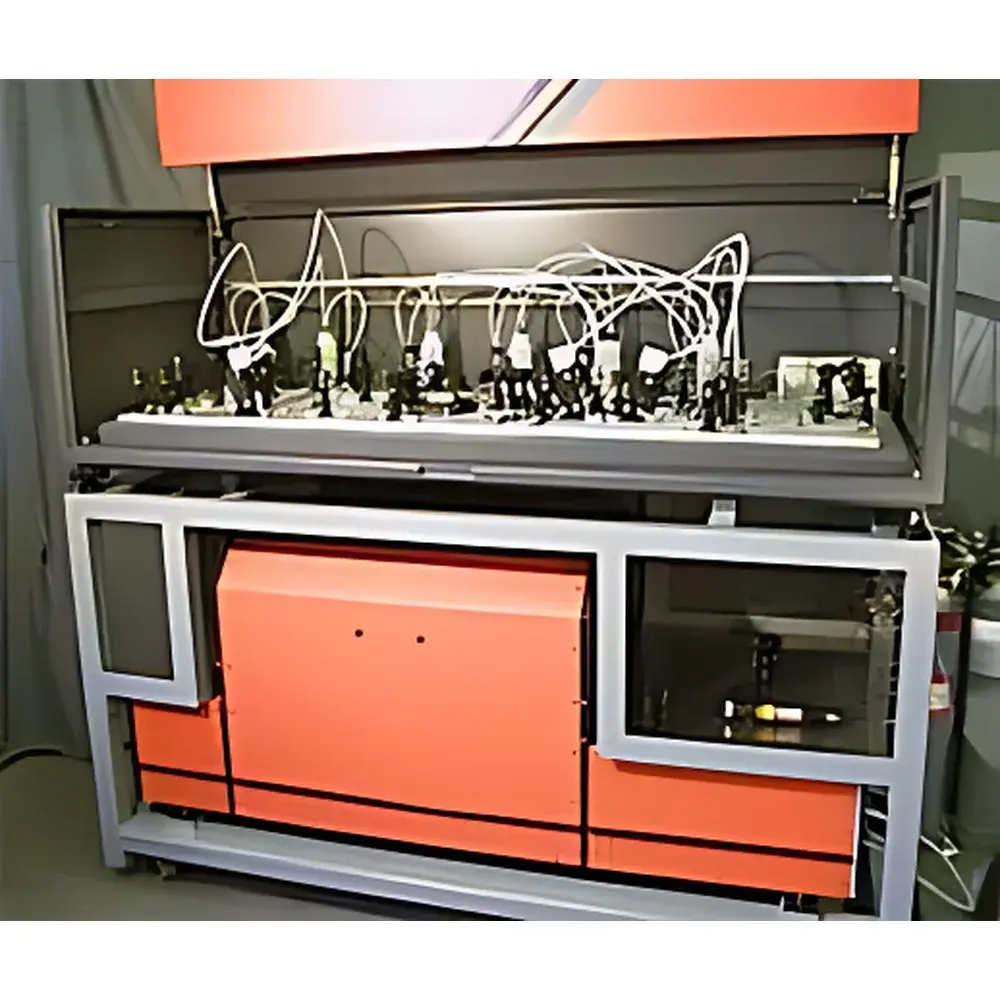
UV-fs-compact Ultrafast Ultraviolet Laser System by Laser-Laboratorium Göttingen e.V.
| Brand | Laser-Laboratorium Göttingen e.V. |
|---|---|
| Origin | Germany |
| Model | UV-fs-compact |
| Wavelength | 248 nm |
| Pulse Energy | 10 mJ per pulse |
| Repetition Rate | 0–10 Hz |
| Beam Dimensions | 25 × 25 mm² |
| Beam Quality | M² ≈ 1.5 (input M² = 1) |
| Pump Source | Excimer-laser-pumped dye laser system with dual-discharge amplification stage |
| Configuration | Integrated, turnkey ultrafast UV source |
Overview
The UV-fs-compact Ultrafast Ultraviolet Laser System is a fully integrated, turnkey femtosecond laser platform engineered for high-precision photochemical, photophysical, and time-resolved spectroscopic applications in the deep ultraviolet spectral region. Unlike conventional Ti:sapphire-based systems requiring complex external frequency conversion chains, the UV-fs-compact employs a robust excimer-pumped dye laser architecture followed by harmonic generation and dual-stage discharge amplification—delivering transform-limited pulses at 248 nm with sub-100-fs temporal duration (typical). Its design prioritizes stability, spatial coherence, and pulse-to-pulse reproducibility under laboratory conditions, making it suitable for pump-probe experiments, ultrafast photoelectron spectroscopy, and ablation studies where vacuum-ultraviolet (VUV) transparency or molecular bond-selective excitation is required. The system operates at low repetition rates (0–10 Hz), enabling high-energy single-shot operation while minimizing thermal load on optical components and target samples.
Key Features
- Integrated architecture with no external alignment required—factory-aligned and pre-characterized for immediate deployment.
- Dual-discharge cavity design enhances amplification efficiency of frequency-doubled dye laser output, ensuring consistent pulse energy up to 10 mJ at 248 nm.
- Beam homogeneity optimized via relay-imaged beam shaping optics; rectangular 25 × 25 mm² output profile supports uniform illumination over extended interaction volumes.
- M² ≈ 1.5 beam quality (measured at fundamental input wavelength, M² = 1) ensures diffraction-limited focusing capability when coupled with high-NA optics—critical for micro-ablation and nonlinear excitation geometries.
- Robust mechanical housing with vibration-damped optical baseplate and sealed gas handling for excimer and dye media—designed for long-term operation in standard laboratory environments without cleanroom requirements.
- Comprehensive interlock system compliant with IEC 60825-1:2014 Class 4 laser safety standards, including shutter control, emission indicators, and emergency stop integration.
Sample Compatibility & Compliance
The UV-fs-compact is compatible with solid-state, liquid-phase, and gas-phase samples housed in vacuum chambers, flow cells, or ambient atmosphere setups—provided appropriate UV-grade optical access and radiation shielding are implemented. Its 248 nm output falls within the absorption bands of many organic chromophores, DNA bases, and wide-bandgap semiconductors (e.g., SiC, AlN), enabling selective electronic excitation and non-thermal ablation. The system meets CE marking requirements for electromagnetic compatibility (EMC Directive 2014/30/EU) and low-voltage safety (LVD Directive 2014/35/EU). All optical enclosures conform to DIN EN 60825-4:2019 for laser product classification and user protection. Documentation includes full traceable calibration reports for pulse energy (NIST-traceable pyroelectric sensor), beam profile (CCD-based profiler), and temporal pulse width (autocorrelation measurement with SHG crystal).
Software & Data Management
Control is managed via a dedicated Windows-based GUI application supporting local USB and Ethernet interfaces. The software provides real-time monitoring of pulse energy, repetition rate, shutter status, and internal diagnostics—including gas pressure levels, dye circulation flow rate, and discharge voltage history. All operational parameters are logged with timestamped metadata in HDF5 format, facilitating post-experiment analysis and audit trail generation. Export options include CSV and MATLAB-compatible binaries. For regulated environments, optional firmware extensions support 21 CFR Part 11-compliant electronic signatures, role-based access control, and audit log retention—enabling compliance with GLP and GMP workflows in academic core facilities and industrial R&D labs.
Applications
- Ultrafast transient absorption spectroscopy of UV-absorbing biomolecules and photocatalysts.
- Pump-probe studies of excited-state dynamics in wide-bandgap materials (e.g., ZnO, GaN) and insulators.
- Time-of-flight photoelectron spectroscopy (PES) with high photon flux at fixed 248 nm photon energy (5.0 eV).
- Single-pulse laser-induced forward transfer (LIFT) for microfabrication of UV-sensitive polymers and bioinks.
- Calibration source for VUV spectrometers and EUV metrology tools requiring stable, narrowband UV reference pulses.
- Fundamental studies of multiphoton ionization thresholds and strong-field physics in atomic and molecular gases.
FAQ
What is the typical pulse duration at 248 nm?
The UV-fs-compact delivers pulses with durations below 100 fs, verified via second-harmonic generation autocorrelation using BBO crystals. Exact values depend on dye selection and cavity tuning but remain consistently sub-100-fs across the operational range.
Is vacuum UV (VUV) output available?
No—the system is optimized for 248 nm output. Harmonic generation beyond the fourth harmonic is not supported due to transmission losses in available nonlinear crystals and gas-phase absorption.
Can the repetition rate be externally triggered?
Yes. The system accepts TTL-level external trigger signals (5 V CMOS compatible) for synchronized operation with delay generators, data acquisition systems, or other pulsed sources.
What maintenance intervals are recommended?
Dye solution replacement every 200–300 million shots; excimer gas refill every 1–2 billion shots; optical coatings inspected annually. Full service documentation and OEM spare parts are provided with purchase.
Does the system support wavelength tuning?
No—this is a fixed-wavelength system operating exclusively at 248 nm. Tunability is sacrificed for pulse energy stability, beam quality, and system compactness.




