
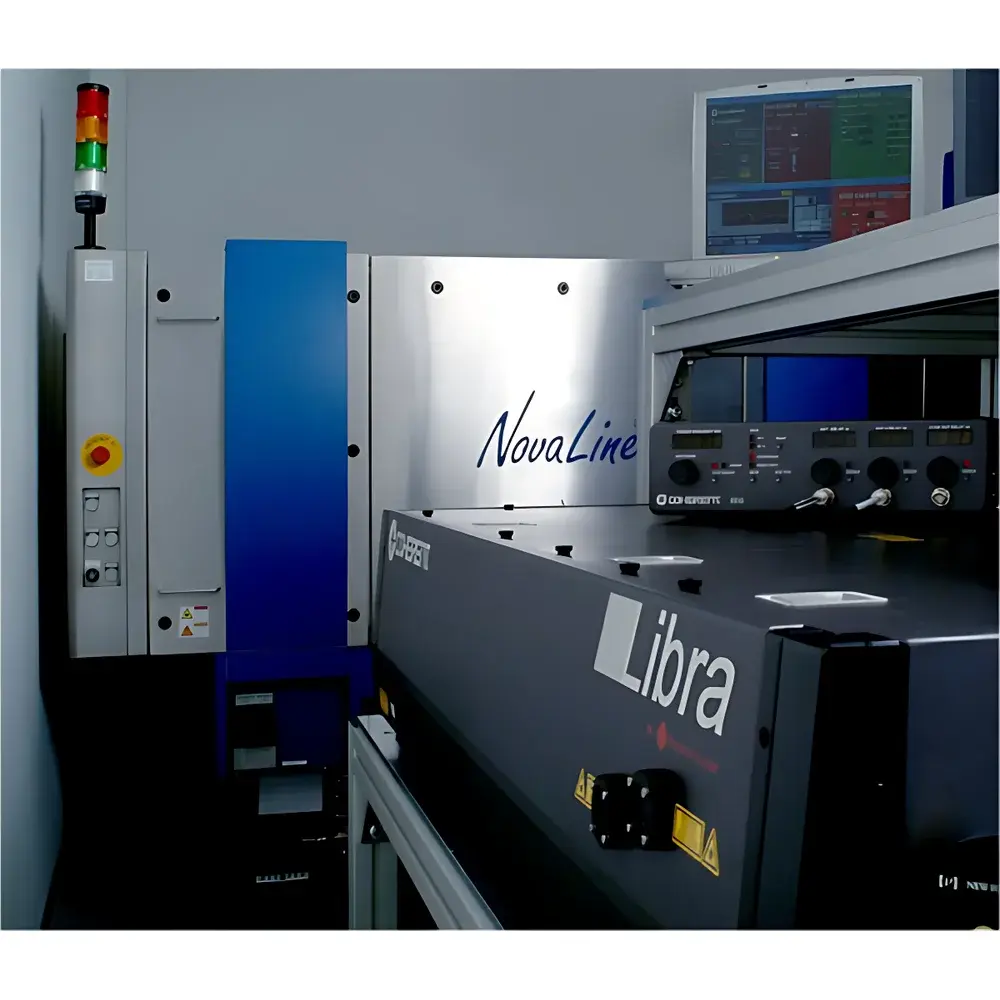
LLG UV-UF Laser System (UV Ultrafast Laser System)
| Brand | Laser-Laboratorium Göttingen e.V. |
|---|---|
| Origin | Germany |
| Model | UV-UF-Laser |
| Wavelength | 248 nm |
| Pulse Duration | 200–700 fs |
| Repetition Rate | 10–300 Hz |
| Pulse Energy | 5–50 mJ |
| Configuration | Solid-State Ultrafast Laser System |
Overview
The LLG UV-UF Laser System is a turnkey solid-state ultrafast laser platform engineered for high-precision photochemical, photophysical, and time-resolved spectroscopic applications in academic research laboratories and industrial R&D environments. Operating at a fundamental output wavelength of 248 nm in the deep ultraviolet (DUV) spectral region, this system delivers sub-picosecond pulses generated via frequency conversion of a Ti:sapphire or Yb-based femtosecond oscillator-amplifier architecture. The 248 nm output enables resonant excitation of electronic transitions in wide-bandgap materials (e.g., SiC, GaN, diamond), direct photodissociation of small molecules, and single-photon ionization of valence orbitals—capabilities not readily accessible with near-IR or visible ultrafast sources. Designed and assembled by Laser-Laboratorium Göttingen e.V., a non-profit research institute with decades of expertise in ultrafast laser development, the UV-UF-Laser adheres to stringent German engineering standards for thermal stability, beam pointing stability (<5 µrad RMS over 8 h), and pulse-to-pulse energy fluctuation (<1.5% RMS at 100 Hz). Its modular architecture supports integration into vacuum chambers, pump-probe delay lines, and time-of-flight mass spectrometers without requiring on-site optical realignment.
Key Features
- Deep-UV output at 248 nm with tunable pulse duration from 200 fs to 700 fs, optimized for minimizing multiphoton effects while maintaining sufficient peak intensity for nonlinear processes
- Adjustable repetition rate spanning 10–300 Hz, enabling flexible trade-offs between signal-to-noise ratio (low-rep-rate high-energy mode) and data acquisition speed (high-rep-rate averaging mode)
- Pulse energy range of 5–50 mJ per shot, calibrated traceably to NIST-traceable pyroelectric sensors and certified annually per ISO/IEC 17025 requirements
- Hermetically sealed, air-cooled solid-state amplifier stage with integrated chirped-pulse amplification (CPA) and third-harmonic generation (THG) in BBO crystals
- Integrated diagnostics: real-time pulse energy monitor, beam profiler (12-bit CMOS sensor), and autocorrelator (SHG-type, <10 fs resolution) with USB 3.0 interface
- CE-compliant enclosure with interlocked safety shutter, Class 4 laser labeling per IEC 60825-1:2014, and embedded key-switch access control
Sample Compatibility & Compliance
The UV-UF-Laser is compatible with standard UHV-compatible optical mounts (e.g., Thorlabs KM100, Newport UH125), 25 mm and 50 mm clear aperture beam paths, and common DUV-transmissive optics (MgF₂, CaF₂, synthetic fused silica). It meets EN 61000-6-3 (EMC emission) and EN 61000-6-2 (immunity) for laboratory environments. All firmware and control logic comply with IEC 62443-3-3 for secure device configuration. For regulated analytical workflows—including those governed by FDA 21 CFR Part 11—the system supports optional audit trail logging and user role-based access control when paired with LLG’s certified LabControl Suite v4.2.
Software & Data Management
Operation is managed via LLG’s cross-platform LabControl Suite (Windows/Linux/macOS), which provides deterministic timing control down to ±10 ps jitter for pump-probe experiments. The software includes built-in routines for automated wavelength verification (using a calibrated UV spectrometer module), pulse duration optimization via adaptive dispersion compensation, and energy stabilization feedback loops. Raw diagnostic data (pulse energy traces, beam profiles, autocorrelation traces) are saved in HDF5 format with embedded metadata (timestamp, operator ID, instrument serial number, calibration certificate hash). Export modules support ASCII, MATLAB .mat, and FAIR-compliant NeXus format for long-term archival and interoperability with institutional data repositories.
Applications
- Ultrafast transient absorption spectroscopy of wide-bandgap semiconductors and insulators
- Time-resolved photoelectron spectroscopy (TR-PES) using 248 nm pump / 800 nm probe schemes
- Photodissociation dynamics studies of halogenated hydrocarbons and atmospheric radicals
- Single-shot laser-induced breakdown spectroscopy (LIBS) for elemental analysis of refractory ceramics
- Generation of coherent EUV harmonics via high-harmonic generation (HHG) in noble gas jets
- Calibration source for DUV radiometry and detector responsivity characterization (per CIE S 025/E:2015)
FAQ
Is the UV-UF-Laser system compliant with GLP or GMP requirements?
Yes—when configured with the optional Audit Trail Module and operated under documented SOPs, the system satisfies GLP Annex 4 and EU GMP Annex 11 criteria for analytical instrumentation used in regulated quality control labs.
Can the pulse duration be adjusted in real time during an experiment?
Yes—the LabControl Suite allows dynamic adjustment of compressor grating separation via motorized stages, enabling on-the-fly tuning between 200 fs and 700 fs with <30 s stabilization time.
What maintenance intervals are recommended for the harmonic generation crystals?
BBO and CLBO crystals require inspection every 500 hours of operation; replacement is advised after 2000 hours or upon observed >15% transmission loss at 248 nm, as verified by in-situ UV spectrophotometry.
Does the system include alignment aids for downstream beam delivery?
Yes—a HeCd pilot beam (325 nm) co-aligned to within ±25 µm of the UV axis, plus integrated irises and kinematic mirror mounts with ±1 mrad fine adjustment, facilitates rapid reintegration into complex optical setups.
Is remote operation supported for unattended overnight measurements?
Yes—full TCP/IP-based command set (SCPI-compliant) enables integration with LabVIEW, Python (PyVISA), or custom scheduling tools; all safety interlocks remain fully active during remote sessions.




