
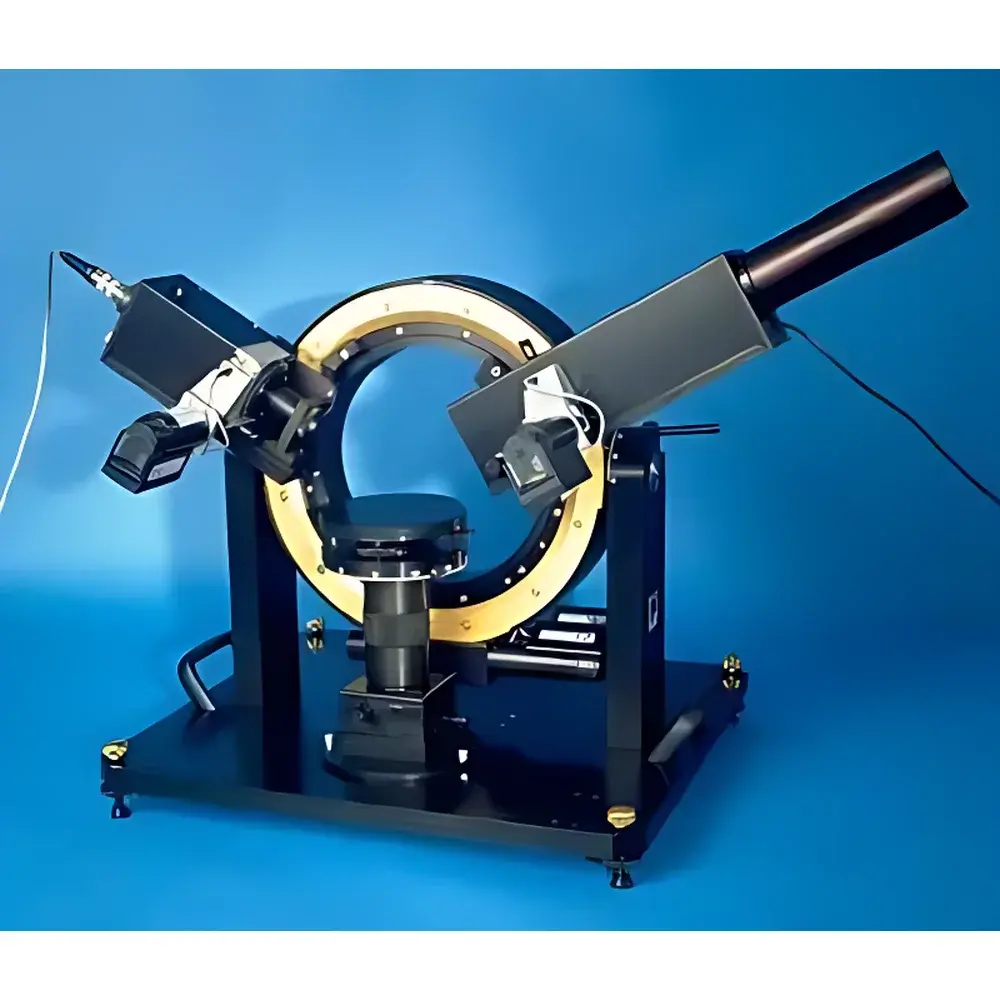
Optrel Multiskop Combined Multi-Function Ellipsometer
| Brand | Optrel |
|---|---|
| Origin | Germany |
| Model | Multiskop |
| Type | Imported Instrument |
| Configuration | Ellipsometry + SPR + Waveguide Mode Analysis + Reflectometry + Brewster Angle Microscopy + SPR Microscopy + Imaging Ellipsometry + Contact Angle Analysis |
| Measurement Speed | Sub-millisecond time resolution (SPR mode) |
| Thickness Resolution | 0.1 nm (ellipsometry) |
| Lateral Resolution | 2 µm (imaging ellipsometry) |
| Vertical Resolution | 0.1 nm (imaging ellipsometry) |
| Typical Field of View (BAM) | 20–200 µm |
| Reflectivity Detection Limit | 10⁻⁶ (BAM) |
| Software Modules | Angle-resolved reflectance scan, Kinetic angle tracking, Reflectance time-series monitoring, Advanced data processing suite |
Overview
The Optrel Multiskop Combined Multi-Function Ellipsometer is an integrated optical metrology platform engineered for quantitative, non-destructive characterization of thin films, interfaces, and surface molecular architectures. Unlike conventional single-technique ellipsometers, the Multiskop unifies seven complementary surface-sensitive optical methods—spectroscopic ellipsometry, surface plasmon resonance (SPR) spectroscopy and microscopy, waveguide mode analysis, broadband reflectometry, Brewster angle microscopy (BAM), imaging ellipsometry, and contact angle analysis—within a single, co-aligned optical train. Its core measurement principle relies on polarization-state modulation and interferometric detection of reflected light, enabling simultaneous extraction of complex dielectric functions (n, k), layer thicknesses, interfacial roughness, molecular orientation, and real-time dynamic response. Designed for fundamental surface science and applied interface engineering, the system supports in situ and operando studies of adsorption kinetics, corrosion initiation, polymer swelling, glass transition confinement effects, and biomolecular binding events—all without sample labeling or physical contact.
Key Features
- Multi-modal optical architecture: Fully synchronized operation of ellipsometry, SPR, waveguide mode analysis, reflectometry, BAM, SPR microscopy, imaging ellipsometry, and contact angle analysis on one platform.
- Sub-millisecond temporal resolution in SPR kinetic mode, enabling quantitative monitoring of fast interfacial processes such as protein-ligand association/dissociation or electrochemical monolayer reorganization.
- Imaging ellipsometry with 2 µm lateral and 0.1 nm vertical resolution—capable of resolving sub-monolayer coverage gradients and domain formation across mm-scale areas.
- Brewster angle microscopy with 10⁻⁶ reflectivity sensitivity and 20–200 µm field-of-view, providing label-free, real-time visualization of molecular tilt, azimuthal rotation, and domain boundaries at air–liquid and solid–liquid interfaces.
- Waveguide mode analysis optimized for anisotropic and thick (>500 nm) dielectric films, where conventional ellipsometry suffers from parameter correlation; delivers high-fidelity dispersion modeling by jointly fitting all refractive index components (nx, ny, nz).
- Automated contact angle analysis with AI-assisted droplet segmentation—eliminates manual thresholding and enables robust, operator-independent quantification of surface energy heterogeneity and chemical gradient mapping.
- Modular environmental control compatibility: Integrated ports for temperature, humidity, pH, and surface tension monitoring during kinetic experiments.
Sample Compatibility & Compliance
The Multiskop accommodates rigid and flexible substrates (Si wafers, ITO/glass, polymer films, hydrogels, liquid–liquid interfaces), including conductive, transparent, and highly scattering surfaces. All measurement modes comply with ISO/IEC 17025 traceability frameworks when operated with certified reference standards (e.g., SiO₂/Si calibration wafers, gold SPR chips). SPR and imaging modules support FDA 21 CFR Part 11–compliant audit trails and electronic signature workflows when deployed in regulated biopharmaceutical QC environments. Data acquisition adheres to GLP/GMP documentation requirements through timestamped metadata embedding and raw-data immutability protocols.
Software & Data Management
The proprietary Multiskop Control Suite is built on a modular architecture with four primary functional modules: (1) Angle-resolved reflectance scanning for dispersion curve acquisition; (2) Kinetic angle-tracking engine with multi-parameter synchronization (temperature, RH, pH, tensiometry); (3) Real-time reflectance time-series monitoring with configurable trigger logic; and (4) Unified data processing environment supporting joint inversion of ellipsometric, SPR, and waveguide datasets using constrained optical dispersion models (Cauchy, Tauc-Lorentz, B-spline). All software modules generate FAIR-compliant (Findable, Accessible, Interoperable, Reusable) HDF5-formatted output files containing raw interferograms, instrument configuration logs, and full uncertainty propagation metadata.
Applications
- Quantitative determination of optical constants (n, k) and thickness of ultrathin (<1 nm) organic monolayers and 2D materials (graphene, MoS₂, MXenes).
- In situ monitoring of microcontact printing fidelity, SAM formation kinetics, and photochemical surface patterning.
- High-resolution mapping of surface morphology scaling laws, ion distribution profiles, and adsorption isotherms on functionalized sensor surfaces.
- Corrosion onset detection via sub-nanometer oxide growth tracking at metal–electrolyte interfaces under potentiostatic control.
- Swelling dynamics and Tg confinement studies in nanostructured polymer brushes and hydrogel thin films.
- Label-free, real-time biosensing of antibody–antigen, DNA hybridization, and exosome binding events using SPR microscopy coupled with kinetic modeling (1:1 Langmuir, heterogeneous ligand models).
- Surface energy mapping of patterned polymer blends and phase-separated block copolymer thin films via automated contact angle analysis.
FAQ
What sample types are compatible with the Multiskop platform?
Solid substrates (Si, glass, quartz, Au, ITO), soft matter films (hydrogels, polyelectrolytes), liquid–liquid interfaces (oil–water, surfactant monolayers), and air–solid interfaces—including rough, textured, or optically absorbing surfaces.
Does the system support automated environmental control during measurements?
Yes—integrated hardware interfaces enable synchronized acquisition with external sensors for temperature, relative humidity, pH, and surface tension, with all parameters logged alongside optical data.
Is SPR chip integration supported out of the box?
Yes—Optrel supplies certified gold-coated SPR sensor chips (50 nm Au on BK7 glass) with documented refractive index homogeneity and surface roughness specifications (RMS < 0.4 nm).
How is data integrity ensured for regulatory submissions?
The software enforces 21 CFR Part 11 compliance via role-based access control, electronic signatures, immutable audit trails, and cryptographic hash verification of raw datasets.
Can the system perform quantitative analysis of anisotropic thin films?
Yes—waveguide mode analysis and generalized ellipsometry modules jointly fit biaxial and monoclinic optical tensor components, making it suitable for aligned polymers, liquid crystals, and strained semiconductor heterostructures.





