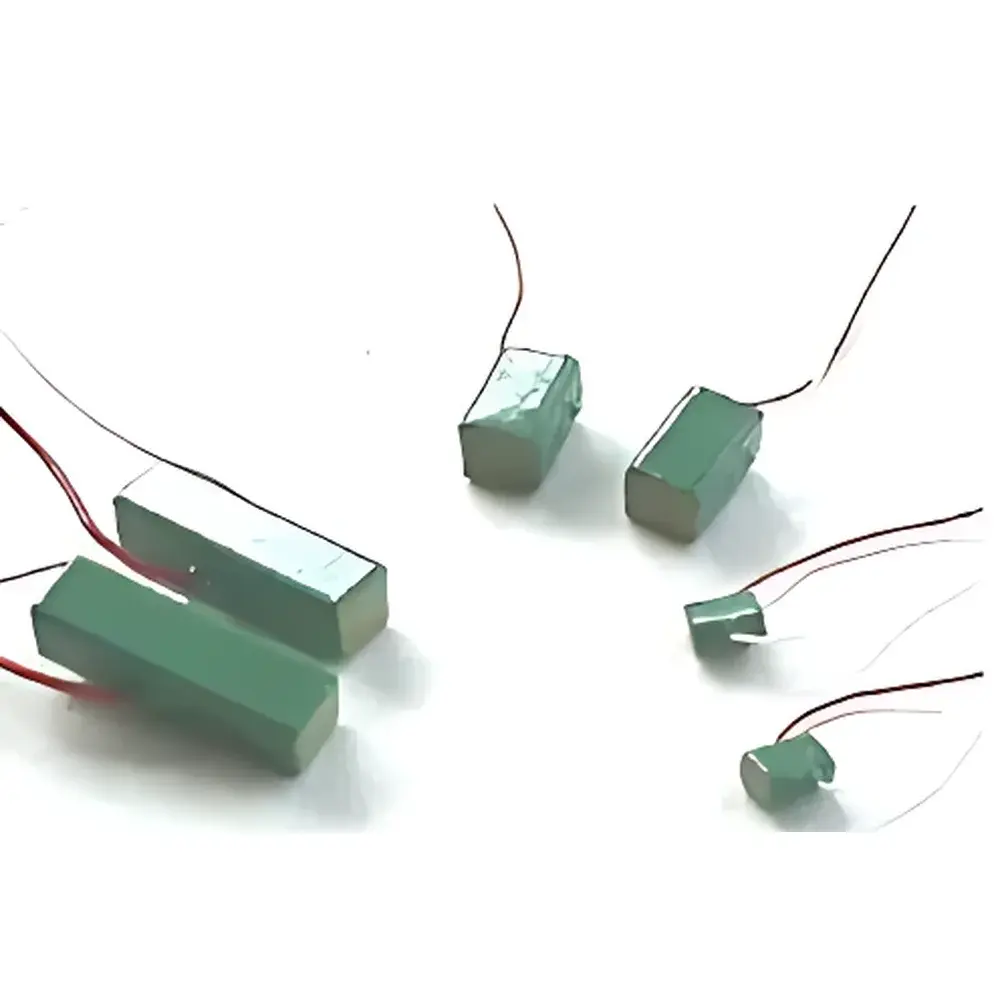
MCL Think Nano Piezo Actuators (PZT Series)

| Brand | MCL Think Nano |
|---|---|
| Origin | USA |
| Model | PZT1 / PZT2 / PZT3 / PZT4 |
| Actuator Type | Low-Voltage Multilayer Piezoelectric Actuator |
| Max. Displacement | 4.6–17.4 µm |
| Max. Driving Voltage | 150 VDC |
| Capacitance | 0.10–0.75 µF ±20% |
| Resonant Frequency | 69–276 kHz |
| Blocking Force | 200–850 N |
| Operating Temperature Range | −25 to +85 °C |
| Cross Section | 3.5×4.5 mm or 6.5×6.5 mm |
| Young’s Modulus | 4.4×10¹⁰ N/m² |
| Tensile Strength | 20–85 MPa |
Ask about pricing, availability and specifications.
Overview
MCL Think Nano Piezo Actuators (PZT Series) are precision-engineered, low-voltage multilayer piezoelectric transducers designed for high-resolution, sub-nanometer positioning in optical laboratory instrumentation and nanoscale motion control systems. Based on the inverse piezoelectric effect—where applied electric fields induce controlled dimensional changes in ferroelectric ceramic materials—these actuators deliver deterministic, hysteresis-minimized displacement with exceptional repeatability and response bandwidth. Unlike traditional stepper- or servo-driven translation stages, piezoelectric actuators provide direct-drive motion without mechanical backlash, gear wear, or electromagnetic interference, making them ideal for interferometric alignment, adaptive optics, scanning probe microscopy (SPM) tip positioning, and ultra-stable optical cavity tuning.
Key Features
- Four standardized models (PZT1–PZT4) optimized for distinct displacement-force trade-offs, enabling selection based on application-specific requirements for stroke length, stiffness, and dynamic response.
- Low-voltage operation (≤150 VDC) reduces power supply complexity and enhances system safety in sensitive optical environments.
- High blocking force (up to 850 N) ensures robust resistance to external loads and thermal drift-induced preload loss during long-term static holding.
- Resonant frequencies ranging from 69 kHz to 276 kHz support closed-loop scanning at kilohertz rates—critical for real-time beam steering and active vibration cancellation.
- Uniform cross-sectional geometry (3.5×4.5 mm or 6.5×6.5 mm) facilitates mechanical integration into flexure-guided stages, kinematic mounts, and custom OEM assemblies.
- Stable performance across −25 °C to +85 °C enables deployment in temperature-controlled cleanrooms, vacuum-compatible enclosures (with optional coatings), and industrial metrology workstations.
Sample Compatibility & Compliance
These actuators are compatible with standard optical breadboards, kinematic mirror mounts, and nanopositioning stages utilizing flexure-based guidance mechanisms. Their non-magnetic, non-outgassing ceramic construction meets ISO 14644-1 Class 5 cleanroom compatibility requirements when integrated with appropriate housing. While the bare PZT elements themselves are not certified to specific regulatory standards, their design adheres to material and electrical safety principles aligned with IEC 61000-4 (EMC immunity) and UL 61010-1 (laboratory equipment safety). When integrated into larger motion systems, full compliance with ISO/IEC 17025 calibration traceability, FDA 21 CFR Part 11 data integrity requirements (via associated amplifier firmware), and GLP/GMP audit trails is achievable through documented configuration control and third-party validation protocols.
Software & Data Management
MCL Think Nano provides the PA25 high-bandwidth piezo amplifier as a dedicated drive solution, featuring analog voltage input (±10 V), low-noise output (<100 µV RMS), and built-in overvoltage/overcurrent protection. The amplifier supports both open-loop and closed-loop operation when paired with external capacitive or strain-gauge position sensors. While the actuators themselves do not embed firmware or digital interfaces, they integrate seamlessly with industry-standard motion control ecosystems—including National Instruments LabVIEW, MATLAB Instrument Control Toolbox, and Python-based PyVISA frameworks—via analog command signals and TTL synchronization triggers. All amplifier firmware revisions maintain backward compatibility and include audit-ready logging of voltage history, thermal status, and fault events, supporting traceable calibration records per ISO/IEC 17025 Clause 7.7.
Applications
- Active stabilization of laser cavities and interferometer arms in gravitational wave detection prototypes.
- Nanoscale focus adjustment in confocal and multiphoton microscopes requiring <5 nm step resolution.
- Dynamic compensation of thermal lensing in high-power solid-state laser systems.
- Sub-microradian beam steering in free-space optical communication terminals.
- Integration into custom-designed flexure stages for atomic force microscope (AFM) scanners and nanoindenter load cells.
- Position feedback loops in adaptive optics systems using deformable mirrors with segmented actuation arrays.
FAQ
What is the recommended driving waveform for optimal linearity and lifetime?
A trapezoidal or sinusoidal voltage waveform with slew rate limited to ≤10 V/ms is recommended to minimize depolarization risk and hysteretic creep. Avoid DC-biased square waves.
Can these actuators be operated in vacuum environments?
Yes—standard versions are suitable for high vacuum (10⁻⁶ mbar) when mounted with vacuum-compatible adhesives and outgassing-tested cabling. Optional gold-plated electrodes are available upon request.
Is closed-loop operation supported natively?
No—closed-loop control requires external position sensing (e.g., capacitive sensor) and a compatible controller. MCL offers integration guidance but does not supply embedded sensors.
How is displacement calibrated for metrological applications?
Displacement is verified using traceable laser interferometry per ISO 230-2 Annex B; individual unit calibration certificates (with uncertainty budgets) are available as an add-on service.
What thermal management considerations apply during continuous high-frequency operation?
At >1 kHz drive frequencies, self-heating may cause ~0.5–1.2 °C rise per watt dissipated. Passive heatsinking via aluminum mounting plates is sufficient for most lab-scale duty cycles.