
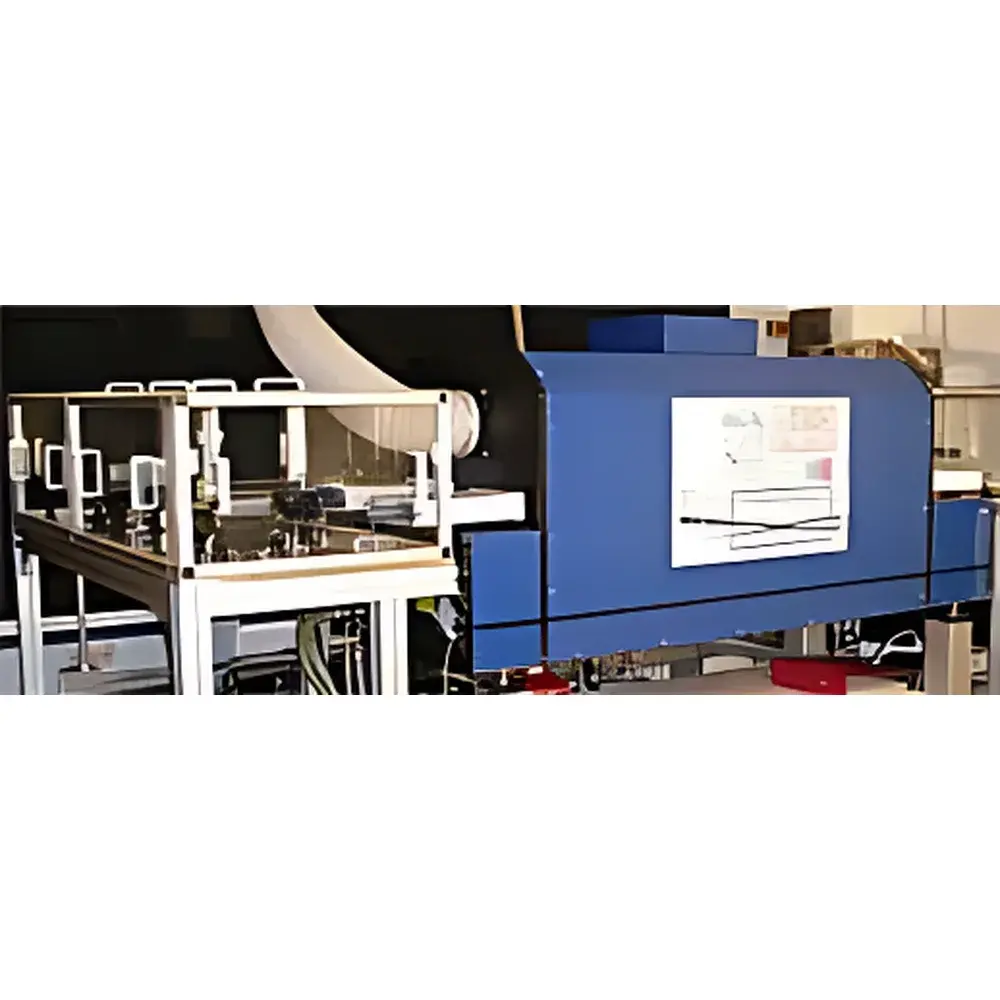
TwinAmp UV Femtosecond Laser Amplifier by Laser-Laboratorium Göttingen e.V.
| Brand | Laser-Laboratorium Göttingen e.V. |
|---|---|
| Origin | Germany |
| Manufacturer Type | Authorized Distributor |
| Origin Category | Imported |
| Model | TwinAmp |
| Price Range | USD 68,000 – 136,000 (estimated) |
| Core Technology | Excimer-based UV femtosecond amplification system |
| Wavelength | 248 nm |
| Single-Pulse Energy | 40 mJ (with seed pulse energy > 50 µJ at 248 nm) |
| Timing Jitter | ±2 ns (relative to external trigger) |
| Beam Dimensions | 36 × 36 mm² |
| Beam Quality | M² ≤ 1.5 (input M² = 1) |
| Pulse Duration | ≤250 fs (with seed pulse < 180 fs) |
| ASE Background Suppression | >10¹⁰ in far field |
Overview
The TwinAmp UV Femtosecond Laser Amplifier is a high-gain, dual-chamber excimer-based amplifier system engineered for ultrafast ultraviolet laser pulse generation at 248 nm. Unlike conventional Ti:sapphire or fiber-based UV conversion architectures, the TwinAmp leverages a master oscillator–power amplifier (MOPA) configuration built around two synchronized KrF excimer discharge amplification stages. This architecture enables exceptional small-signal gain (>10⁷), minimal temporal distortion, and robust suppression of amplified spontaneous emission (ASE) — critical for applications demanding high peak intensity, low temporal contrast, and diffraction-limited spatial fidelity. The system integrates intracavity spatial filtering and chirped-pulse compression between amplification stages, permitting precise control over beam propagation, spectral phase, and temporal profile. Designed and validated at Laser-Laboratorium Göttingen e.V., the TwinAmp meets stringent requirements for pump-probe spectroscopy, attosecond science infrastructure, and high-harmonic generation (HHG) seeding in vacuum-UV and soft X-ray regimes.
Key Features
- Dual-stage KrF excimer amplifier architecture with independent discharge control and thermal management for stable long-term operation
- Integrated spatial filter and grating-based pulse compressor positioned between amplification stages to minimize B-integral accumulation and preserve femtosecond pulse integrity
- Beam quality maintained at ≤1.5× diffraction limit (M²) under full-energy output conditions, verified via ISO 11146-compliant beam profiling
- Low timing jitter (<±2 ns RMS relative to external TTL trigger) ensures synchronization compatibility with pump-probe delay stages and electron/X-ray detection systems
- Far-field ASE suppression ratio exceeding 10¹⁰, achieved through optimized gas mixture dynamics, cavity dumping, and spectral filtering — essential for nonlinear optical experiments requiring high temporal contrast
- Modular mechanical design compliant with ISO 10110 optical mounting standards; accommodates integration into Class 1000 cleanroom environments and ultra-high-vacuum beamlines
Sample Compatibility & Compliance
The TwinAmp operates exclusively at 248 nm and is intended for use with UV-grade fused silica optics, MgF₂ lenses, and dielectric-coated mirrors rated for high-peak-power UV irradiation. It complies with IEC 60825-1:2014 (Laser Product Safety) and EN 61000-6-3:2019 (EMC Emission Standards). System control firmware supports audit-trail logging per GLP/GMP-aligned laboratory practices. While not FDA-cleared (as it is a research-grade instrument), its performance parameters align with ASTM F2793-19 guidelines for ultrafast laser characterization and are routinely referenced in publications adhering to APS, OSA, and IOP journal technical reporting standards.
Software & Data Management
The TwinAmp is operated via a dedicated LabVIEW-based control suite supporting remote monitoring of discharge voltage, gas pressure, pulse energy (via calibrated photodiode + calorimeter), and inter-stage alignment diagnostics. All operational parameters are timestamped and exportable in HDF5 format for traceability. The software includes built-in routines for jitter analysis, pulse duration estimation (via autocorrelation proxy metrics), and ASE background mapping. Data logs conform to NIH FAIR principles and support metadata tagging compatible with institutional ELN (Electronic Lab Notebook) platforms such as LabArchives and Benchling. Optional Python API enables integration with custom automation frameworks and real-time feedback loops for adaptive pulse shaping.
Applications
- Seeding high-harmonic generation (HHG) sources in gas-phase and solid-target configurations
- Pump-probe transient absorption and photoelectron spectroscopy in molecular and condensed-phase systems
- Ultrafast ablation and precision micromachining of wide-bandgap materials (e.g., AlN, SiC, CaF₂)
- Time-resolved X-ray diffraction (TR-XRD) and ultrafast electron diffraction (UED) experiments requiring sub-500-fs UV pump pulses
- Fundamental studies of strong-field ionization dynamics and non-sequential double ionization (NSDI) in noble gases
- Calibration and validation of single-shot UV autocorrelators and FROG devices
FAQ
What seed laser is required to drive the TwinAmp?
The TwinAmp requires a mode-locked KrF-seeded oscillator delivering ≥50 µJ pulses at 248 nm with duration <180 fs and repetition rate ≤10 Hz. Compatible seed sources include colliding-pulse mode-locked (CPM) KrF oscillators or synchronously pumped dye lasers followed by fourth-harmonic generation in BBO.
Is gas replenishment automated?
Yes — the system incorporates a closed-loop Kr/F₂ gas recirculation module with real-time partial pressure monitoring and automated top-up cycles triggered by discharge efficiency decay thresholds.
Can the TwinAmp be integrated into an existing vacuum beamline?
Absolutely. The output port features a CF-63 flange with differential pumping capability, and all internal optics are mounted on kinematic mounts compatible with UHV-compatible alignment procedures.
Does the system support remote operation and diagnostics?
Yes — full bidirectional Ethernet (TCP/IP) communication is provided, including live telemetry streaming, error-code decoding, and firmware update capability via secure SSH tunnel.
What maintenance intervals are recommended?
Discharge electrode inspection every 10⁶ shots; gas mixture refresh every 5×10⁵ shots or quarterly (whichever occurs first); optical surface cleaning per ISO 10110-7 protocol after 2×10⁴ shots or upon visible contamination detection.




