
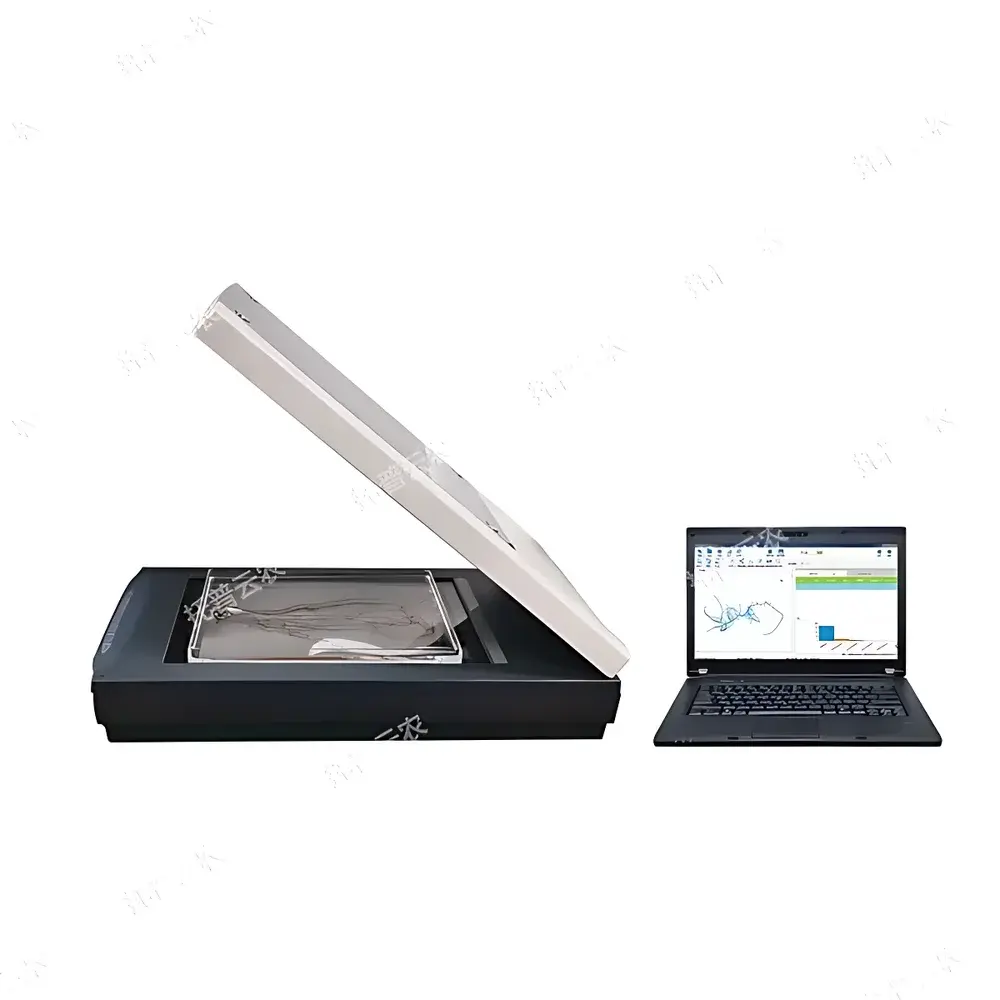
Top Cloud-agri GXY-A Plant Root Imaging & Analysis System
| Brand | Top Cloud-agri |
|---|---|
| Origin | Zhejiang, China |
| Manufacturer Type | Direct Manufacturer |
| Country of Origin | China |
| Model | GXY-A |
| Price | USD 7,650 (FOB) |
Overview
The Top Cloud-agri GXY-A Plant Root Imaging & Analysis System is a high-resolution, non-destructive root phenotyping platform engineered for quantitative morphological and topological characterization of excavated or hydroponically grown plant root systems. It operates on the principle of high-fidelity digital image acquisition—using a 22-megapixel overhead imaging module with adjustable backlighting and anti-glare compression plate—to generate distortion-free, shadow-free grayscale images of washed root samples placed on a calibrated translucent surface. The system implements pixel-based geometric reconstruction algorithms to convert 2D projection data into biologically meaningful metrics including total root length, average diameter, volume estimation via pixel-area-to-volume modeling, fractal dimension (box-counting), and topological hierarchy (up to six-order branching). Designed specifically for post-extraction analysis workflows, it supports standardized root phenotyping protocols aligned with FAO/IAEA guidelines for root architecture studies and complements controlled-environment phenotyping pipelines in agronomic and ecological research.
Key Features
- High-Resolution Imaging Module: 22 MP CMOS sensor with real-time 1-second image capture latency; independently adjustable LED backlight intensity and top illumination compensation to eliminate specular reflection and shadow artifacts.
- Topological Hierarchy Analysis: Automated classification of root architecture into six hierarchical orders (primary, secondary, tertiary, etc.), with individual parameter extraction per order—including length, diameter distribution, projection area, and volumetric contribution.
- Geometric Segmentation & Binning: Customizable diameter-based segmentation (e.g., 0–0.2 mm, 0.2–0.5 mm, >0.5 mm) with auto-generated histograms for length, surface area, and volume distribution across bins.
- Interactive Image Correction Suite: Tools for manual topology refinement—including branch merging/splitting, tip deletion/reconnection, noise suppression (pixel-threshold-based background subtraction), main root reorientation, and fine-root diameter smoothing.
- Multi-Parameter Batch Processing: Fully automated analysis of ≥100 root images per session; progress auto-saves upon interruption; results export directly to Excel-compatible .csv with timestamped metadata.
- Secure Data Governance: Dual-layer software licensing via dynamic QR code + hardware dongle, registered to institutional credentials; supports audit-trail logging for GLP-compliant environments.
- Cross-Platform Data Integration: Native synchronization with the “Zhi Jian Geng Yun” mobile application and cloud-hosted analytics dashboard (HTTPS-secured, ISO/IEC 27001-aligned infrastructure).
Sample Compatibility & Compliance
The GXY-A accepts root samples from dicotyledonous and monocotyledonous species—including but not limited to Arabidopsis thaliana, maize (Zea mays), rice (Oryza sativa), wheat (Triticum aestivum), soybean (Glycine max), and woody perennials—provided roots are thoroughly rinsed free of soil particulates and laid flat without overlap. The system complies with standard sample preparation practices defined in ASTM D7928-17 (Standard Guide for Root Architecture Characterization) and supports data traceability requirements under ISO/IEC 17025:2017 for testing laboratories. While not FDA 21 CFR Part 11-certified out-of-the-box, its audit-log functionality and user-authenticated workflow enable validation for regulated agricultural R&D applications requiring documented chain-of-custody.
Software & Data Management
The proprietary analysis software features a modular GUI with toggle-enabled visualization layers: root tips (red), junction nodes (yellow), connection segments (blue), primary root (thick green), and side roots by order (graded cyan-to-purple). All measurements undergo automatic calibration upon entry of scanner DPI (dots per inch); users may define region-of-interest (ROI) masks to exclude non-root debris or container edges. Export options include tabular summaries (.csv), annotated TIFF overlays, histogram PDFs, and fractal dimension reports. Cloud sync enables version-controlled storage, multi-user access control (role-based permissions), and longitudinal dataset comparison across experimental replicates—critical for QTL mapping, drought-response screening, and mycorrhizal colonization studies.
Applications
- Quantitative assessment of root architectural plasticity under nutrient stress (N/P/K deficiency), water deficit, or salinity gradients.
- Evaluation of breeding lines for ideotype traits: deep rooting index, lateral root density, basal root whorl number, and crown root angle.
- Phenotypic validation of gene-editing outcomes (e.g., DEEPER ROOTING 1, ROOT HAIR DEFECTIVE 3) in transgenic populations.
- Root-soil interface modeling input generation—e.g., spatial distribution parameters for HYDRUS-1D or R-SWMS numerical simulations.
- Ecological studies of invasive species root competitiveness, allelopathic interference, and rhizosphere microbial niche partitioning.
- Forestry nursery stock quality control: taproot integrity scoring, fibrous root mass ratio, and transplant shock resilience indicators.
FAQ
What sample preparation is required prior to scanning?
Roots must be carefully excavated or harvested from hydroponic systems, washed to remove all adhering particles, gently blotted dry, and arranged flat on the backlight panel without overlapping or curling. Excess moisture should be minimized to prevent optical refraction artifacts.
Can the system analyze live roots in soil or gel media?
No—the GXY-A is designed exclusively for ex situ, two-dimensional imaging of cleaned root systems. For in situ root monitoring, complementary technologies such as minirhizotrons or X-ray CT are recommended.
Is the software compatible with macOS or Linux operating systems?
The native desktop application runs on Windows 10/11 (64-bit) only. Cloud dashboard access and mobile app functionality are OS-agnostic via web browser or iOS/Android clients.
How is measurement accuracy validated?
Accuracy is verified against NIST-traceable stage micrometers and synthetic root phantoms with known geometry. Repeatability (CV% across 10 repeated scans of same sample) is ≤2.3% for total length and ≤4.1% for fractal dimension under controlled lighting conditions.
Does the system support third-party integration (e.g., with LIMS or Python scripts)?
Yes—CSV output conforms to MIAPPE v1.1 metadata standards, and RESTful API endpoints are available for institutional IT integration upon request and separate licensing agreement.




