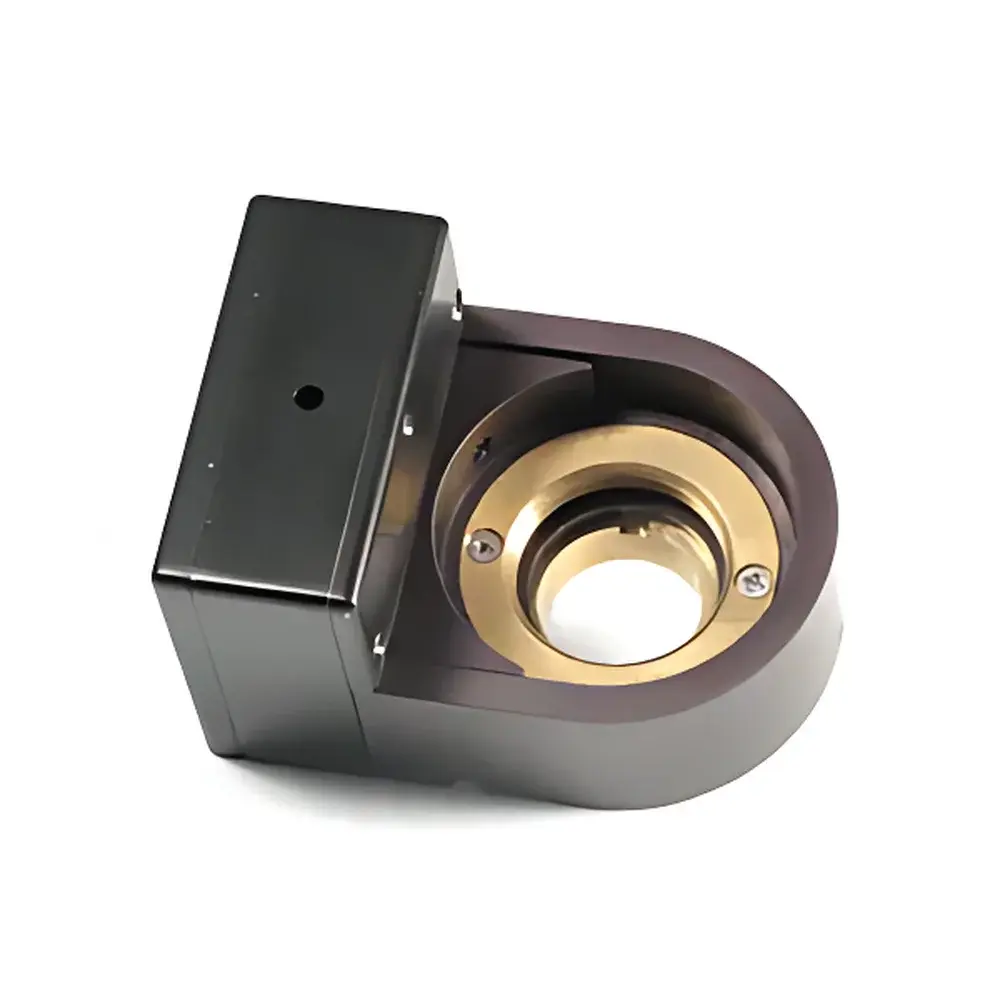
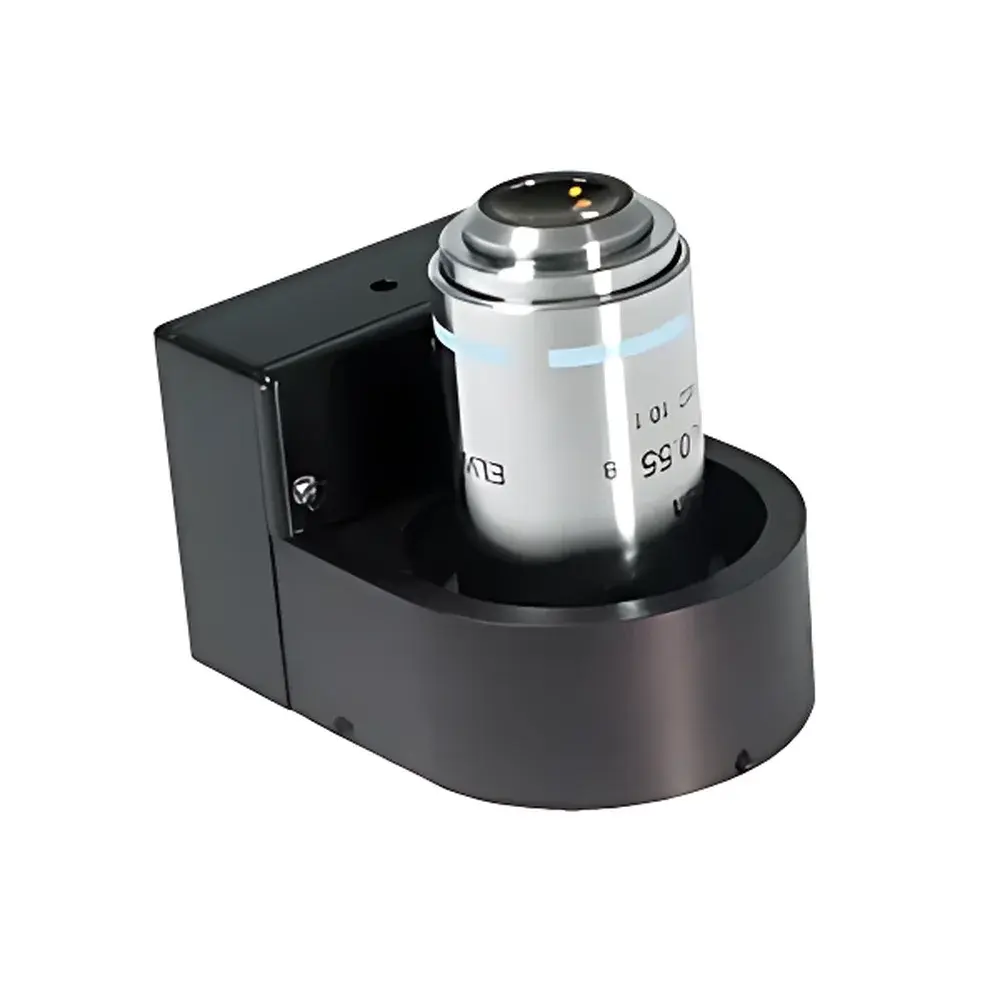
Mad City Labs Nano-F25HS High-Speed Closed-Loop Piezo Objective Focusing Stage

| Brand | Mad City Labs (MCL Think Nano) |
|---|---|
| Origin | USA |
| Model | Nano-F25HS |
| Type | Motorized Precision Translation Stage for Microscope Objective Positioning |
| Travel Range | 25 µm |
| Resolution | 0.05 nm |
| Resonant Frequency (Unloaded) | 1.2 kHz ±20% |
| Resonant Frequency (Loaded, 200 g) | 450 Hz ±20% |
| Runout (θx/θy) | 2 µrad |
| Stiffness | 1.5 N/µm |
| Max Recommended Load | 0.5 kg |
| Body Material | Aluminum & Brass |
| Adapter Threads | RMS, M25, M26 |
| Control Architecture | Closed-loop with integrated PicoQ® capacitive position sensing |
| Compatible Controllers | Nano-Drive® |
Ask about pricing, availability and specifications.
Overview
The Mad City Labs Nano-F25HS is a high-performance, closed-loop piezoelectric objective focusing stage engineered specifically for ultrafast, sub-nanometer precision positioning of microscope objectives in demanding optical microscopy applications. Unlike traditional stepper- or servo-driven translation stages, the Nano-F25HS employs a monolithic flexure-guided direct-drive piezo actuator architecture—eliminating backlash, hysteresis, and mechanical wear while enabling step response times under 100 µs. Its 25 µm travel range is optimized for fine-focus correction rather than coarse scanning, making it ideal for dynamic focus stabilization during time-lapse imaging, confocal Z-stacking, and adaptive optics integration. The stage operates on the principle of electrostrictive displacement amplification within a preloaded piezoceramic stack, coupled with real-time position feedback from proprietary PicoQ® capacitive sensors embedded directly into the motion path—ensuring absolute positional accuracy and long-term repeatability without drift.
Key Features
- Sub-nanometer resolution (0.05 nm) enabled by integrated PicoQ® capacitive position sensing and digital closed-loop control
- High resonant frequency—1.2 kHz unloaded and 450 Hz with 200 g objective load—supporting rapid focus modulation up to kilohertz bandwidths
- Monolithic aluminum-brass flexure body with zero-wear guidance, delivering <2 µrad angular runout (θx and θy) across full travel
- Compact form factor (≤38 mm diameter × 22 mm height) designed for seamless integration beneath standard microscope nosepieces and C-mount adapters
- Modular quick-mount threaded adapter system supporting RMS (0.800″-36), M25×0.75, and M26×0.75 objective lens interfaces—custom thread options available upon request
- Bi-directional stiffness of 1.5 N/µm ensures minimal focus shift under thermal or vibrational perturbation, critical for quantitative live-cell imaging
Sample Compatibility & Compliance
The Nano-F25HS is compatible with upright and inverted research-grade microscopes from Nikon, Olympus, Zeiss, and Leica—provided mechanical clearance and mounting interface specifications are met. It supports objective lenses weighing up to 500 g (with engineering consultation required for loads exceeding this threshold). All electronic components comply with FCC Part 15 Class B and CE EMC Directive 2014/30/EU standards. While not intrinsically certified for cleanroom use, its non-outgassing aluminum-brass construction and absence of lubricants make it suitable for ISO Class 5–7 environments when installed with appropriate shielding. The stage meets mechanical design requirements referenced in ISO 10110-7 (optical component mounting) and aligns with best practices for GLP-compliant instrument qualification per ASTM E2500-13.
Software & Data Management
The Nano-F25HS interfaces natively with Mad City Labs’ Nano-Drive® controller suite via USB 2.0 or optional analog/digital I/O expansion modules. Firmware supports real-time streaming of position data at up to 10 kHz sampling rate, enabling synchronization with camera triggers, laser pulse generators, or external DAQ systems. Software drivers are provided for Windows (x64), Linux (kernel ≥5.4), and MATLAB (via Instrument Control Toolbox). All position commands and sensor readings are timestamped with microsecond precision and support audit-trail logging compliant with FDA 21 CFR Part 11 when used with validated Nano-Drive® configurations. Optional Python API (pynanodrive) enables integration into custom acquisition pipelines for AI-assisted autofocus or multiplexed Z-control algorithms.
Applications
- Real-time autofocus in widefield, TIRF, and light-sheet microscopy
- Z-axis stabilization during long-duration confocal or multiphoton time-lapse experiments
- Dynamic focus correction in adaptive optics systems compensating for sample-induced aberrations
- High-speed optical sectioning for volumetric imaging at frame rates >30 Hz
- Integration into automated patch-clamp rigs requiring precise electrode–cell interface maintenance
- Calibration reference stage in metrology labs validating interferometric focus sensors
FAQ
What is the maximum recommended load for the Nano-F25HS, and can it be exceeded?
The manufacturer specifies a maximum recommended static load of 0.5 kg. Loads beyond this threshold require direct consultation with Mad City Labs’ application engineering team to evaluate mechanical resonance degradation and thermal drift behavior.
Is the Nano-F25HS compatible with third-party controllers?
Yes—the stage accepts analog voltage input (±10 V) for open-loop operation and provides differential encoder output for external closed-loop integration; however, full closed-loop performance and PicoQ® sensor calibration are only guaranteed when used with Nano-Drive® firmware.
Does the Nano-F25HS require periodic recalibration?
No. The PicoQ® capacitive sensing system is drift-free and does not require routine recalibration. Factory calibration data is stored in non-volatile memory and persists across power cycles.
Can the Nano-F25HS be used in vacuum environments?
Standard units are rated for ambient air operation only. Vacuum-compatible variants (with modified materials and outgassing mitigation) are available as custom-engineered solutions—contact engineering support for chamber pressure and bake-out specifications.
How is thermal stability managed during extended operation?
The flexure-based design minimizes heat generation, and the aluminum-brass thermal mass provides passive damping. Under continuous 1 kHz modulation at full range, temperature rise at the base remains below 1.2°C after 30 minutes—well within typical microscope thermal tolerance limits.