
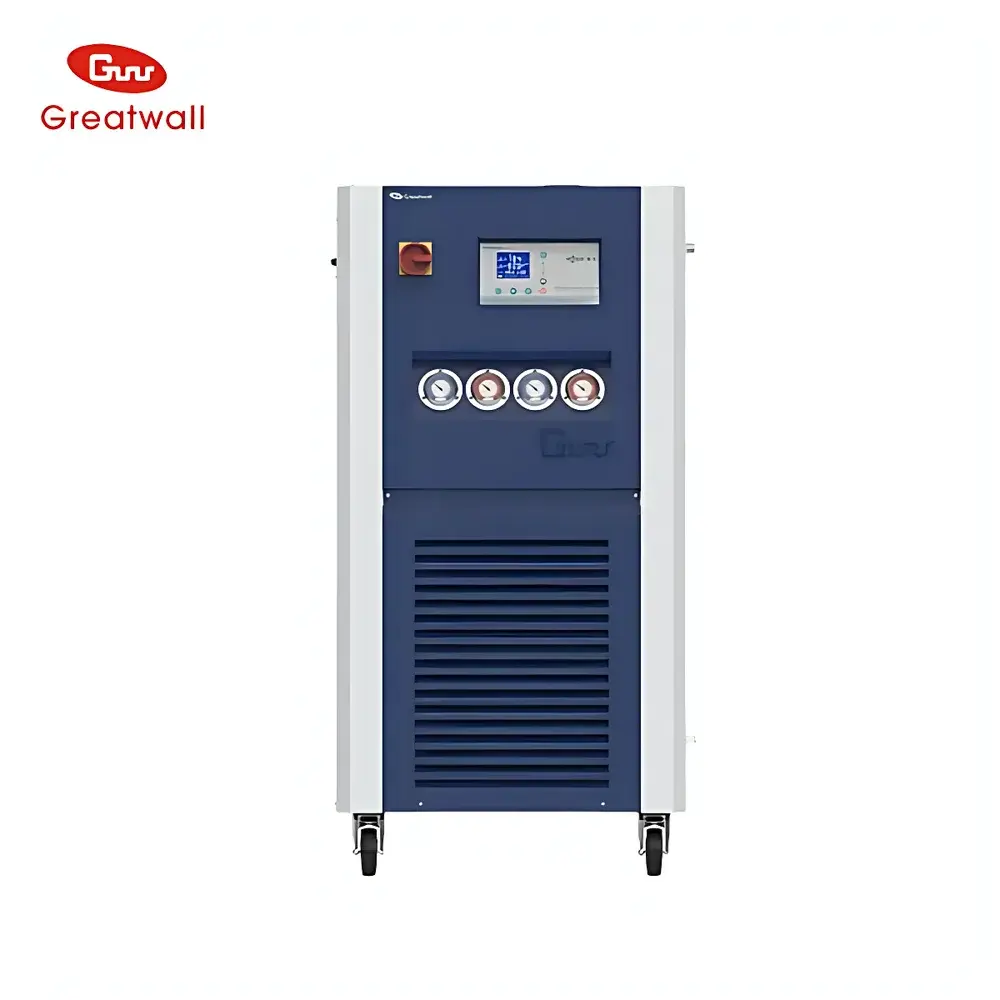
LT-100-80 Ultra-Low Temperature Circulating Chiller by The Great Wall
| Brand | The Great Wall |
|---|---|
| Origin | Henan, China |
| Manufacturer Type | Direct Manufacturer |
| Product Origin | Domestic (China) |
| Model | LT-100-80 |
| Instrument Type | Integrated Unit |
| Temperature Control Range | –80 °C to –40 °C |
| Cooling Capacity | 2500–10000 W |
| Temperature Stability | ±2 °C |
| Circulating Pump Pressure | 1 bar |
| Circulating Pump Flow Rate | 30 L/min |
Overview
The LT-100-80 Ultra-Low Temperature Circulating Chiller is an integrated, high-reliability thermal management system engineered for precise and stable low-temperature process control in demanding laboratory and pilot-scale environments. Utilizing a cascade refrigeration architecture with dual-stage compressors and environmentally compliant refrigerants (R23/R508B or equivalent), the unit delivers consistent cooling output across its full operating range of –80 °C to –40 °C. Unlike single-stage chillers limited to –40 °C or above, the LT-100-80 achieves sub-–70 °C operation through thermodynamically optimized stage coupling and enhanced heat exchange surface area—enabling direct temperature control of jacketed reactors, cryogenic material testers, and analytical instrumentation requiring sustained ultra-low thermal sinks. Its sealed circulation loop minimizes vapor loss and moisture ingress, preserving thermal fluid integrity over extended operational cycles—a critical requirement for long-duration synthesis, polymerization, or crystallization studies.
Key Features
- Integrated cascade refrigeration system with dual independent compression stages, enabling stable operation down to –80 °C without external cryogen supplementation.
- Hermetically sealed closed-loop circulation design using synthetic silicone or low-temperature hydrocarbon-based heat transfer fluids—resistant to oxidation, hydrolysis, and viscosity drift at extreme sub-zero conditions.
- Comprehensive electrical and mechanical protection suite: high-pressure cut-off, phase sequence monitoring, compressor thermal overload relay, timed start-up delay (≥3 min), and overcurrent circuit interruption.
- Intelligent liquid-level management with overflow detection and automatic drain activation to prevent pump cavitation or seal damage from overfilling.
- Stainless steel reservoir and fluid path components compatible with common organic solvents and non-corrosive process media; optional inert gas purging port for oxygen-sensitive applications.
- Front-panel digital interface with real-time display of setpoint, actual bath temperature, outlet pressure, flow rate, and system fault codes—supporting manual or remote setpoint adjustment via analog 0–10 V or 4–20 mA input.
Sample Compatibility & Compliance
The LT-100-80 is designed for integration with jacketed glass reactors (1–100 L), calorimeters, rheometers, and material testing frames requiring externally sourced cold fluid. It maintains compatibility with ASTM E2913 (Standard Practice for Low-Temperature Calibration of Thermal Analysis Instruments) and supports GLP-compliant workflows when paired with validated temperature probes and audit-trail-capable controllers. While not certified to UL/CSA or CE for standalone safety compliance, its electrical architecture conforms to IEC 61000-6-2 (immunity) and IEC 61000-6-4 (emissions) standards. Fluid selection must align with ISO 6743-22 (classification of heat transfer fluids) and avoid chloride-containing compounds that may accelerate corrosion in stainless steel loops.
Software & Data Management
The chiller operates autonomously but supports external data logging via RS485 Modbus RTU protocol (addressable as slave device). When interfaced with LabVIEW, DeltaV, or Siemens PCS7 systems, it enables synchronized temperature ramping, event-triggered alarms (e.g., flow loss >5 s), and timestamped operational logs—including cumulative compressor runtime, high-pressure excursions, and thermal fluid temperature deviation history. Optional Ethernet gateway modules provide HTTP API access for integration into centralized facility monitoring platforms compliant with ISA-95 Level 2 architecture. All logged parameters meet FDA 21 CFR Part 11 requirements when deployed with electronic signature-enabled SCADA software and appropriate user access controls.
Applications
- Pharmaceutical process development: Controlled low-temperature crystallization of APIs, cryo-milling support, and lyophilizer condenser precooling.
- Chemical synthesis: Exothermic Grignard, lithiation, or nitration reactions requiring precise –70 °C reactor jacket control.
- Materials science: Thermal cycling of shape-memory alloys, low-temperature tensile testing, and superconductivity characterization setups.
- Biotechnology: Cold-stage preservation of enzyme kinetics assays, cryo-EM sample preparation support, and chilled centrifugation auxiliary cooling.
- Quality control labs: Validation of thermal stability in battery electrolytes, aerospace sealants, and cryogenic adhesives per ISO 11357-3 protocols.
FAQ
What heat transfer fluids are recommended for continuous operation at –80 °C?
Synthetic polyalphaolefin (PAO)-based fluids or specially formulated silicone oils with pour points ≤ –90 °C and kinematic viscosity < 50 cSt at –80 °C are recommended. Avoid ethylene glycol/water mixtures, which freeze solid below –40 °C.
Can the LT-100-80 be used with open-bath systems?
No—it is engineered exclusively for closed-loop circulation. Open baths introduce moisture contamination, volatile loss, and uncontrolled heat exchange, compromising both temperature stability and fluid longevity.
Is remote monitoring supported out of the box?
Yes—RS485 Modbus RTU communication is standard. Ethernet or Wi-Fi connectivity requires an optional field-installable gateway module.
What maintenance intervals are specified for the cascade refrigeration system?
Compressor oil analysis and filter dryer replacement every 2000 operating hours; full refrigerant charge verification and leak inspection annually per ISO 5149-2 guidelines.
Does the unit comply with GMP documentation requirements?
The hardware itself does not carry GMP certification, but its operational data outputs—when captured via compliant software with audit trail, electronic signatures, and role-based access—can satisfy Annex 11 and ALCOA+ data integrity principles.



