
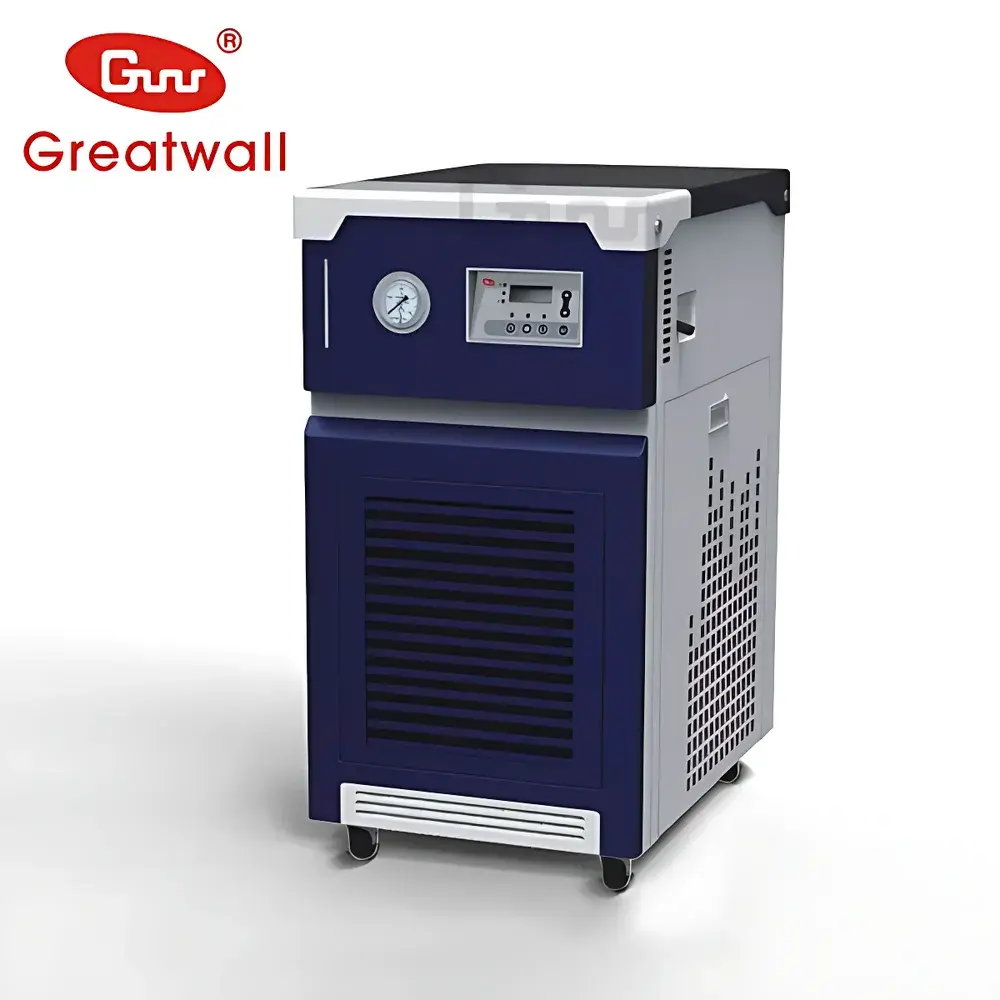
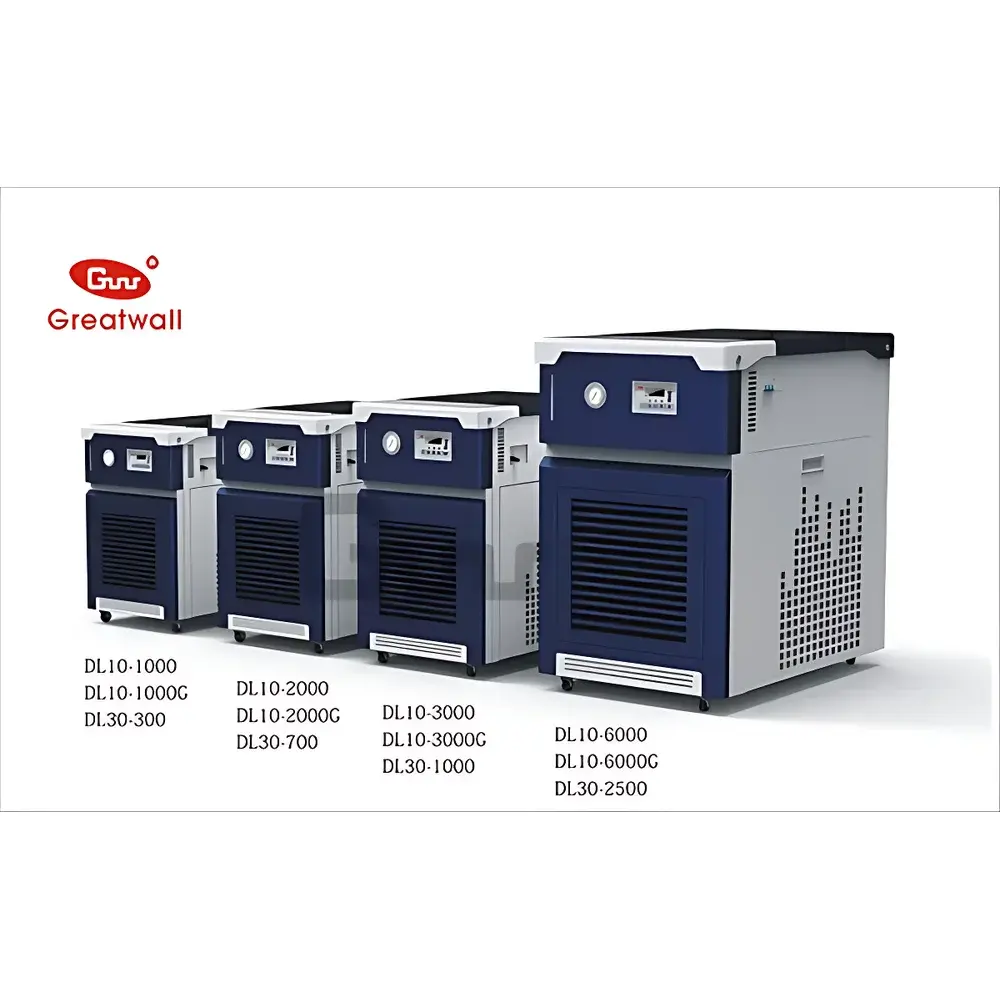
The Great Wall DL10-3000 Circulating Chiller
| Brand | The Great Wall |
|---|---|
| Origin | Henan, China |
| Manufacturer Type | Direct Manufacturer |
| Product Type | Integrated Circulating Chiller |
| Cooling Method | Air-Cooled |
| Temperature Range | −10 °C to 25 °C |
| Cooling Capacity | 3000 W @ 15 °C |
| Temperature Stability | ±2 °C |
| Circulation Pump Pressure | 1 bar |
| Circulation Flow Rate | 30 L/min |
| Reservoir Volume | 30 L |
| Operation Mode | Continuous |
Overview
The Great Wall DL10-3000 Circulating Chiller is an engineered thermal management solution designed for precision temperature control in demanding laboratory environments. Operating on the principle of vapor-compression refrigeration with a hermetically sealed compressor, it delivers stable, continuous cooling across a wide operational range (−10 °C to 25 °C) to support instruments requiring consistent low-temperature heat dissipation or process cooling. Its air-cooled architecture eliminates dependency on external chilled water infrastructure, enabling rapid deployment in standard laboratory spaces without dedicated HVAC integration. The unit maintains thermal equilibrium through closed-loop circulation of environmentally compliant R134a refrigerant and a glycol–water heat transfer fluid, ensuring minimal thermal drift (±2 °C stability) under variable load conditions typical of multi-instrument setups.
Key Features
- Hermetically sealed, high-efficiency compressor from a globally recognized OEM — optimized for low acoustic emission (<62 dB(A)) and extended service life under continuous 24/7 operation.
- Robust closed-loop circulation system with integrated particulate filtration (5–10 µm nominal retention), preventing contamination and blockage of sensitive instrument cooling jackets and condenser coils.
- Adjustable high-pressure vane-type circulation pump (rated 30 L/min at 1 bar; optional G-series variant supports up to 16 bar for high-backpressure applications).
- 30 L stainless steel reservoir with level indicator window and pressure gauge for real-time system diagnostics and maintenance readiness.
- R134a refrigerant — non-ozone-depleting (ODP = 0), low global warming potential (GWP = 1430), compliant with EU F-Gas Regulation (EU No 517/2014) and EPA SNAP program requirements.
- Modular mechanical design: removable side panels allow tool-free access to pump, filter, and refrigerant circuit components for routine servicing and calibration verification.
- Compact footprint (740 × 490 × 830 mm) with reinforced structural frame — suitable for benchtop placement or floor-standing installation adjacent to analytical instrumentation racks.
Sample Compatibility & Compliance
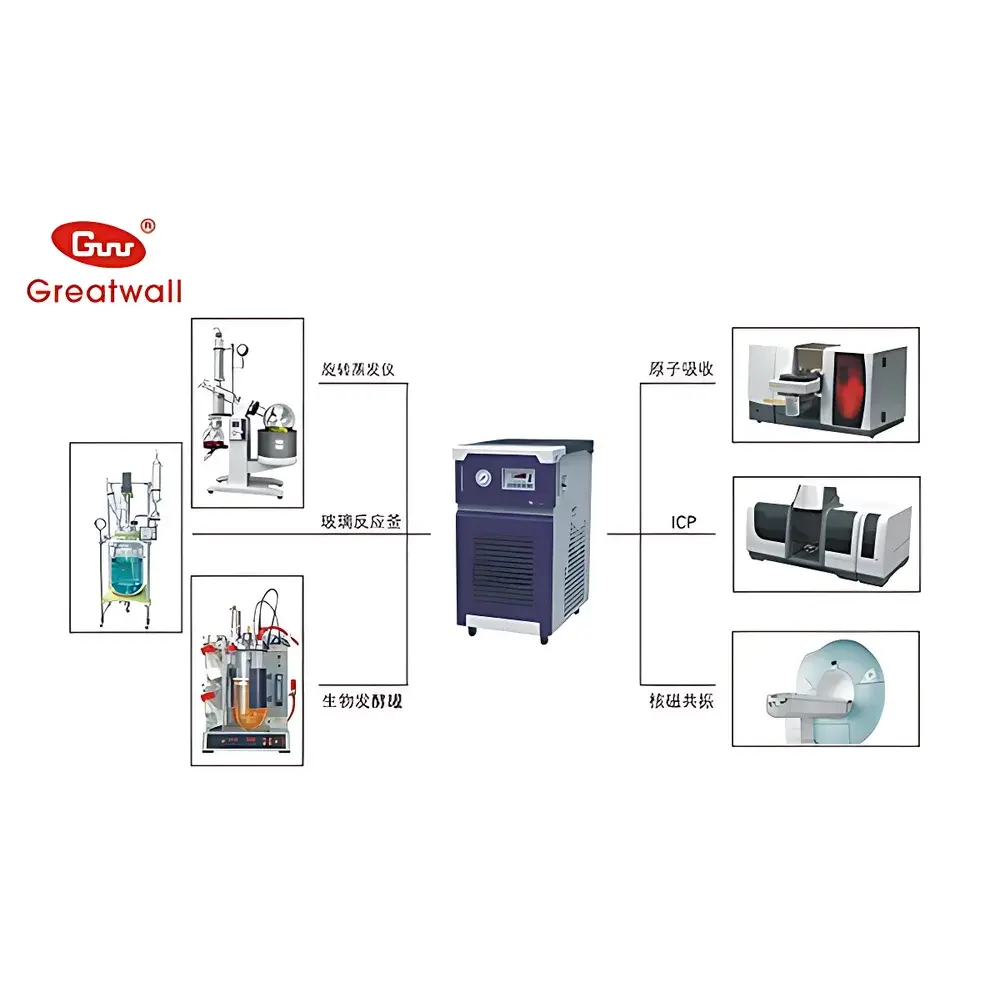
The DL10-3000 is compatible with a broad spectrum of laboratory equipment requiring active thermal regulation, including but not limited to: atomic absorption spectrometers (AAS), inductively coupled plasma optical emission spectrometers (ICP-OES) and mass spectrometers (ICP-MS), nuclear magnetic resonance (NMR) console chillers, CCD detector cryo-units, laser-based systems (e.g., Ti:sapphire, DPSS), vacuum deposition tools (sputtering, evaporation), and electron microscopy cooling stages. It meets electromagnetic compatibility standards per IEC 61326-1:2023 (industrial environment) and electrical safety requirements per IEC 61010-1:2010. While not certified for GMP/GLP-regulated production environments, its stable thermal output, audit-ready mechanical log (via pressure/level indicators), and traceable component sourcing support compliance with ISO/IEC 17025:2017 clause 6.4.7 (equipment suitability) when deployed in accredited testing laboratories.
Software & Data Management
The DL10-3000 operates as a standalone analog-controlled chiller with no embedded microprocessor or digital interface. Temperature setpoint and pump activation are managed via front-panel mechanical dials and toggle switches, ensuring deterministic response and immunity to firmware failure or network vulnerability. For integration into automated lab environments, optional analog 0–10 VDC or 4–20 mA temperature feedback signals can be configured (upon request) to interface with building management systems (BMS) or SCADA platforms. All operational parameters—including reservoir level, system pressure, and ambient intake temperature—are accessible via direct-reading analog gauges, supporting manual logbook documentation in accordance with GLP Annex 11 principles for non-computerized systems.
Applications
- Cooling of rotary evaporators (e.g., R1020 series) during solvent removal under reduced pressure, preventing bumping and improving condensation efficiency.
- Thermal stabilization of high-power laser diodes and solid-state amplifiers in spectroscopy and metrology setups.
- Condenser jacket cooling for gas chromatography (GC) and liquid chromatography (LC) systems operating at elevated column temperatures.
- Heat extraction from vacuum chambers in thin-film deposition systems where radiant and conductive heating must be offset to maintain substrate integrity.
- Process cooling of bioreactor jackets and fermenter heat exchangers in microbial culture studies requiring precise sub-ambient thermal profiles.
- Support of cryogenic sample handling accessories in X-ray diffraction (XRD) and X-ray fluorescence (XRF) instrumentation.
FAQ
What is the minimum ambient temperature required for stable operation?
The unit is rated for continuous operation in ambient environments between 10 °C and 35 °C. Below 10 °C, compressor oil viscosity increases significantly, risking lubrication failure; operation below this threshold requires factory-installed crankcase heater option.
Can the chiller be used with ethylene glycol–water mixtures?
Yes — the circulation system is chemically compatible with aqueous solutions containing ≤50% (v/v) USP-grade ethylene glycol. Viscosity increase beyond this concentration may reduce flow rate and require pump pressure recalibration.
Is remote monitoring supported out-of-the-box?
No. The base DL10-3000 model features analog-only controls. RS485 Modbus RTU or Ethernet/IP communication modules are available as custom-engineered add-ons subject to lead time and validation documentation.
What maintenance intervals are recommended?
Filter cartridge replacement every 6 months under continuous use; compressor oil analysis every 24 months; annual inspection of refrigerant charge integrity using manifold gauge set and leak detection spray.
Does the unit comply with FDA 21 CFR Part 11 requirements?
No — as a non-computerized, non-auditable device with no electronic data storage or user authentication, it falls outside the regulatory scope of Part 11. Its use in regulated workflows must be justified via risk assessment and documented in the laboratory’s SOPs.



