
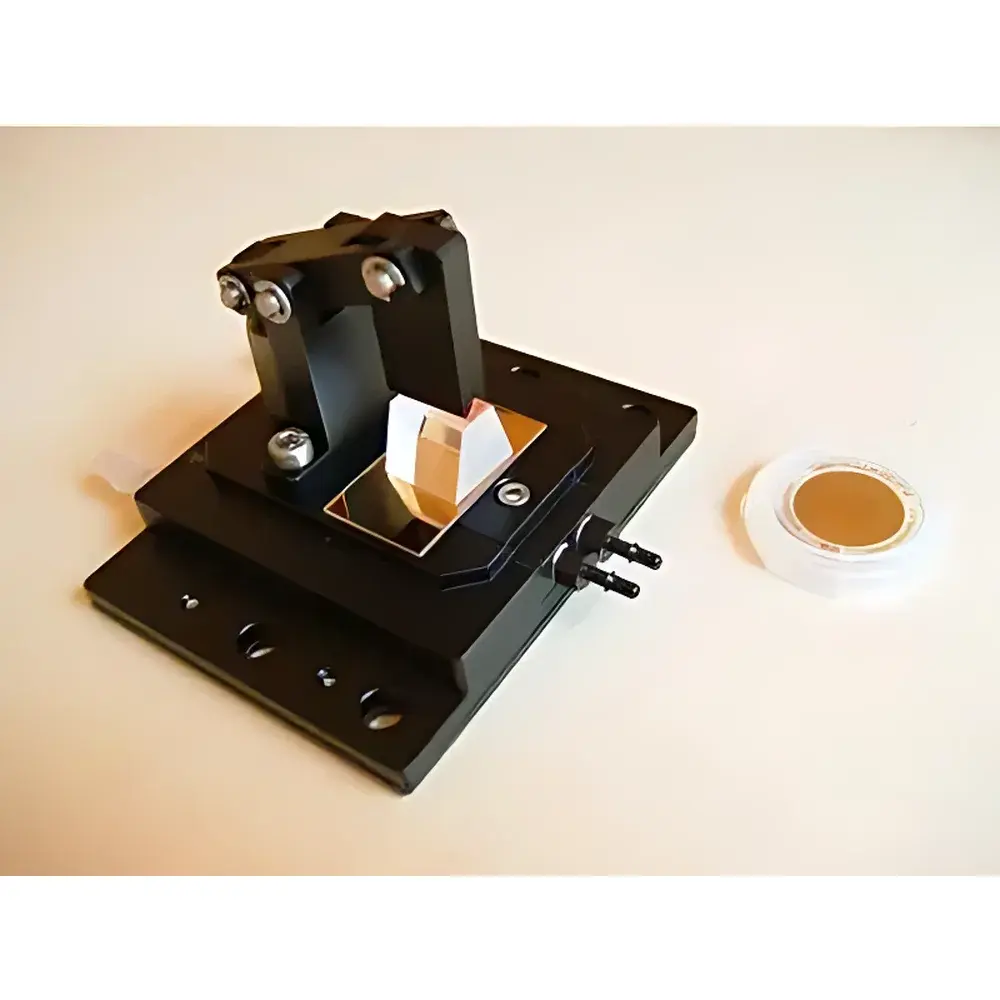
Optrel Multiskop-SPR Surface Plasmon Resonance Instrument
| Brand | Optrel |
|---|---|
| Origin | Germany |
| Model | Multiskop-SPR |
| Configuration | Kretschmann-based angular interrogation SPR system |
| Angular scanning range | 20–120° |
| Angular resolution | ≤0.002° (2 mdeg) |
| Kinetic sampling interval | ≥50 ms |
| Imaging capability | Integrated SPR imaging module |
| Sensor chip compatibility | Standard Au-coated glass prism substrates (e.g., 50 nm Au on SF10/BK7) |
Overview
The Optrel Multiskop-SPR is a laboratory-grade surface plasmon resonance (SPR) instrument engineered for label-free, real-time biomolecular interaction analysis. It operates on the Kretschmann configuration—a widely accepted optical coupling geometry in which p-polarized light undergoes total internal reflection at a metal-dielectric interface (typically a gold film deposited on a high-refractive-index prism), generating evanescent waves that excite surface plasmon polaritons. At the resonant angle—highly sensitive to refractive index changes within ~200 nm of the metal surface—incident light intensity drops sharply, enabling precise detection of binding events without fluorescent or enzymatic labels. Designed for academic research labs, pharmaceutical development units, and quality control environments, the Multiskop-SPR delivers quantitative kinetic and affinity data (ka, kd, KD) for protein-protein, protein-small molecule, antibody-antigen, nucleic acid-ligand, and carbohydrate-receptor interactions.
Key Features
- Kretschmann angular interrogation architecture with motorized high-precision goniometer, enabling continuous θ–θ scanning from 20° to 120°—sufficient to cover resonance angles across diverse sensor chip configurations and buffer refractive indices.
- Sub-millidegree angular resolution (≤0.002°), achieved via calibrated stepper motor positioning and real-time photodiode array signal normalization, ensuring reproducible baseline stability and minimal drift over extended acquisition periods.
- Dedicated kinetic measurement mode with configurable time resolution down to 50 ms per data point, supporting transient adsorption/desorption profiling under continuous flow conditions using integrated microfluidic cuvettes or external peristaltic pumps.
- Integrated SPR imaging module allowing spatially resolved binding maps across functionalized sensor surfaces—enabling multiplexed analysis of up to 16 independent spots on a single chip, with pixel-level reflectivity quantification.
- Modular optical design compatible with standard 25 mm × 75 mm glass prism substrates and commercially available gold-coated SPR chips (e.g., 50 nm Au on SF10 or BK7), supporting custom surface chemistry (SAMs, dextran, carboxymethylated matrices).
Sample Compatibility & Compliance
The Multiskop-SPR accepts liquid-phase samples delivered via standard Luer-lock or microbore tubing interfaces. It supports aqueous buffers (PBS, HEPES, Tris), low-conductivity solvents, and viscous media up to 10 cP when paired with appropriate flow cell geometry. Sample volumes per injection range from 50 µL to 500 µL depending on flow path design. The system complies with ISO/IEC 17025 general requirements for calibration traceability of angular encoders and photodetector linearity. While not pre-certified for GMP environments, its software architecture supports audit-trail-enabling configurations aligned with FDA 21 CFR Part 11 principles—including user access controls, electronic signatures, and immutable raw data logging—when deployed with validated third-party LIMS integration.
Software & Data Management
Instrument control, data acquisition, and kinetic fitting are performed via Optrel’s proprietary SPR Analysis Suite v4.x. The software provides real-time sensorgram visualization, global fitting algorithms (1:1 Langmuir, bivalent analyte, heterogeneous ligand models), and batch processing for multi-cycle kinetics. Raw angular shift data (in degrees) and normalized reflectivity (%) are exported in ASCII or CSV format for downstream analysis in MATLAB, Python (SciPy), or GraphPad Prism. All processed datasets retain metadata tags including timestamp, temperature (via optional Peltier sensor), flow rate, and user-defined annotation fields—ensuring full traceability per GLP documentation standards.
Applications
- Real-time characterization of monoclonal antibody affinity maturation campaigns during biologics development.
- Screening of fragment libraries against membrane protein targets reconstituted in nanodiscs or liposomes.
- Validation of epitope binning strategies in therapeutic antibody discovery pipelines.
- Quantitative assessment of food allergen cross-reactivity using immobilized IgE-capture surfaces.
- Environmental monitoring of pesticide–acetylcholinesterase binding inhibition kinetics in water extracts.
- Fundamental studies of polymer–protein corona formation at nanoparticle interfaces.
FAQ
What types of sensor chips are supported by the Multiskop-SPR?
Standard 25 mm × 75 mm glass prisms with 50 nm thermally evaporated gold films; compatible with carboxymethylated dextran, self-assembled monolayers (SAMs), and nitrocellulose-based immobilization chemistries.
Can the system operate under temperature-controlled conditions?
Yes—optional Peltier-based temperature control module maintains sample compartment stability within ±0.2°C from 15°C to 40°C.
Is the software compliant with 21 CFR Part 11 requirements?
The base software includes user authentication, audit trail generation, and electronic signature support; full compliance requires site-specific validation and integration with enterprise identity management systems.
What is the minimum detectable mass change per unit area?
Typical sensitivity is ~0.3 pg/mm² for refractive index shifts corresponding to sub-monolayer protein adsorption under optimized flow and surface chemistry conditions.
Does Optrel provide application support for assay development?
Yes—application scientists offer remote protocol optimization, surface chemistry consultation, and kinetic model selection guidance as part of extended service contracts.





