
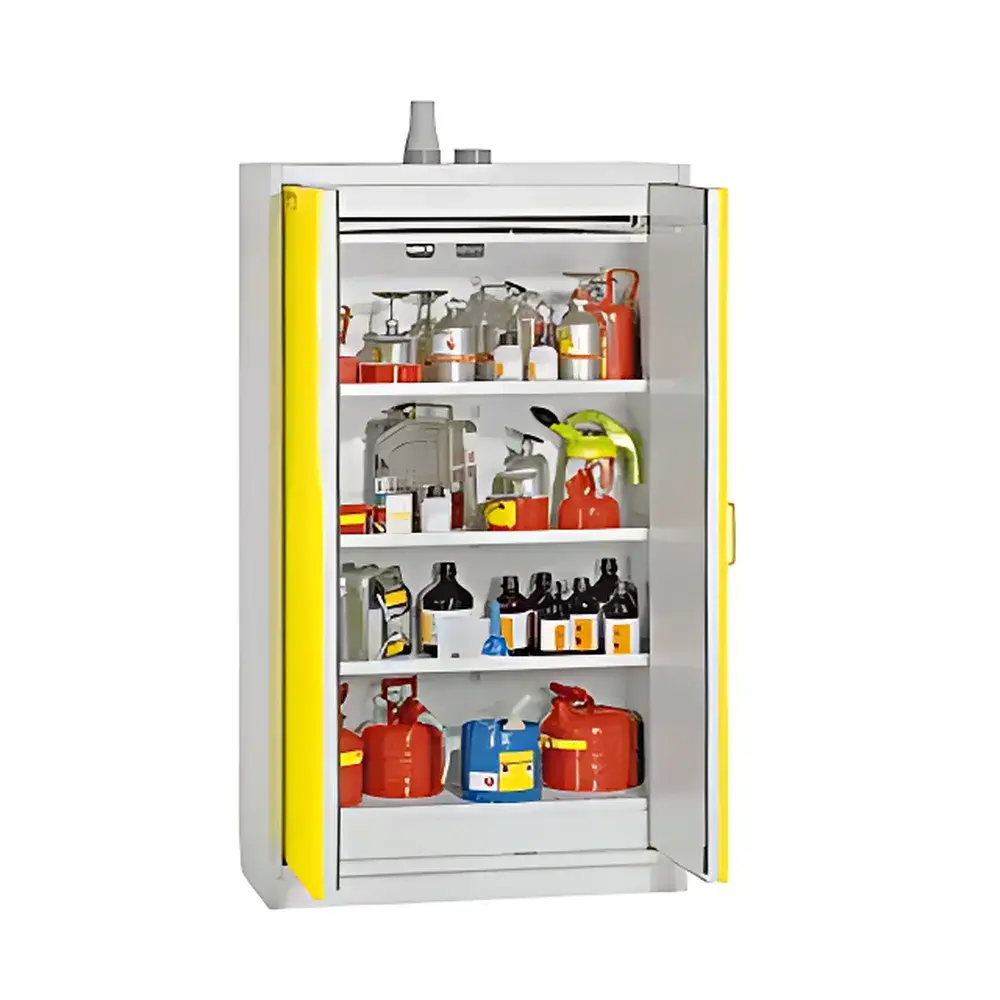
Dueperthal Fire-Resistant Safety Cabinet with Wing Doors
| Brand | Dueperthal |
|---|---|
| Origin | Germany |
| Model | Fire-Resistant Safety Cabinet (Wing-Door Type) |
| Fire Resistance Rating | 90 minutes |
| Compliance | DIN 18604, GS Mark, CE Directive 2014/68/EU (PED), ISO 9001 Quality Management System |
| Construction Material | Cold-Rolled Steel with Epoxy-Polyester Powder Coating |
| Door Mechanism | Dual Wing Doors with Self-Closing Hydraulic Dampers |
| Internal Configuration | Adjustable Galvanized Steel Shelving, Optional Pull-Out Trays or Drawer Modules |
| Ventilation | Optional Passive Ventilation Kit (EN 14470-1 Compliant) |
| Capacity Options | 30 L to 1200 L |
Overview
The Dueperthal Fire-Resistant Safety Cabinet with Wing Doors is an engineered storage solution designed for the secure containment of hazardous substances in laboratory, pharmaceutical, chemical manufacturing, and industrial R&D environments. Built to DIN 18604 (Fire Protection Requirements for Storage Cabinets) and compliant with EN 14470-1 for flammable liquid storage, this cabinet provides a certified 90-minute fire resistance rating—ensuring structural integrity and internal temperature control below 180 °C during standardized fire exposure tests. Its core function is passive fire containment: in the event of external fire, the cabinet’s double-walled steel construction, intumescent door seals, and thermally insulated cavity delay heat transfer, preventing ignition of stored contents and limiting vapor release. Unlike general-purpose storage furniture, this unit integrates mechanical safety logic—including self-closing hydraulic dampers activated at 50 °C—and conforms to EU Pressure Equipment Directive (PED) 2014/68/EU where applicable to pressurized auxiliary systems.
Key Features
- Double-wall cold-rolled steel construction with 38 mm mineral wool insulation between walls and doors, delivering verified 90-minute fire resistance per DIN 18604 Type A testing protocol
- Hydraulically damped wing-door mechanism with automatic thermal release at 50 °C, ensuring fail-safe closure without manual intervention
- Galvanized steel adjustable shelving (standard), with optional stainless-steel pull-out trays or lockable drawer modules for segregated storage of acids, bases, or oxidizers
- Integrated spill containment sump (150 mm deep) with corrosion-resistant epoxy-polyester powder coating (RAL 3000)
- Passive ventilation ports (optional) configured to meet EN 14470-1 requirements for controlled vapor dispersion, compatible with centralized lab exhaust systems
- GS-marked and CE-certified per Machinery Directive 2006/42/EC and Low Voltage Directive 2014/35/EU; quality management system certified to ISO 9001:2015
Sample Compatibility & Compliance
This cabinet supports safe storage of Class I–IV flammable liquids (flash point ≤ 60 °C), corrosive agents (e.g., concentrated HCl, NaOH solutions), toxic compounds (including WHO Class 1–3 substances), aqueous environmental samples, pressurized gas cylinders (when used with dedicated cylinder-retention brackets), and sensitive documentation. It is not intended for volatile peroxides or pyrophoric materials requiring inert-atmosphere handling. All configurations comply with German occupational safety regulation BGV D6 (formerly VBG 100), EU CLP Regulation (EC) No. 1272/2008 labeling requirements, and support GLP-compliant inventory logging when integrated with barcode-scanned access logs. For pharmaceutical QC labs, it satisfies Annex 15 (Validation and Qualification) prerequisites for documented storage integrity.
Software & Data Management
While the cabinet itself is a passive mechanical system, Dueperthal offers optional digital integration kits including RFID-tagged shelf labels, Bluetooth-enabled door-open duration logging (with timestamped audit trail), and API-compatible interfaces for connection to LIMS or EHS platforms (e.g., Intelex, Sphera). These modules support 21 CFR Part 11–compliant electronic signatures and generate tamper-evident PDF reports for internal audits or regulatory inspections (e.g., FDA pre-approval inspections, MHRA GMP audits). Firmware updates are delivered via encrypted USB key with version-controlled changelogs traceable to ISO 9001 design history files.
Applications
- Centralized flammable liquid storage in analytical chemistry labs (HPLC solvents, GC mobile phases)
- Segregated acid/alkali storage in university teaching laboratories per ACS Guidelines for Chemical Laboratory Safety
- On-site containment of environmental water samples prior to EPA Method 525.3 analysis
- GMP-grade intermediate storage in API synthesis suites, supporting ICH Q7 Annex 11 data integrity expectations
- Cylinder staging for inert gas purging in glovebox-supported material synthesis workflows
- Secure archival of SOPs, batch records, and calibration certificates in QA/QC departments under ISO/IEC 17025 clause 8.3
FAQ
Does this cabinet require electrical power or active ventilation?
No—it operates entirely passively. Power is only required if optional digital monitoring modules (e.g., door-event logging) are installed.
Can it be installed in a corridor or exit route?
Per local building codes (e.g., NFPA 1, German MBO §27), fire-rated cabinets may be placed in corridors only if they do not reduce required egress width by >50% and are mounted on non-combustible substrates.
Is third-party fire certification documentation available?
Yes—TÜV Rheinland test reports (DIN 18604 Type A, Report No. TÜV-Rheinland-XXXXX) and GS certificate copies are provided with each unit shipment.
What maintenance intervals are recommended?
Quarterly visual inspection of door seals, damper function, and sump integrity; annual functional test of thermal release mechanism using calibrated heat source per manufacturer’s SOP-FC-003.
Are custom dimensions or coatings available?
Yes—Dueperthal offers OEM-configurable variants including stainless-steel cladding (AISI 316L), explosion-proof lighting integration, and footprint adaptations for cleanroom ISO Class 7–8 installations.
Related Products



