
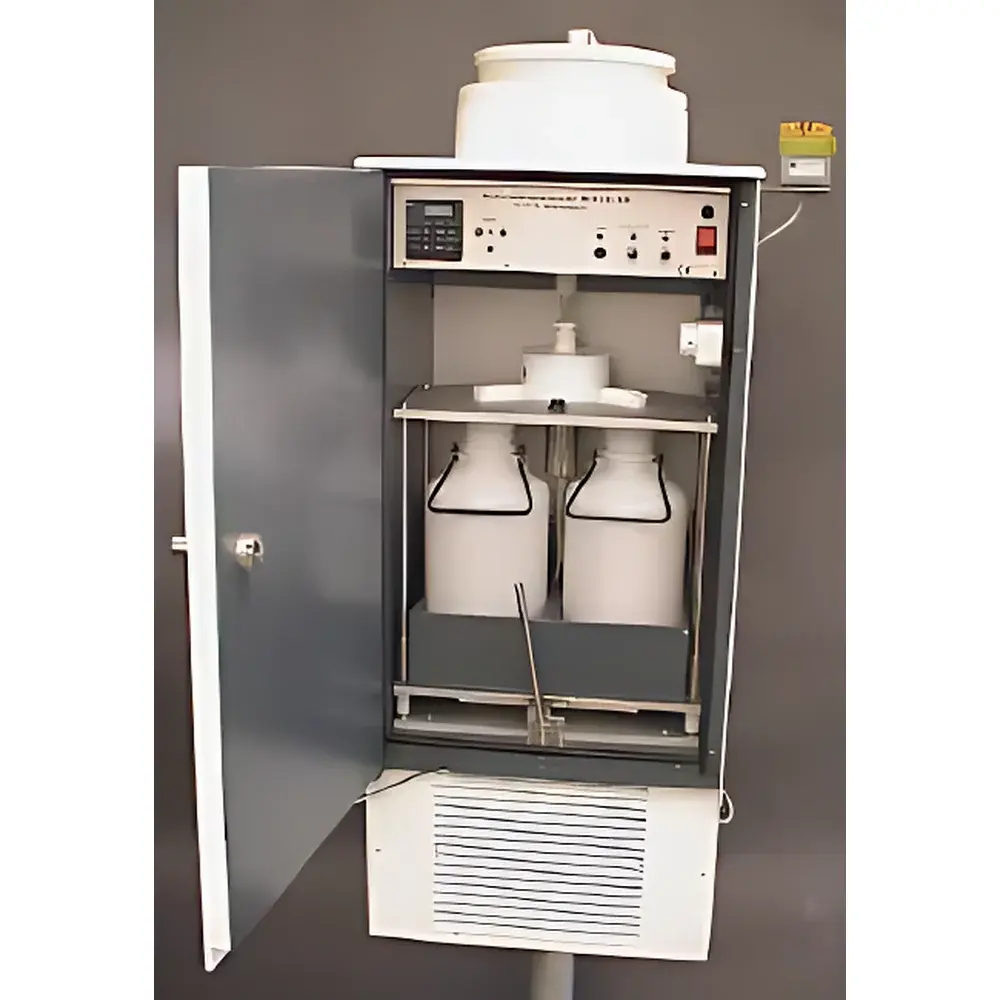
Eigenbrodt NSA181/K-TYPE Automatic Precipitation Sampler
| Brand | Eigenbrodt |
|---|---|
| Country of Origin | Germany |
| Model | NSA181/K-TYPE |
| Sampling Configurations | E-type (single 5–10 L bottle), D-type (dual 5 L weekly bottles), S-type (eight 1 L daily bottles) |
| Collection Area | 500 cm² |
| Temperature Control Range | 3–10 °C (standard operating setpoint: 4–6 °C) |
| Cooling Medium | R134a (CFC-free) |
| Sensor Interface | RS 85 precipitation sensor (standard) |
| Enclosure | Double-walled insulated PVC cabinet |
| Materials | Chemically inert components (HD-PE, DURAN® borosilicate glass, quartz options available) |
| Compliance | VDI 3870-compliant funnel geometry and material specification |
| Control System | SIEMENS® LOGO! programmable logic controller |
Overview
The Eigenbrodt NSA181/K-TYPE Automatic Precipitation Sampler is an engineered solution for standardized, unattended collection of atmospheric precipitation—rain, snowmelt, and mixed-phase events—in compliance with VDI 3870 (German Association of Engineers) methodology. Designed for long-term environmental monitoring networks, research stations, and regulatory compliance programs, the system operates on a physically robust sampling principle: precipitation initiation triggers a calibrated RS 85 sensor, which actuates electromechanical opening of a precisely dimensioned 500 cm² funnel. The funnel’s aerodynamically optimized geometry minimizes wind-induced undercatch while ensuring laminar flow into the collection pathway. All wetted surfaces—including funnel, transfer tubing, and sample containers—are constructed from chemically neutral materials (HD-polyethylene, DURAN® borosilicate glass, or fused quartz), eliminating leaching artifacts critical for trace-metal, anion, cation, and organic contaminant analysis.
Key Features
- Triple-configurable sampling architecture: E-type (single large-volume bottle), D-type (dual weekly bottles), and S-type (eight individually timed daily bottles), enabling flexible deployment across seasonal, spatial, and analytical requirements.
- Active thermal management: Integrated plate-evaporator refrigeration maintains sample chamber temperature at 4–6 °C (adjustable range: 3–10 °C), preventing microbial growth and volatile compound loss without ozone-depleting refrigerants (R134a only).
- Intelligent actuation sequence: Upon sensor activation, the funnel cover retracts laterally and lowers to eliminate airflow disruption; upon cessation, a programmable delay ensures complete drainage before closure.
- Redundant power resilience: In case of mains failure, all switching states default to safe positions—funnel closes, heating elements deactivate, and data retention remains intact.
- Chemically inert construction throughout: No metallic or catalytic surfaces contact samples; all structural and fluid-path components meet ISO 3534-1 traceability and USP polymer classification standards for aqueous environmental matrices.
- Modular enclosure: Double-walled PVC housing with passive ventilation mitigates solar gain, while integrated desiccant-assisted dehumidification prevents condensation in humid climates.
Sample Compatibility & Compliance
The NSA181/K-TYPE supports both polymeric (HD-PE) and glass-based (DURAN®, quartz) sample containment, permitting method-specific selection per analytical protocol—for example, HD-PE for routine ion chromatography (IC) and quartz for ultra-trace elemental analysis via ICP-MS. Its funnel geometry, surface finish, and collection area are validated against VDI 3870 Annex A, ensuring inter-laboratory comparability. Optional IRSS 88 infrared snow sensors and NRS 80 optical precipitation detectors extend operational reliability in low-snowfall or high-wind alpine environments. The system meets GLP-aligned data integrity requirements when paired with the optional data logger (IEC 61508 SIL2-rated firmware), supporting audit-ready timestamping, event logging, and sensor calibration history per ISO/IEC 17025:2017 clause 7.7.
Software & Data Management
Control logic resides in a SIEMENS® LOGO! 8 PLC with non-volatile memory, programmable via USB or Ethernet interface using LOGO! Soft Comfort v8.3. The embedded firmware records all critical events—including precipitation onset/duration, temperature excursions, motor actuation cycles, and power interruptions—with UTC-synchronized timestamps. Optional data logging modules provide CSV-exportable datasets compliant with EPA Method 1694 metadata conventions and support direct integration into LIMS platforms via Modbus TCP. All configuration changes and calibration entries are subject to electronic signature and audit trail per FDA 21 CFR Part 11 requirements when enabled.
Applications
- Long-term atmospheric deposition monitoring for sulfur, nitrogen, heavy metals, and persistent organic pollutants (POPs) under national emission reduction programs (e.g., CLRTAP, EU NEC Directive).
- Source apportionment studies requiring time-resolved precipitation chemistry to distinguish marine, crustal, anthropogenic, and biogenic contributions.
- Validation of atmospheric transport models (e.g., EMEP, WRF-Chem) through high-temporal-resolution wet deposition flux quantification.
- Acid rain network operations where strict adherence to VDI 3870 and ISO 10301 field protocols is mandated.
- Calibration and verification of remote sensing precipitation estimates (e.g., GPM, IMERG) using ground-truth volumetric and chemical endpoints.
FAQ
Does the NSA181/K-TYPE comply with international precipitation sampling standards?
Yes—it conforms to VDI 3870 (Germany), ISO 10301 (international wet deposition sampling), and aligns with EPA Guidance for Atmospheric Deposition Monitoring (EPA/600/R-12/529).
Can the system operate autonomously during extended power outages?
It maintains fail-safe mechanical states during mains loss; however, continuous operation requires an external UPS or solar-charged battery bank (not included).
What maintenance intervals are recommended for the refrigeration unit?
Compressor and evaporator inspection every 24 months; desiccant cartridge replacement every 12 months in high-humidity environments.
Is remote diagnostics supported?
Yes—via optional GSM or Ethernet telemetry module enabling real-time status polling, alarm notification, and over-the-air firmware updates.
How is sample cross-contamination prevented between collection intervals?
Each S-type bottle is isolated by a dedicated silicone tubing path; rotating head seals are self-cleaning via gravity-driven rinse during transition; no shared fluid pathways exist.
Related Products







