
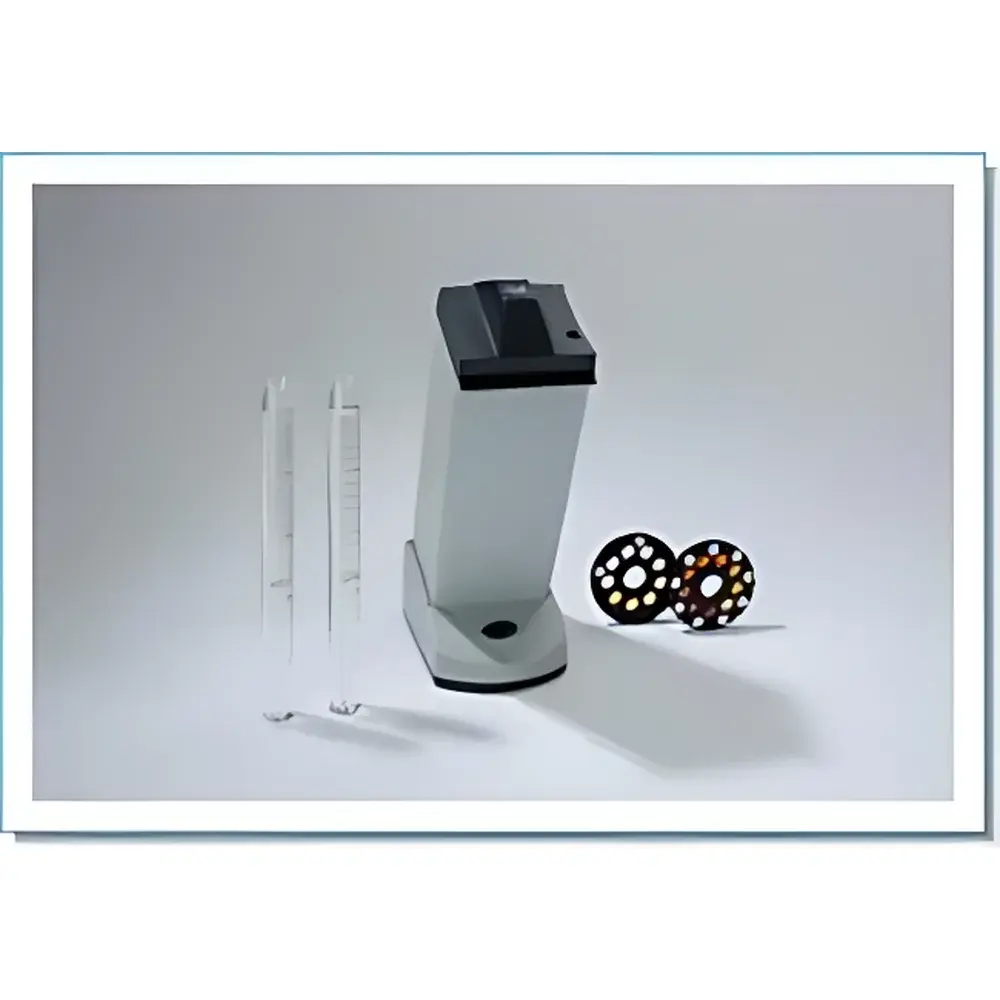
Lovibond AF327 Platinum-Cobalt (Pt-Co) Colorimeter
| Brand | Lovibond/Tintometer |
|---|---|
| Origin | United Kingdom |
| Model | AF327 |
| Color Scale | Pt-Co/Hazen/APHA (0–500 units) |
| Light Source | Daylight 2000 Illumination System |
| Comparator Type | Visual Nessleriser with 288 mm Path Length |
| Compliance | ASTM D1209, AOCS Td 1b-64, ISO 2211, ISO 6271, BS 5339 |
Overview
The Lovibond AF327 Platinum-Cobalt (Pt-Co) Colorimeter is a precision visual color measurement instrument engineered for the quantitative assessment of yellowness in transparent, low-turbidity liquids. It operates on the fundamental principle of comparative visual colorimetry—matching the hue and intensity of a liquid sample against a series of calibrated Pt-Co reference standards under controlled illumination. The Pt-Co scale (also designated as Hazen or APHA) defines color intensity based on the absorbance of standardized platinum-cobalt chloride solutions, ranging from 0 (water-white) to 500 (deep amber). This scale remains the internationally accepted benchmark for color specification in water quality monitoring, pharmaceutical excipients, food-grade glycerin, industrial solvents (e.g., carbon tetrachloride, alcohols), plasticizers, and refined petrochemicals. The AF327 implements the classical Nessleriser design with a fixed 288 mm optical path length—a geometry explicitly prescribed in ASTM D1209 for optimal sensitivity in low-color-range applications.
Key Features
- Optimized 288 mm path-length comparator cell assembly, ensuring high resolution and repeatability for samples within the 0–500 Pt-Co range.
- Integrated Daylight 2000 illumination system: a stable, daylight-simulating light source (CIE Standard Illuminant D65 equivalent) delivering consistent spectral output independent of ambient conditions—critical for metrological reliability in GLP-compliant laboratories.
- Dedicated Nessleriser 1209 viewing chamber designed to eliminate parallax error and minimize observer bias through standardized sample presentation and viewing geometry.
- Pre-calibrated Pt-Co glass color standards traceable to NIST-referenced primary solutions; each disc corresponds to discrete integer values across the full scale.
- Robust mechanical architecture with corrosion-resistant housing, suitable for routine use in QC labs, wastewater treatment facilities, and chemical manufacturing environments.
- No electronics or software dependency—designed for operational simplicity, minimal maintenance, and long-term calibration stability.
Sample Compatibility & Compliance
The AF327 is validated for use with clear, non-opalescent, low-absorbing liquids exhibiting minimal suspended solids (<0.1 NTU) and negligible fluorescence. Typical applications include potable water, purified water (USP/EP), glycerol, ethylene glycol, acetone, methyl ethyl ketone (MEK), chlorinated solvents, and hydrogen peroxide solutions. Its methodology conforms strictly to ASTM D1209 (“Standard Test Method for Color of Clear Liquids (Platinum-Cobalt Scale)”), AOCS Td 1b-64, ISO 2211 (for water), ISO 6271 (for petroleum products), and BS 5339. As such, it supports regulatory reporting under EPA Method 180.1, WHO Guidelines for Drinking-water Quality, and EU Directive 98/83/EC. While not an electronic spectrophotometer, its traceability framework satisfies audit requirements for ISO/IEC 17025-accredited testing laboratories when operated within defined procedural controls.
Software & Data Management
The AF327 is a purely analog, observer-based instrument and does not incorporate digital data capture, onboard memory, or software interfaces. All measurements are recorded manually by trained personnel following documented standard operating procedures (SOPs). For laboratories requiring electronic recordkeeping, integration is achieved via external LIMS or ELN systems using structured entry templates aligned with 21 CFR Part 11 principles—e.g., dual-user verification of reported Pt-Co values, timestamped entries, and audit-trail-enabled worksheets. Calibration verification records (including annual checks against certified reference materials) must be retained per GLP and GMP documentation standards.
Applications
- Regulatory compliance testing of drinking water and wastewater effluents per APHA Standard Methods 2120B.
- Quality control of pharmaceutical raw materials where color deviation indicates oxidation or degradation (e.g., USP monographs for glycerin, propylene glycol).
- In-process monitoring of solvent purification cycles in fine chemical synthesis.
- Specification verification of edible oils, biodiesel feedstocks, and cosmetic-grade alcohols.
- Benchmarking of decolorization efficiency in activated carbon or ion-exchange treatment systems.
- Validation of filtration performance in membrane separation processes.
FAQ
What is the difference between Pt-Co, Hazen, and APHA color units?
They are functionally identical scales defined by the same platinum-cobalt chloride reference solutions and measurement geometry; “Hazen” honors the original developer, “APHA” reflects adoption by the American Public Health Association, and “Pt-Co” denotes the chemical basis.
Can the AF327 measure colored samples outside the 0–500 range?
No—values exceeding 500 Pt-Co require sample dilution with deionized water and subsequent correction using the dilution factor; undiluted readings beyond this limit lack linearity and metrological validity.
Is the Daylight 2000 lamp replaceable, and what is its rated lifetime?
Yes—the lamp module is field-replaceable; typical service life exceeds 5,000 hours under continuous operation, with luminous flux stability maintained within ±2% over the first 3,000 hours.
Does the instrument require annual recalibration?
While the glass standards are inherently stable, annual verification against a NIST-traceable secondary standard is recommended per ISO/IEC 17025 clause 6.6 and internal QA protocols.
Can the AF327 be used for turbid or fluorescent samples?
No—turbidity interferes with visual matching; fluorescence alters perceived hue under D65 illumination; such samples must be pre-filtered or assessed via alternative methods (e.g., spectrophotometric Yellowness Index or CIE L*a*b*).



