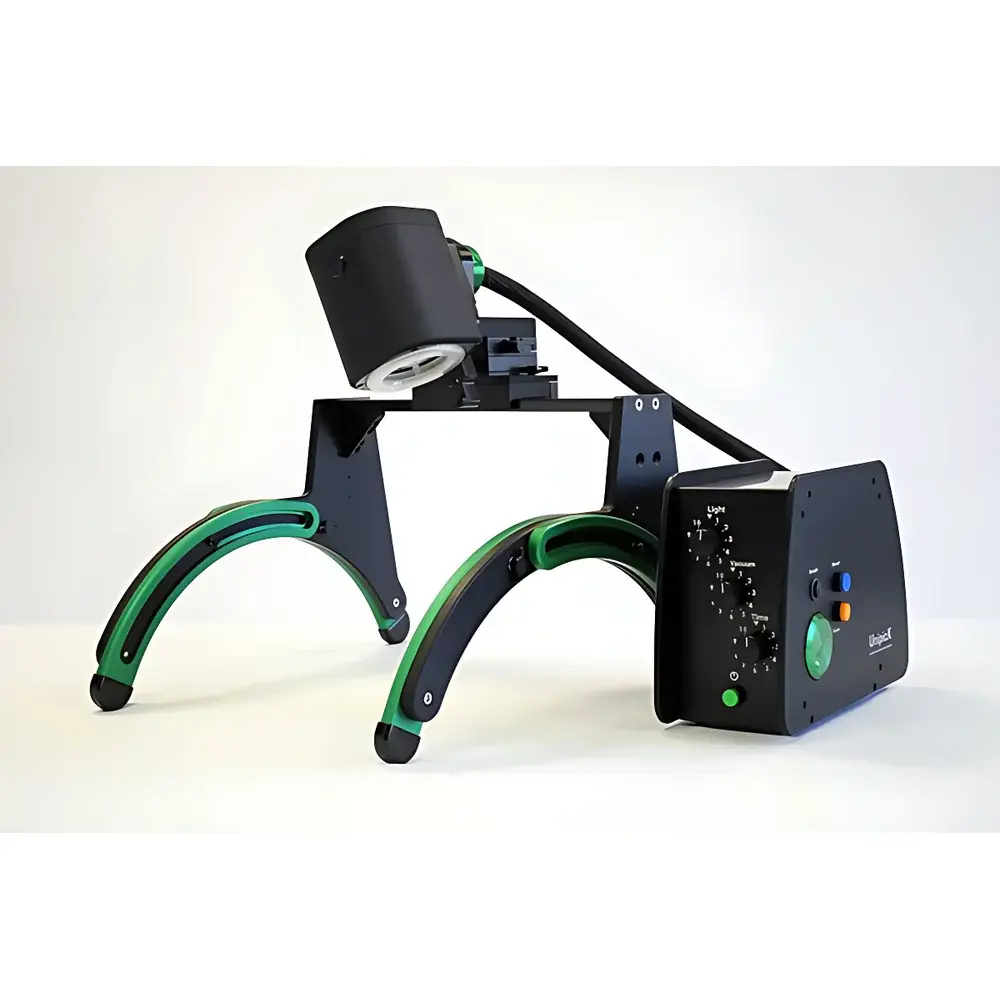
NEUROINDX UnipicK Universal Single-Cell and Tissue Microdissection System
| Brand | NEUROINDX |
|---|---|
| Origin | USA |
| Manufacturer Type | Authorized Distributor |
| Origin Category | Imported |
| Model | UnipicK |
| Pricing | Available Upon Request |
Overview
The NEUROINDX UnipicK is a universal, microscope-integrated microdissection platform engineered for precise, manual isolation of single cells, clonal cell populations, and defined tissue regions under direct optical visualization. Unlike laser-capture or automated robotic systems, UnipicK operates on a vacuum-assisted capillary aspiration principle—leveraging controlled negative pressure to gently aspirate target specimens into calibrated glass or fused-silica capillaries. This contact-based, label-free methodology preserves native cellular integrity, avoids thermal or photochemical damage, and enables immediate downstream transfer without enzymatic dissociation or fixation. Designed specifically for integration with standard inverted microscopy workstations, UnipicK supports both routine cell picking in adherent cultures and spatially resolved tissue microdissection in fixed or live ex vivo preparations—including brain slices, organoids, and epithelial explants.
Key Features
- Modular vacuum-driven aspiration system with adjustable negative pressure control (range: 0–80 kPa), enabling tunable suction force for fragile neurons, robust fibroblasts, or semi-solid tissue fragments.
- Universal mounting architecture compatible with major inverted microscope models—including Olympus CKX41/51, IX71/73/81/83—via dedicated interface kits; also supports custom adapter integration for Nikon Eclipse Ti, Zeiss Axio Observer, and Leica DMi8 platforms.
- Standardized capillary handling protocol: borosilicate or quartz capillaries (inner diameters: 1–20 µm) are manually loaded, positioned via micromanipulator, and aspirated under real-time phase-contrast or DIC observation.
- No integrated fluidics or automated dispensing—ensures full operator control over timing, volume, and mechanical interaction during capture, critical for electrophysiology prep, patch-clamp-compatible harvesting, or low-input omics workflows.
- Compact benchtop footprint (28 × 22 × 18 cm) with ESD-safe housing and CE-compliant electrical design, suitable for ISO Class 5–7 cleanroom environments and GLP-compliant cell banking labs.
Sample Compatibility & Compliance
UnipicK accommodates a broad spectrum of biological specimens without requiring pre-labeling, staining, or genetic modification. Validated use cases include primary neuronal cultures, iPSC-derived cardiomyocytes, tumor spheroids, cryosectioned brain tissue (10–50 µm thickness), and formalin-fixed paraffin-embedded (FFPE) tissue sections post-deparaffinization. Capillary-based recovery maintains RNA integrity (RIN > 8.5 confirmed via Bioanalyzer post-isolation) and enables seamless transition to single-cell RNA-seq, whole-genome amplification (WGA), or microfluidic loading. The system conforms to ASTM F2971-22 (Standard Practice for Microdissection of Biological Specimens) and supports traceability requirements under ISO 13485 for diagnostic sample procurement. All hardware components are autoclavable or ethanol-sterilizable, and documentation packages include IQ/OQ templates aligned with FDA 21 CFR Part 11 expectations for audit-ready instrument qualification.
Software & Data Management
UnipicK operates as a hardware-only platform with no embedded firmware or proprietary software—eliminating validation overhead associated with regulated digital systems. Users record acquisition metadata (date/time, capillary ID, microscope settings, operator ID) in laboratory notebooks or LIMS-integrated electronic logs. For enhanced reproducibility, optional third-party image annotation tools (e.g., QuPath, ImageJ/Fiji macros) can be synchronized with microscope camera feeds to timestamp and geotag each picked region. Audit trails remain fully user-managed, preserving data sovereignty and simplifying compliance with GDPR, HIPAA, and institutional biospecimen governance policies.
Applications
- Single-cell isolation for scRNA-seq library preparation from heterogeneous primary tissues (e.g., cortical layer-specific neuron subtypes).
- Clonal expansion workflows: retrieval of monoclonal colonies from limiting-dilution plates for CRISPR-edited line validation.
- Tissue microdissection for spatial proteomics—targeted excision of tumor-stroma interfaces or lesion margins from FFPE slides.
- Electrophysiology support: harvesting intact, membrane-intact neurons for acute slice patch-clamp recording without trypsin exposure.
- Quality control in biomanufacturing: verification of clone homogeneity in CHO or HEK293 suspension cultures prior to master cell bank generation.
FAQ
Is UnipicK compatible with upright microscopes?
No—UnipicK is designed exclusively for inverted microscope configurations due to gravity-assisted capillary positioning and bottom-stage access requirements.
Can I use UnipicK for live-cell time-lapse picking?
Yes, provided the microscope stage is temperature- and CO2-controlled; the system introduces no phototoxicity or thermal stress during aspiration.
What capillary types are supported?
Standard borosilicate glass (e.g., Sutter BF150-86-10) and quartz capillaries (e.g., World Precision Instruments QF100-78-10), pulled or un-pulled, with inner diameters between 1 µm and 20 µm.
Does UnipicK require regulatory clearance for clinical use?
UnipicK is intended for research use only (RUO); it is not cleared by FDA, CE-IVD, or other clinical regulatory bodies for diagnostic specimen procurement.
How is sample transfer to downstream vessels performed?
After aspiration, the capillary is manually detached from the holder and connected to a sterile syringe; gentle positive pressure dispenses the contents directly into PCR tubes, microcentrifuge tubes, or microfluidic chips.
Related Products