
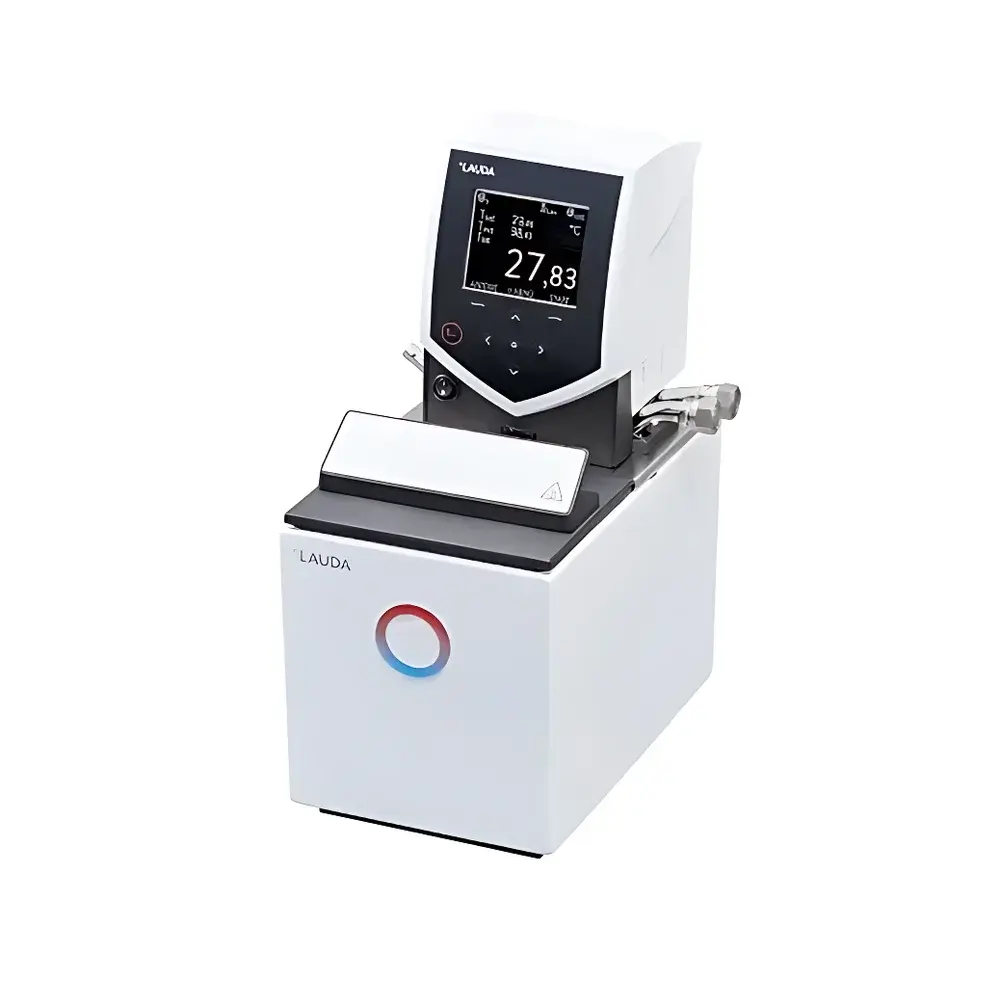
LAUDA ECO E 4 G Precision High-Temperature Circulating Bath, 20–200 °C, ±0.01 °C Stability
| Brand | LAUDA |
|---|---|
| Origin | Germany |
| Model | ECO E 4 G |
| Instrument Type | Heating Circulating Bath |
| Circulation Mode | Internal & External |
| Temperature Range | 20–200 °C |
| Temperature Stability | ±0.01 °C |
| Bath Volume | 3.5–40 L |
| Heating Power | 2.6 kW |
| Max. Pump Flow | 22 L/min |
| Bath Opening | 135 × 105 mm |
| Dimensions (W×D×H) | 168 × 272 × 376 mm |
| Power Supply | 230 V, 50/60 Hz |
| Safety Class | III |
| Standard Features | Integrated cooling coil, stainless steel bath, bath cover, external pump interface, rear drain valve, ECO Gold color TFT display, USB port, 6-level adjustable circulation pump, programmable controller with independent overtemperature protection |
Overview
The LAUDA ECO E 4 G is a high-precision, heating-only circulating bath engineered for demanding laboratory applications requiring stable thermal control across an extended temperature range—from 20 °C up to 200 °C. Built upon LAUDA’s decades of German engineering excellence in thermal management systems, the E 4 G employs a robust resistive heating architecture combined with high-resolution Pt100 sensing and advanced PID algorithm regulation to achieve exceptional temperature stability of ±0.01 °C under steady-state conditions. Unlike basic immersion heaters or low-end baths, this unit integrates a sealed stainless steel bath vessel rated for prolonged operation at elevated temperatures, enabling safe and reliable use with high-boiling-point heat transfer fluids such as Therminol VP-1 or LAUDA Therm 250. Its Class III safety certification confirms suitability for both flammable and non-flammable media—critical for compliance with laboratory risk assessments per DIN EN 61010-1 and IEC 61010-2-010.
Key Features
- ECO Gold color TFT touchscreen display with intuitive menu navigation and real-time parameter visualization
- Integrated cooling coil for optional auxiliary temperature control (e.g., when paired with external chillers)
- Stainless steel bath chamber with rear-mounted drain valve for safe, spill-free fluid exchange
- Bath cover and dedicated external pump interface included as standard—enabling seamless integration into closed-loop external systems
- 6-stage adjustable circulation pump (0–22 L/min) with pressure-compensated flow delivery for consistent thermal homogeneity
- Programmable controller supporting multi-step temperature ramps, hold times, and user-defined overtemperature cut-off thresholds
- USB port for firmware updates and future expansion via optional interface modules (e.g., RS485, Ethernet, analog I/O)
- Support for external control via Pt100/Libus modules or LAUDA Command controllers—facilitating centralized lab automation and SCADA integration
Sample Compatibility & Compliance
The E 4 G accommodates a wide range of sample vessels—including glass reactors (up to 5 L), jacketed flasks, and custom fixtures—via its 135 × 105 mm bath opening and 3.5–40 L usable volume range (with external reservoirs). Its stainless steel construction ensures chemical compatibility with common heat transfer fluids, including silicone oils, glycols, and synthetic thermal fluids. The device conforms to ISO/IEC 17025 requirements for calibration traceability and supports GLP-compliant operation through audit-ready temperature logging (when used with LAUDA’s optional software suite). It meets CE marking requirements under the Low Voltage Directive (2014/35/EU) and EMC Directive (2014/30/EU), and its safety design aligns with laboratory standards for equipment handling elevated-temperature liquids (DIN VDE 0700-1, UL 61010-1).
Software & Data Management
While the E 4 G operates autonomously via its onboard controller, it provides full digital extensibility for regulated environments. The integrated USB port enables direct connection to Windows-based PCs for configuration, data export (CSV), and firmware upgrades. When paired with LAUDA’s Pegasus software or third-party platforms compliant with Modbus RTU or OPC UA protocols, users can implement electronic record-keeping with time-stamped temperature profiles, alarm logs, and operator authentication—supporting FDA 21 CFR Part 11 compliance where required. All programmable parameters—including ramp rates, setpoint tolerances, and dual-stage overtemperature limits—are stored with non-volatile memory retention and support version-controlled backup.
Applications
This bath serves critical roles in analytical chemistry (e.g., HPLC column ovens, viscometer temperature control), polymer characterization (melt indexers, DSC sample prep), pharmaceutical stability testing (ICH Q1A–Q1E), and materials science (rheology sample conditioning, catalyst testing). Its ability to maintain ±0.01 °C stability at 200 °C makes it particularly suited for high-temperature viscosity measurements (ASTM D445), accelerated aging studies, and reaction calorimetry pre-conditioning. The external circulation capability allows integration into jacketed reactor systems, distillation setups, or custom-built test rigs—providing precise thermal input without compromising system integrity.
FAQ
Does the E 4 G support refrigeration or only heating?
The E 4 G is a heating-only bath. However, its integrated cooling coil enables connection to an external chiller for hybrid temperature control down to ambient or sub-ambient levels.
Can the bath be operated without the cover?
Yes, though operation without the cover may reduce thermal efficiency and increase evaporation—especially above 100 °C—and is not recommended for long-term stability testing.
Is the stainless steel bath resistant to corrosion from glycol/water mixtures?
Yes—the AISI 316 stainless steel bath is fully compatible with aqueous glycol solutions and commonly used synthetic heat transfer fluids.
What is the maximum external system pressure the pump can handle?
The internal pump delivers up to 22 L/min at ≤0.6 bar backpressure; for higher-pressure external loops, an external booster pump is recommended.
How is calibration verified and maintained?
LAUDA recommends annual verification using NIST-traceable Pt100 probes; the unit supports two-point calibration via service mode and stores calibration offsets in non-volatile memory.



