
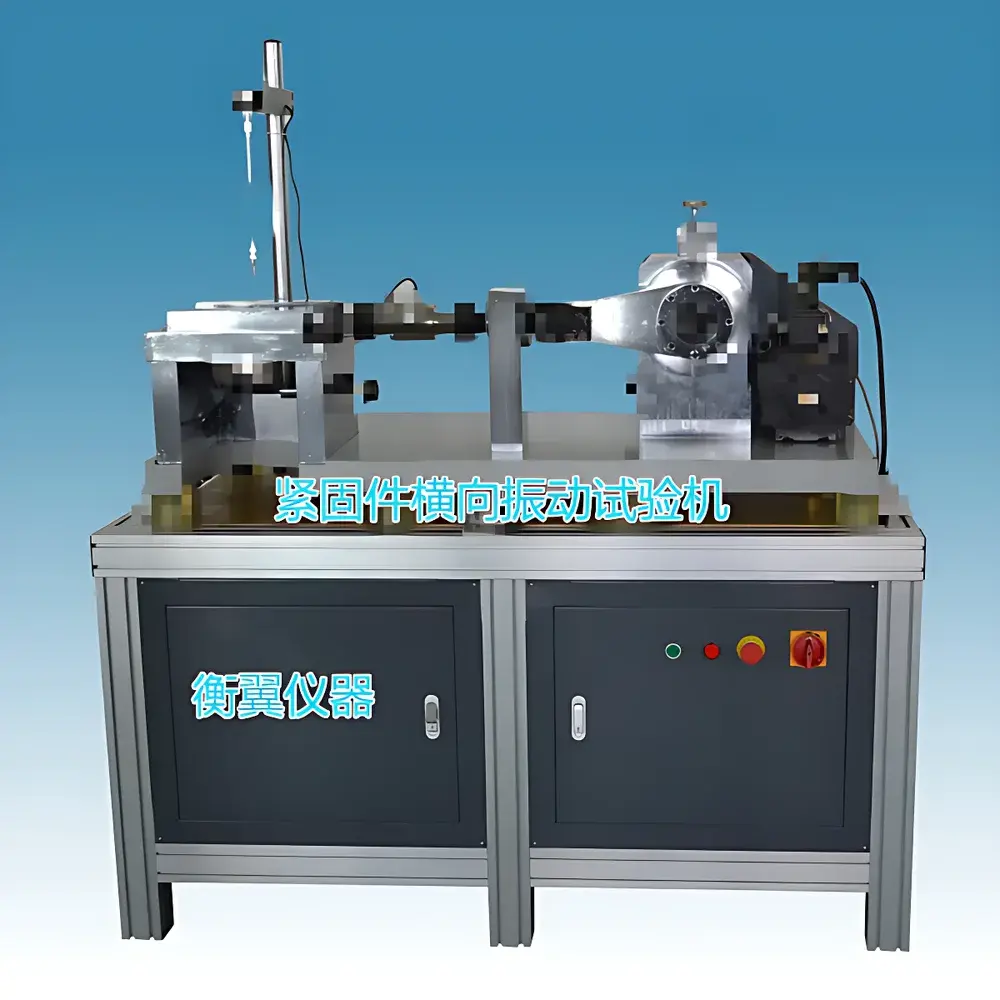
Hengyi HY-40050 Fully Automated Transverse Vibration Tester for Fasteners
| Brand | Hengyi |
|---|---|
| Origin | Shanghai, China |
| Manufacturer | Hengyi Test Equipment Co., Ltd. |
| Model | HY-40050 |
| Instrument Type | Electromechanical Transverse Vibration Shaker |
| Rated Thrust | 50 kN |
| Max. Test Load (Axial Clamping Force) | 400 kN |
| Table Dimensions | 1400 × 700 × 1650 mm |
| Max. Acceleration | 1 g |
| Frequency Range | 0–15 Hz |
| Lateral Displacement Amplitude | ±2 mm (adjustable |
| Displacement Resolution | 0.001 mm |
| Force Resolution | ±30,000 counts (full-scale, no range switching) |
| Fastener Range | M12–M24 |
| Power Supply | 380 V AC, 3-phase |
| Rated Power | 22 kW |
| Weight | 1850 kg |
| Accuracy Class | 0.5 |
Overview
The Hengyi HY-40050 Fully Automated Transverse Vibration Tester is an electromechanical testing system engineered for precision evaluation of fastener self-locking performance under controlled lateral dynamic loading. It operates on the Junker principle—a standardized method for assessing loosening resistance of bolted joints subjected to transverse oscillatory motion. The system applies repeatable, closed-loop controlled sinusoidal displacement (not acceleration-controlled) perpendicular to the bolt axis while simultaneously monitoring axial clamping force decay, angular rotation, lateral thrust, and displacement amplitude in real time. Designed to comply with ISO 16130:2015, GB/T 10431–2008, DIN 65151, and ASTM F2305 (where applicable), it supports deterministic fatigue-based validation of prevailing torque nuts, thread-locking compounds, washers, and other anti-loosening technologies under laboratory or production QA environments.
Key Features
- Fully automated servo-driven tightening station: Precisely applies preset clamp load (e.g., 75% of proof load) or torque prior to vibration initiation—ensuring consistent preload across test series.
- High-fidelity closed-loop displacement control: Lateral oscillation maintained at user-defined frequency (0–15 Hz) and amplitude (±0.001 mm resolution, standard ±2 mm, optional ±5 mm), independent of payload mass within rated capacity.
- Integrated multi-channel synchronized acquisition: Simultaneously records axial force (up to 400 kN, 0.5-class accuracy), lateral thrust (up to 50 kN), angular displacement (loosening angle), and real-time position feedback at ≥1 kHz sampling rate.
- Robust mechanical architecture: Heavy-duty base frame with low-friction linear guide rails ensures minimal parasitic moment generation and high repeatability during transverse excitation.
- Comprehensive safety integration: Interlocked transparent polycarbonate guard enclosure, emergency stop circuitry, overload cutoff (>110% full scale), and autonomous diagnostic routines for drive amplifier, load cell, and encoder subsystems.
- Configurable termination logic: Tests may be halted by elapsed time, total cycle count, axial force drop threshold (e.g., 15% loss), or angular rotation limit—enabling both pass/fail and degradation trend analysis.
Sample Compatibility & Compliance
The HY-40050 accommodates threaded fasteners from M12 to M24 in diameter, including hex bolts, flange bolts, locknuts, and specialty aerospace-grade hardware. Fixture adaptability allows testing of assembled joint configurations (e.g., bolt–nut–washer–plate stacks) with standardized mounting interfaces. All measurement subsystems are traceably calibrated per ISO/IEC 17025 requirements, and force transducers meet EN ISO 376 Class 0.5 specifications. Data acquisition protocols support audit-ready documentation aligned with GLP and GMP frameworks, including electronic signature capability and FDA 21 CFR Part 11–compliant metadata logging (when paired with validated software version).
Software & Data Management
The proprietary Hengyi TestSuite v4.x software provides real-time visualization of six synchronized parameter curves: clamping force vs. cycle count, lateral thrust vs. displacement, loosening angle vs. time, and cross-plots such as force decay versus angular rotation. Built-in analysis modules compute key metrics—including rate of axial force loss per 100 cycles, cumulative angular displacement, K-factor (torque coefficient), total friction coefficient, and normalized energy dissipation. Users may define custom analysis windows (e.g., cycles 500–1500) for comparative assessment across multiple test conditions. Raw data exports to CSV, MATLAB (.mat), and universal HDF5 formats; report templates conform to ISO 16130 Annex B requirements and support bilingual (English/Chinese) output.
Applications
- Qualification of thread-locking adhesives (e.g., Loctite, Nord-Lock washers) per OEM design release criteria.
- Development and validation of vibration-resistant fastener geometries (e.g., serrated flange nuts, wedge-lock systems).
- Production line incoming inspection of critical fasteners used in automotive powertrain, rail bogies, wind turbine nacelles, and heavy machinery.
- Root cause analysis of field failures attributed to joint relaxation under service-level vibration spectra.
- Research into tribological behavior of lubricated vs. dry threads under cyclic shear loading.
- Supporting technical documentation for PPAP submissions and AS9100-certified aerospace suppliers.
FAQ
What standards does the HY-40050 directly support?
ISO 16130:2015, GB/T 10431–2008, DIN 65151, and ASTM F2305 (Standard Test Method for Measuring the Resistance to Rotation of Preloaded Bolts).
Can the system test pre-assembled components (e.g., bolt + washer + plate)?
Yes—the base fixture includes T-slots and adjustable clamping plates to secure complex joint assemblies while maintaining pure transverse excitation alignment.
Is displacement amplitude calibrated and traceable?
Yes—integrated LVDT and optical encoder feedback loops are factory-calibrated against NIST-traceable displacement standards; certificate included with shipment.
Does the software support automated comparative reporting across test batches?
Yes—batch comparison mode enables side-by-side overlay of force decay curves, statistical summary tables (mean, SD, min/max), and pass/fail flagging based on user-defined thresholds.
What maintenance intervals are recommended for long-term metrological stability?
Annual recalibration of load cells and displacement sensors is advised; biannual verification of servo motor encoder linearity and guide rail lubrication per maintenance manual Section 7.2.



