
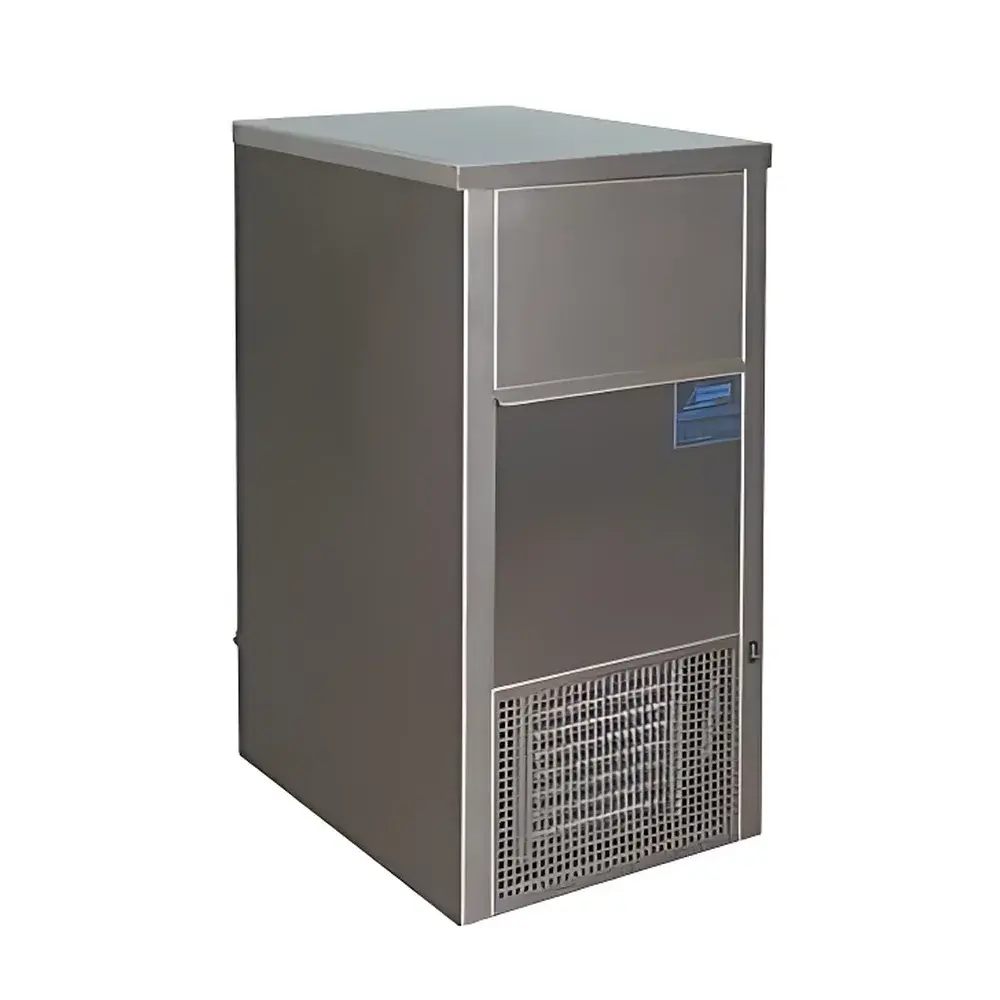
ZIEGRA ZBE 110-35 Flake Ice Machine
| Brand | ZIEGRA |
|---|---|
| Origin | Germany |
| Model | ZBE 110-35 |
| Ice Production Capacity | 110 kg/24 h |
| Storage Capacity | 35 kg |
| Water Consumption | 1 L/kg |
| Cooling Method | Hermetic Compressor |
| Ice Type | Flake Ice |
| Refrigerant | R404A (optional R290) |
| Noise Level | 47 dBA |
| Power Supply | 1/N/PE ~ 230 V, 50 Hz |
| Ambient Operating Temperature | 7–42 °C |
| Inlet Water Temperature | 5–30 °C |
| Water Pressure | 1–5 bar |
| Dimensions (W×D×H) | 460 × 600 × 910 mm |
| Weight | 80 kg |
| Construction | Full Stainless Steel (AISI 304) |
| Insulation | Polyurethane Foam, 40 mm Thickness |
Overview
The ZIEGRA ZBE 110-35 is a high-reliability, laboratory- and industrial-grade flake ice machine engineered for continuous, hygienic ice production under demanding operational conditions. Designed and manufactured in Germany, it employs a dual-screw extrusion principle to generate dry, thin, irregularly shaped flake ice with a consistent temperature of –0.5 °C — a specification critical for biological sample cooling, pharmaceutical cold chain maintenance, and precision thermal management in analytical workflows. Unlike cube or nugget ice systems, flake ice offers superior surface-area-to-volume ratio, rapid thermal transfer, and non-compacting morphology — enabling uniform contact with heat-sensitive specimens without mechanical stress or localized freezing. Its hermetically sealed refrigeration circuit, using R404A (with R290 available as an eco-friendly alternative), ensures stable performance across ambient temperatures ranging from 7 °C to 42 °C, making it suitable for installation in non-climate-controlled labs, QC rooms, or mobile processing units.
Key Features
- Full AISI 304 stainless steel construction — both interior and exterior — compliant with EU drinking water directives (DIN EN 13242, DIN 1988-200) and resistant to corrosion, microbial adhesion, and cleaning agent degradation.
- Dual-screw extrusion system delivering flake ice at precisely –0.5 °C; ice remains free-flowing for >72 hours in insulated storage bin without agglomeration.
- Microprocessor-based control unit with programmable start/stop cycles, real-time status monitoring (compressor load, water flow, bin fill level), and automatic defrost sequence optimized for energy efficiency.
- Polyurethane insulation layer (40 mm thick) minimizing thermal bridging and reducing standby energy consumption by up to 22% versus standard foam-insulated units.
- Hermetic compressor design ensuring oil-free refrigerant circulation, low vibration transmission, and extended service intervals — rated for ≥15 years of continuous operation at rated capacity.
- Low-noise operation (47 dBA at 1 m) achieved via acoustic damping mounts and optimized airflow routing — compatible with noise-sensitive environments including cleanrooms and adjacent analytical laboratories.
Sample Compatibility & Compliance
The ZBE 110-35 is certified for use in applications requiring traceable, contamination-free thermal media. All wetted surfaces meet EC Regulation No. 1935/2004 for materials in contact with foodstuffs and are validated per NSF/ANSI Standard 12 for commercial ice makers. The unit complies with IEC 61000-6-3 (EMC emissions) and IEC 61000-6-2 (immunity), and its electrical architecture conforms to EN 60335-1 (safety of household and similar electrical appliances). While not classified as medical device under MDR 2017/745, it supports GLP/GMP-aligned workflows where documented temperature stability, material traceability, and audit-ready operational logs are required — e.g., cryopreservation support, reagent pre-chilling prior to HPLC injection, or cold-stage preparation for electron microscopy sample handling.
Software & Data Management
The integrated microcontroller provides local digital interface only (no cloud connectivity or proprietary software suite). Operational data — including cumulative runtime, total ice output (kg), number of automatic defrost cycles, and fault event timestamps — are retained in non-volatile memory for ≥12 months. Audit trails comply with ALCOA+ principles when exported manually via RS-485 serial port (Modbus RTU protocol) for integration into validated lab information management systems (LIMS). No FDA 21 CFR Part 11 electronic signature functionality is included, as the device operates autonomously without user-authenticated command inputs.
Applications
- Biological specimen transport and temporary storage (e.g., blood bags, tissue biopsies, PCR master mixes).
- Cold trapping during solvent evaporation or rotary evaporation in organic synthesis labs.
- Temperature stabilization of calorimetric cells, rheometer sample holders, or laser optics mounts.
- Food safety testing labs requiring ISO/IEC 17025-compliant cold chain validation.
- On-site ice supply for field-deployable environmental sampling kits operating under variable ambient conditions.
FAQ
What is the minimum inlet water temperature required for optimal ice quality?
The unit is designed for feed water between 5 °C and 30 °C. At ≤10 °C, ice density increases slightly; above 25 °C, production rate may decrease by up to 12% due to reduced condenser efficiency.
Can the ZBE 110-35 be installed in a ventilated cabinet?
Yes — provided rear and top clearance exceeds 150 mm and ambient air exchange meets ≥3 air changes/hour. Avoid recirculating exhaust air from fume hoods or HVAC zones with high particulate loading.
Is routine descaling required?
Descaling frequency depends on feed water hardness. For water with >10°dH, perform citric acid descaling every 3–6 months. Units supplied with integrated scale-inhibiting water filter (optional accessory) extend interval to ≥12 months.
Does the unit support three-phase power input?
No — the ZBE 110-35 operates exclusively on single-phase 230 V, 50 Hz supply with 16 A circuit protection. Three-phase variants are not offered in this model series.
How is ice harvested from the storage bin?
Ice exits via gravity-fed front-access chute with adjustable flow gate; no auger or mechanical conveyor is used, eliminating shear-induced fragmentation or metal wear debris.



