
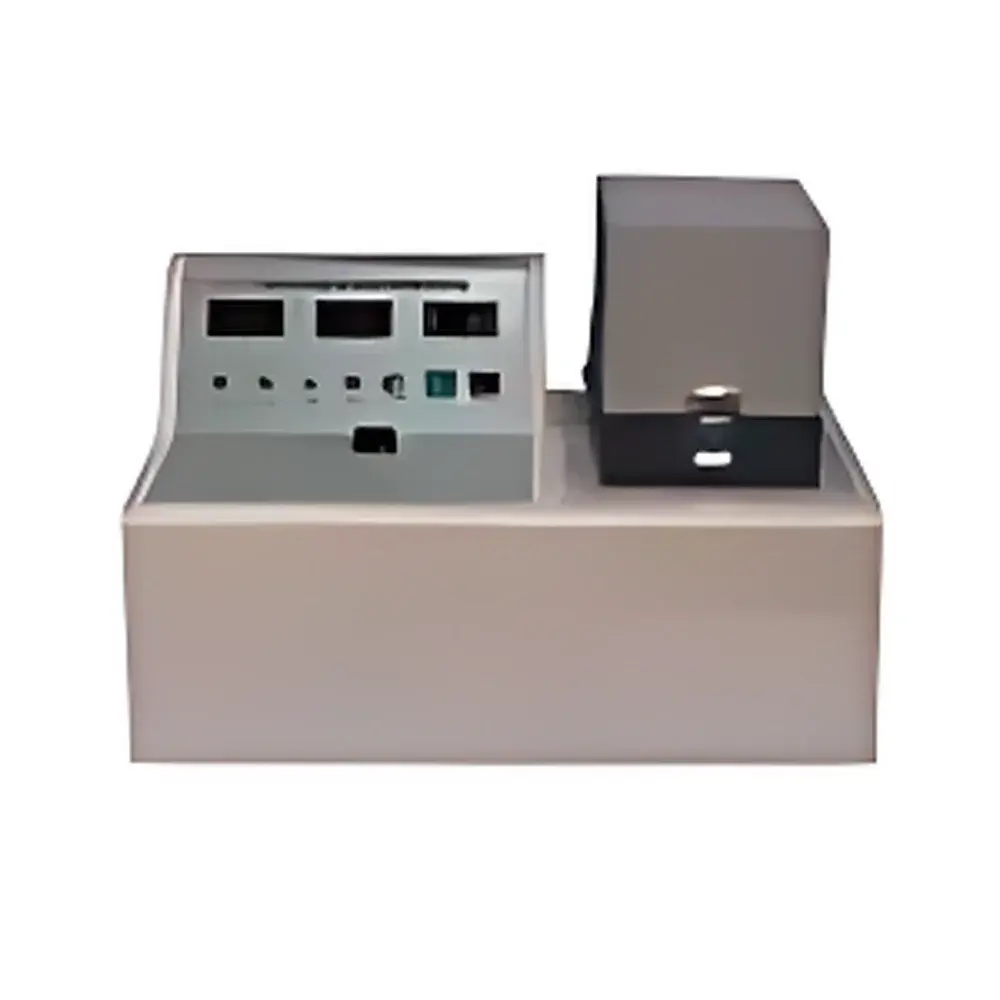
Kyoyuan KYD-2003 Emulsion Breaker and Electro-Dehydration Performance Tester
| Brand | Kyoyuan |
|---|---|
| Origin | Jiangsu, China |
| Manufacturer Type | Direct Manufacturer |
| Country of Origin | China |
| Model | KYD-2003 |
| Instrument Type | Benchtop Centrifuge |
| Speed Category | Low-Speed Centrifuge (up to 10,000 rpm) |
| Functionality | Refrigerated Centrifuge |
| Configuration | Fixed-Angle Rotor Centrifuge |
| Maximum Capacity | 6 × 85 mL |
| Maximum Rotational Speed | 30,000 rpm |
| Maximum RCF | Not Specified |
| Dimensions (W×D×H) | 400 × 550 × 650 mm |
| Input Voltage | AC 220 V ± 22 V |
| High-Voltage Output Range | AC 0–6,000 V (adjustable) |
| Power Consumption | 1,000 W |
| Temperature Control Range | Ambient to 180 °C |
| Temperature Accuracy | ±5 °C |
| Operating Environment | 0–40 °C |
Overview
The Kyoyuan KYD-2003 Emulsion Breaker and Electro-Dehydration Performance Tester is a purpose-built laboratory instrument engineered for quantitative evaluation of demulsifier efficiency and electrostatic dehydration behavior in crude oil–water emulsions. Unlike conventional centrifuges, the KYD-2003 integrates synchronized thermal control, adjustable high-voltage AC electric field generation (0–6 kV), real-time time-programmable operation, and multi-layer safety interlocks—enabling controlled simulation of field-scale electro-dehydration processes under reproducible lab conditions. Its core measurement principle relies on comparative phase separation kinetics: by applying calibrated thermal energy and tunable electric field strength to standardized emulsion samples, the instrument quantifies water dropout volume, sediment formation rate, and interface clarity over defined time intervals—parameters directly correlated with demulsifier performance ranking and compatibility assessment per ASTM D1401 and ISO 6630 standards.
Key Features
- Integrated dual-mode operation: simultaneous or independent control of temperature (ambient to 180 °C) and AC high-voltage field (0–6,000 V, continuously adjustable)
- Microcontroller-based digital control system with programmable time cycles, automatic termination, and event logging
- Dual-safety architecture: hardware-level overtemperature cutoff with audible alarm and current-limiting overcurrent protection that suspends HV output upon detection of excessive conductive load (e.g., high-salinity emulsions), resuming automatically when fault condition clears
- Benchtop modular design with front-access sample chamber, shielded HV terminals, and thermally insulated heating chamber
- Fixed-angle rotor configuration supporting six 85 mL centrifuge tubes—optimized for consistent gravitational and electrophoretic acceleration during parallel testing
- Compliant with IEC 61010-1 for electrical safety in laboratory equipment; meets EMC Class B emission limits
Sample Compatibility & Compliance
The KYD-2003 accommodates standard glass or borosilicate centrifuge tubes (up to 85 mL) and is validated for use with crude oil emulsions containing varying water cuts (5–40 wt%), dissolved salts (NaCl, CaCl₂), and synthetic or field-derived demulsifier formulations. It supports method development aligned with industry-standard test protocols including ASTM D1401 (Standard Test Method for Water Separability of Petroleum Oils), ISO 6630 (Petroleum Products — Determination of Demulsibility), and internal refinery QC specifications for electro-dehydration validation. All operational parameters—including voltage ramp profiles, hold times, and thermal soak durations—are fully configurable and auditable, facilitating GLP-compliant documentation and traceability.
Software & Data Management
While the KYD-2003 operates via embedded firmware without external PC dependency, it provides timestamped digital logs of all critical events: start/stop timestamps, setpoint deviations, HV activation cycles, overtemperature or overcurrent triggers, and final equilibrium readings. These logs are retained in non-volatile memory and can be exported via RS-232 serial interface (optional cable kit required) for integration into LIMS or Excel-based reporting workflows. The control interface supports password-protected parameter locking, ensuring method integrity across multiple users. Full audit trail capability satisfies requirements for FDA 21 CFR Part 11–aligned environments when paired with validated data capture software.
Applications
- Screening and ranking of commercial and experimental demulsifier candidates under simulated reservoir and pipeline conditions
- Optimization of electro-dehydration parameters (voltage gradient, residence time, temperature) for specific crude blends
- Investigation of emulsion stability mechanisms—e.g., impact of asphaltenes, naphthenic acids, or suspended solids on coalescence kinetics
- Quality control of incoming crude feedstocks and blended crudes prior to desalting unit entry
- Supporting API RP 1009 and ISO 10438 compliance verification for upstream processing facilities
- Academic research in colloid science, interfacial rheology, and electrokinetic phenomena in hydrocarbon–aqueous systems
FAQ
Is the KYD-2003 certified for use in hazardous locations (e.g., Class I, Division 1)?
No—the instrument is rated for general laboratory use only and is not intrinsically safe or explosion-proof. It must be operated in well-ventilated, non-hazardous areas compliant with local electrical codes.
Can the high-voltage output be DC instead of AC?
No—the KYD-2003 generates only sinusoidal AC high voltage (50/60 Hz) optimized for dielectric breakdown studies and electrocoalescence testing in viscous media.
Does the instrument include calibration certificates for temperature and voltage?
Factory calibration is performed per internal QA protocol; NIST-traceable calibration certificates are available upon request at additional cost and require separate scheduling.
What maintenance is required for long-term reliability?
Routine cleaning of the heating chamber and rotor cavity is recommended after each use; annual verification of HV insulation resistance and thermal sensor drift is advised per ISO/IEC 17025 guidelines.
Is remote monitoring or Ethernet connectivity supported?
Not natively—the device features RS-232 for basic data export; Ethernet or Wi-Fi modules are not integrated and are not offered as factory options.



