
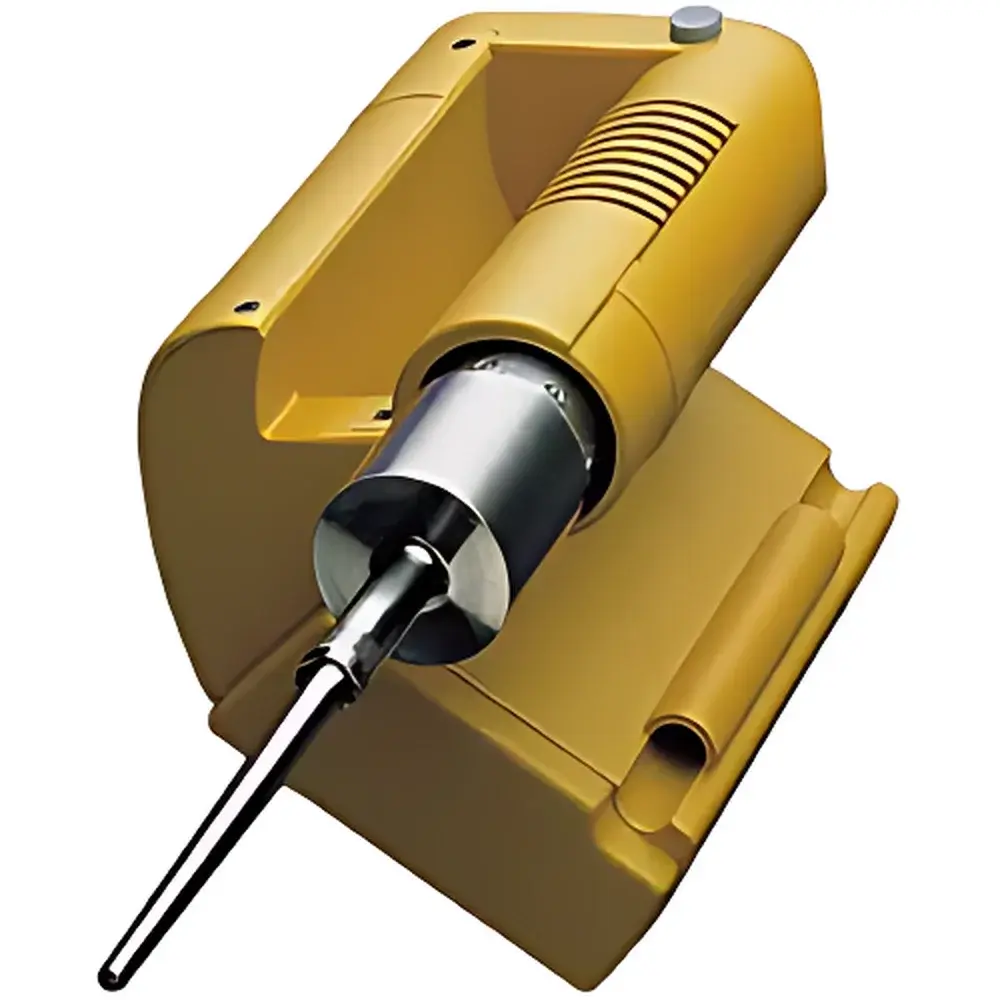
Hielscher UP200H Handheld Ultrasonic Homogenizer
| Brand | Hielscher |
|---|---|
| Origin | Germany |
| Model | UP200H |
| Ultrasonic Power | 200 W |
| Operating Frequency | 24 kHz (auto-tuned) |
| Amplitude Control Range | 20–100% (digital, continuous) |
| Pulse Mode | 0–100% duty cycle |
| Sample Volume Range | 0.1–1000 mL per batch |
| Flow Rate (continuous mode) | up to 2.5 L/h |
| Probe Material | Grade 5 titanium alloy (Ti-6Al-4V) |
| Dimensions (L×W×H) | 257 × 200 × 160 mm |
| Weight | 2.1 kg |
| Input Power | 230 V, 2 A, 50–60 Hz |
| Sterilization Compatibility | Autoclavable (121°C, 20 min, full probe assembly) |
Overview
The Hielscher UP200H Handheld Ultrasonic Homogenizer is an engineered solution for precise, scalable ultrasonic energy delivery in life science and bioprocessing laboratories. Based on piezoelectric transduction principles, it converts high-frequency electrical oscillations into mechanical longitudinal vibrations at a nominal operating frequency of 24 kHz—automatically maintained via real-time frequency tracking to ensure resonance stability under variable load conditions. This resonant energy is transmitted through a titanium alloy sonotrode (probe), generating intense cavitation fields within liquid media. These transient microbubbles collapse asymmetrically near cell membranes or particulate surfaces, producing localized shear forces, microstreaming, and shockwaves sufficient to disrupt cellular envelopes, disintegrate aggregates, emulsify immiscible phases, or accelerate chemical reaction kinetics. Unlike fixed-frequency systems, the UP200H’s adaptive tuning ensures consistent amplitude output across changing sample viscosity, volume, or temperature—critical for reproducible lysis efficiency and process transferability between R&D and pilot-scale applications.
Key Features
- Integrated transducer–generator architecture enables true handheld operation while supporting bench-mounted configurations with optional holders and cooling jackets.
- Digital amplitude control (20–100%) allows fine-tuned energy input without hardware changes—essential for optimizing lysis yield while minimizing thermal denaturation or nucleic acid shearing.
- Pulse mode (0–100% duty cycle) provides temporal control over energy delivery, reducing net heat accumulation during sensitive protocols such as protein extraction or plasmid isolation.
- Full titanium alloy (Ti-6Al-4V) probe construction resists corrosion from organic solvents, acidic/basic buffers, and halogenated reagents; certified autoclavable per ISO 17665-1 for sterile processing environments.
- Real-time frequency auto-tracking maintains resonance despite probe erosion, temperature drift, or viscosity shifts—ensuring stable cavitation intensity and measurement repeatability (CV < 3% across replicate runs).
- Embedded safety logic includes dry-run detection and automatic shutdown if impedance exceeds operational thresholds—protecting both transducer integrity and sample integrity.
Sample Compatibility & Compliance
The UP200H accommodates diverse biological matrices including bacterial cultures (E. coli, Bacillus spp.), yeast suspensions (S. cerevisiae), mammalian cell lines (HEK293, CHO), plant tissues, and tissue homogenates. Its probe geometry supports direct immersion in volumes from 0.1 mL (microcentrifuge tubes) to 1 L (beakers or jacketed reactors). For GMP-aligned workflows, the device complies with IEC 61000-6-3 (EMC emissions) and IEC 61000-6-2 (immunity), and its digital control interface supports audit-trail generation when connected to validated laboratory information management systems (LIMS). While not intrinsically 21 CFR Part 11 compliant, the UP200H’s RS232/USB interface enables integration with third-party software platforms that provide electronic signature, user access control, and change history logging required for GLP/GMP documentation.
Software & Data Management
The UP200H communicates via standard RS232 or USB virtual COM port, enabling bidirectional command exchange with host PCs. Hielscher’s free “Hielscher LabSuite” software (Windows-compatible) permits remote parameter configuration—including amplitude setpoint, pulse duration, total treatment time, and frequency lock status—as well as real-time monitoring of actual power draw and impedance feedback. All executed protocols are timestamped and exportable as CSV files for traceability. For enterprise deployments, the device supports Modbus RTU protocol over RS485 (via optional adapter), facilitating integration into SCADA or MES environments where centralized equipment monitoring and SOP-driven execution are mandated.
Applications
- Cell lysis for intracellular protein, DNA, RNA, and organelle isolation—with optimized protocols available for Gram-negative bacteria, Gram-positive strains, and eukaryotic cells.
- Nanoparticle dispersion and stabilization in drug delivery formulation development (e.g., liposomes, polymeric micelles, exosome isolation).
- Enzyme activation and sonochemical synthesis—leveraging cavitation-induced radical formation to enhance reaction rates in green chemistry applications.
- Deagglomeration of nanomaterials (carbon nanotubes, metal oxides) prior to rheological or spectroscopic characterization.
- Cleaning of microfluidic chips and capillary electrophoresis components via acoustic streaming-assisted residue removal.
- Pre-analytical sample preparation for LC-MS, NMR, and next-generation sequencing workflows requiring minimal analyte degradation.
FAQ
Is the UP200H suitable for use in biosafety level 2 (BSL-2) laboratories?
Yes—the unit operates without hazardous gases or high-voltage exposed components; its sealed transducer housing meets IP54 ingress protection standards, and autoclavable probes enable decontamination between pathogenic samples.
Can the UP200H be used for continuous-flow processing?
Yes—when coupled with Hielscher’s flow-through cells (e.g., GDx series) and recirculation pumps, it supports continuous operation at up to 2.5 L/h with integrated cooling to maintain sample temperature below 35°C.
Does the device support regulatory-compliant data archiving?
While the UP200H itself does not store historical logs internally, its serial/USB interface allows integration with validated third-party software that provides ALCOA+ compliant data handling, including metadata tagging, electronic signatures, and immutable audit trails.
What maintenance is required for long-term reliability?
Annual calibration of amplitude output against traceable reference standards is recommended; probe tip inspection for pitting or cracking should occur before each high-intensity use, and transducer coupling grease must be replaced every 12 months or after 500 autoclave cycles.
How does amplitude control differ from power control in ultrasonic processing?
Amplitude defines the peak-to-peak displacement of the probe tip (micrometers), directly governing cavitation intensity; power (watts) is a derived metric dependent on load impedance—making amplitude the primary, physics-based control variable for method robustness.




