
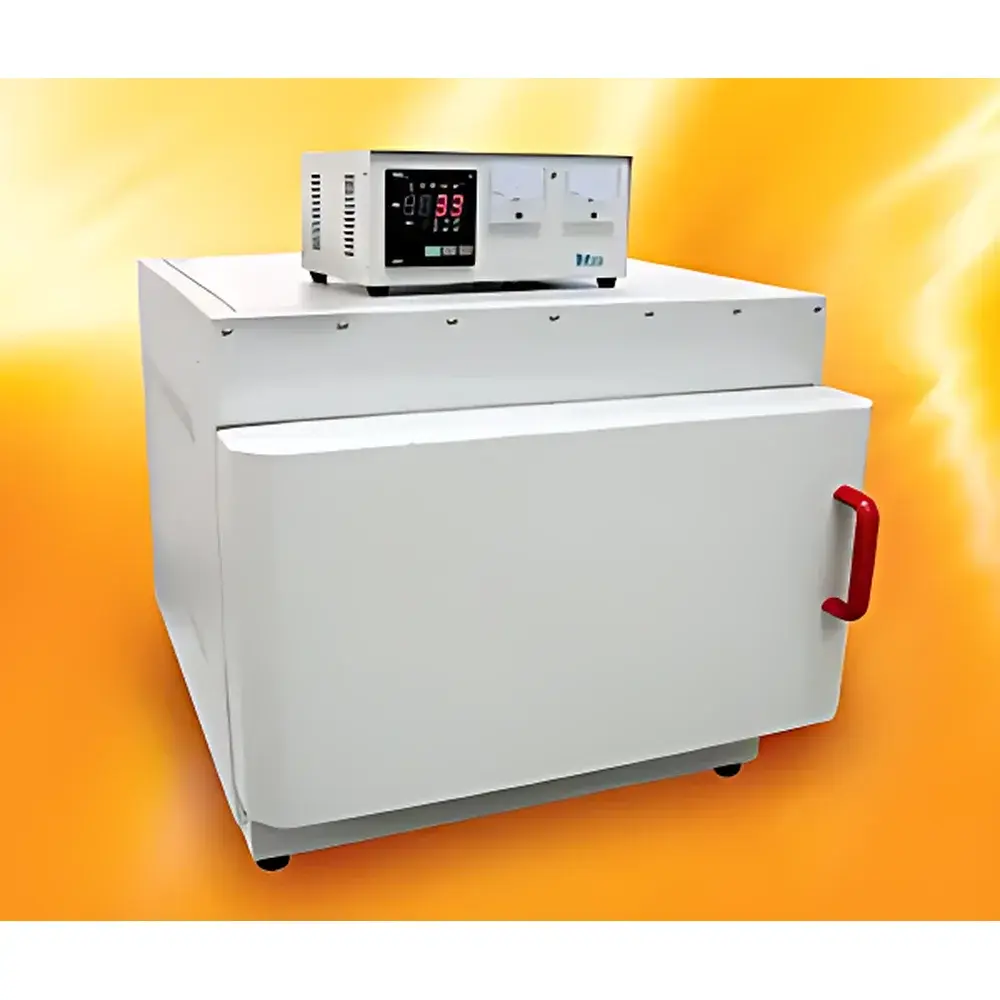
MICHEM TM30 Series High-Temperature Box Furnace
| Brand | MICHEM |
|---|---|
| Origin | Beijing, China |
| Model | TM30 Series |
| Instrument Type | Box Furnace |
| Maximum Temperature | 1000 °C / 1200 °C / 1400 °C |
| Temperature Control Accuracy | ±1 °C |
| Maximum Power | 6 kW |
| Heating Time to Max Temp | 40 min (1000 °C) / 60 min (1200 °C) / 80 min (1400 °C) |
| Heating Element | HRE high-temperature alloy |
| Internal Chamber Dimensions | 300 × 400 × 250 mm (W × D × H) |
Overview
The MICHEM TM30 Series High-Temperature Box Furnace is a precision-engineered laboratory furnace designed for applications requiring stable, uniform, and repeatable thermal environments up to 1400 °C. Built on a robust ceramic fiber insulation architecture, this muffle furnace eliminates conductive heat loss and ensures rapid thermal response while maintaining exceptional energy efficiency. Its heating chamber is fully isolated from combustion gases and external contaminants—making it suitable for ashing, calcination, sintering, annealing, and high-temperature material testing in analytical, metallurgical, and materials science laboratories. The furnace operates on the principle of resistive heating via high-performance HRE (High-Resistance Element) alloy wire elements, embedded within low-thermal-conductivity ceramic fiber walls (≥130 mm thick), enabling precise temperature gradients and minimal thermal lag. With an internal volume of 30 L and a maximum operating temperature of 1400 °C, the TM30 series supports large-batch sample processing without compromising thermal homogeneity or control fidelity.
Key Features
- Ultra-stable temperature control with ±1 °C accuracy across the full operating range (100–1400 °C), validated per ASTM E220 and ISO/IEC 17025 calibration protocols.
- Ceramic fiber insulation (≥130 mm thickness) reduces surface temperature to ≤60 °C at 1000 °C hold—minimizing ambient thermal load and operator safety risk.
- HRE alloy heating elements engineered for extended service life under cyclic high-temperature operation; patented mounting configuration improves thermal distribution and reduces localized oxidation.
- Multi-step programmable PID controller (30-segment ramp-soak profile) with slope control for each segment, supporting GLP-compliant thermal process documentation.
- Integrated safety interlock: automatic power cutoff upon door opening, over-temperature cutout (independent from main controller), and ground-fault circuit interruption (GFCI) protection.
- Standard 3-phase 380 V / 16 A input enables stable high-power delivery with reduced current draw—critical for long-duration holds at elevated temperatures.
- Compact external footprint (710 × 760 × 640 mm) accommodates integration into regulated lab spaces while delivering industry-leading chamber volume-to-footprint ratio.
Sample Compatibility & Compliance
The TM30 series accommodates crucibles, boats, and trays made from alumina, silicon carbide, platinum, and quartz—compatible with ASTM C721 (refractory ceramics), ISO 5660 (fire testing), and USP heavy metal residue analysis procedures. Its sealed muffle design prevents cross-contamination during ashing of biological, pharmaceutical, or environmental samples. The furnace meets IEC 61010-1:2010 safety requirements for electrical equipment for measurement, control, and laboratory use. Optional NIST-traceable calibration certificates and IQ/OQ documentation packages are available to support FDA 21 CFR Part 11 and EU Annex 11 compliance for regulated quality control environments.
Software & Data Management
The standard PP3 temperature controller includes RS485 communication interface (Modbus RTU protocol) for integration with LIMS or SCADA systems. Optional data logging software enables real-time graphing, alarm event tagging, and export of time-stamped temperature profiles in CSV format. All thermal cycles—including ramp rates, soak durations, and deviation alerts—are stored with audit-trail timestamps meeting GLP/GMP record retention standards. Firmware supports user-defined password protection, electronic signature capture for critical process steps, and configurable alarm thresholds for temperature deviation, power failure, and door status.
Applications
- Gravimetric analysis: quantitative ash content determination per AOAC 923.03 and EPA Method 200.7.
- Metallurgical heat treatment: controlled annealing, stress relieving, and austenitizing of ferrous and non-ferrous alloys.
- Ceramic and powder metallurgy: sintering of oxide and carbide compacts under inert or air atmospheres.
- Calibration reference: certified as a stable high-temperature source for thermocouple and pyrometer validation up to 1400 °C (per ISO/IEC 17025 accredited calibration).
- Research-grade thermal aging: accelerated stability testing of polymers, composites, and battery electrode materials.
- Environmental testing: LOI (Loss on Ignition) analysis of soils, sediments, and sludges per ASTM D7348.
FAQ
What is the maximum recommended continuous operating temperature?
The TM30 series is rated for continuous operation at 1400 °C; intermittent use up to 1450 °C is permissible with reduced element lifetime.
Can the furnace be used under inert or reducing atmospheres?
Yes—when equipped with optional gas inlet/outlet ports and compatible refractory fixtures, it supports N₂, Ar, or forming gas (5% H₂/95% N₂) environments.
Is the temperature uniformity verified across the chamber?
Yes—typical radial and axial uniformity is ±5 °C at 1200 °C (measured per ASTM E220 Annex A4 using 9-point mapping).
Does the system comply with FDA 21 CFR Part 11 for electronic records?
With optional firmware upgrade and validated software package, full Part 11 compliance—including audit trail, electronic signatures, and role-based access—is achievable.
What maintenance is required for long-term reliability?
Annual inspection of heating elements, thermocouple calibration verification, and ceramic fiber integrity check are recommended; no routine lubrication or consumable replacement is needed.



