
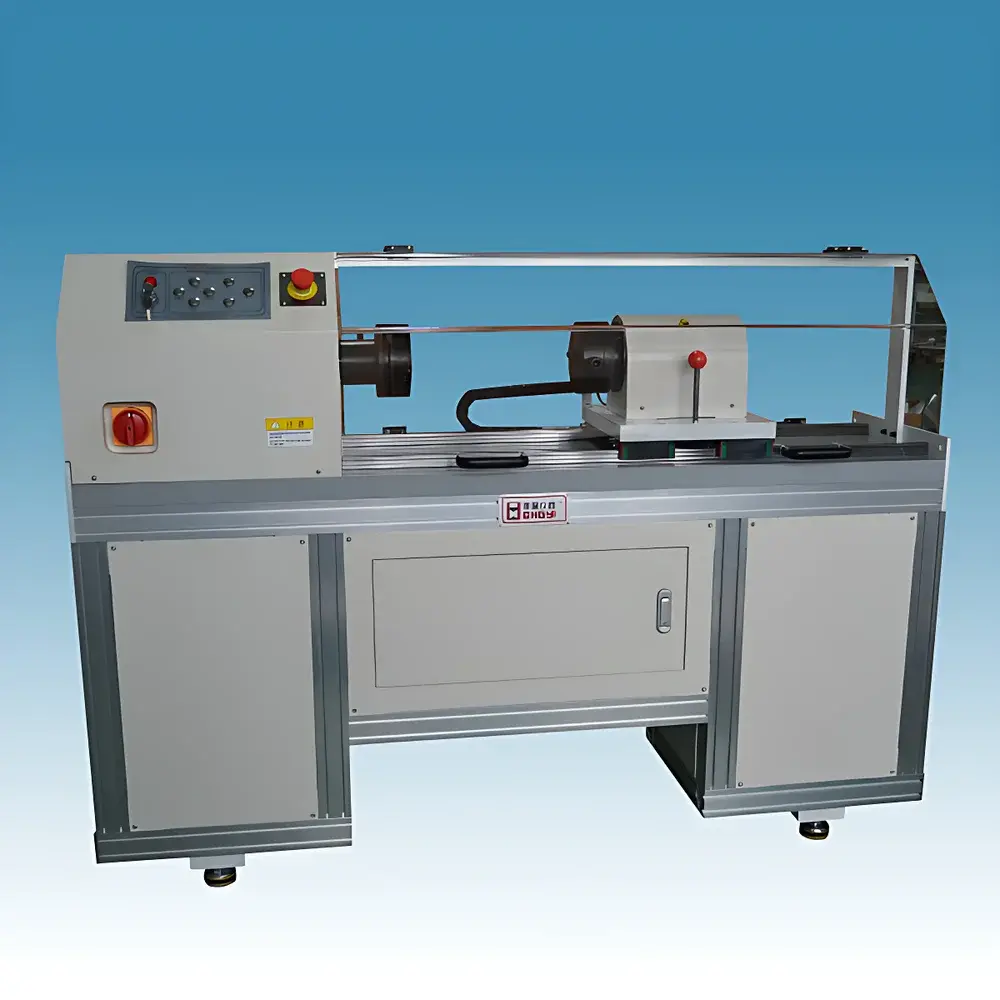
Hengyi HY-1000N·m Electronic Torsion Testing Machine for Epoxy Adhesives
| Brand | Hengyi / Hengyitest |
|---|---|
| Origin | Shanghai, China |
| Manufacturer Type | Direct Manufacturer |
| Regional Category | Domestic (China) |
| Model | HY-1000N·mTHBFH |
| Price Range | USD 2,800 – 7,000 |
| Max Torque | 1000 N·m |
| Torque Measurement Range | 0.1 – 1000 N·m |
| Torque Resolution | 1/500,000 FS |
| Torsion Angle Range | 0–100,000° (or continuous rotation) |
| Motor Power | 0.4 kW |
| Torque Accuracy | ±0.5% of reading |
| Angular Accuracy | ±0.5% of reading |
| Angular Resolution | 0.0045° |
| Torsion Speed | 0–1000°/min |
| Clamp Spacing | 200 mm (customizable) |
| Specimen Grip Range | Φ1–Φ5 mm (customizable) |
| Dimensions (L×W×H) | ≈1000×420×500 mm |
| Weight | 200 kg |
| Compliance | JB/T 9370–1999, GB/T 10128–2007, GB/T 6329–1996, GB/T 7124–2008, JC/T 989–2006, JJG 269 |
Overview
The Hengyi HY-1000N·m Electronic Torsion Testing Machine is a precision-engineered instrument designed for quantitative mechanical characterization of torsional behavior in structural and functional adhesives—particularly epoxy resin-based formulations—under controlled angular displacement and torque loading. Operating on the principle of controlled rotational actuation with high-fidelity torque and angular position feedback, the system applies calibrated torsional stress to bonded joint specimens (e.g., lap-shear or butt-joint configurations) and records real-time torque–angle, torque–time, and angle–time relationships. Unlike uniaxial tensile testers, this machine captures critical interfacial failure modes unique to torsional loading—including peel-initiated debonding, cohesive shear fracture propagation, and interfacial slippage under dynamic twist—enabling evaluation of adhesive performance beyond ASTM D1002 or ISO 4587 tensile standards. Its architecture integrates a servo-motor-driven loading train, dual-channel digital signal acquisition, and closed-loop control algorithms compliant with ISO 17025 traceability requirements for mechanical testing laboratories.
Key Features
- High-resolution torque measurement down to 0.1 N·m with full-scale resolution of 1/500,000, ensuring accurate quantification of low-torque initiation events in brittle or low-viscosity adhesives.
- Precision angular encoder delivering 0.0045° resolution over a 0–100,000° range—or continuous rotation mode—supporting both finite-angle fatigue cycling and unlimited multi-turn characterization.
- Bidirectional torsional actuation (clockwise/counterclockwise) with programmable speed profiles (0–1000°/min), enabling simulation of assembly torque, service-induced twisting, and reverse-load recovery behavior.
- Modular grip system accommodating cylindrical specimens from Φ1 mm to Φ5 mm; custom fixtures available for standardized joint geometries per GB/T 6329–1996 (adhesive butt-joint torsion) and GB/T 7124–2008 (rigid-to-rigid tensile-adhesive bonding).
- Dedicated torsion control firmware with automatic peak torque capture, yield angle detection, and real-time stiffness calculation (dτ/dθ) for modulus derivation in the linear elastic region.
- Self-contained electronic measurement unit with isolated analog input channels, eliminating PC-dependent noise interference and supporting standalone operation during GLP audits.
Sample Compatibility & Compliance
The HY-1000N·m system accommodates a broad spectrum of adhesive chemistries—including epoxy resins, anaerobic acrylics, polyurethanes, phenol-formaldehyde, urea-formaldehyde, and cyanoacrylates—as well as composite substrates (aluminum, stainless steel, FRP, and ceramic-coated surfaces). Joint configurations supported include single-lap, double-lap, and butt-jointed specimens per JC/T 989–2006 (non-structural stone adhesives) and ASTM D3166 (fatigue torsion of adhesive bonds). The instrument meets national metrological verification requirements per JJG 269 (Verification Regulation for Torsion Testing Machines) and adheres to mechanical design specifications outlined in JB/T 9370–1999. Data acquisition protocols are structured to satisfy audit trails required under FDA 21 CFR Part 11 when configured with user-access-controlled software logs and electronic signatures.
Software & Data Management
The embedded Windows-based control interface enables synchronized acquisition of torque, angular displacement, and time stamps at up to 1 kHz sampling rate. Real-time plotting includes overlay-capable torque–angle hysteresis loops, cyclic torsion envelopes, and derivative-based failure onset markers. All raw datasets are saved in CSV and proprietary .HDT binary formats with metadata embedding (operator ID, calibration certificate ID, environmental temperature/humidity tags). Export modules generate PDF reports conforming to GB/T 10128–2007 reporting templates—including ultimate torque, failure angle, torsional modulus, and energy absorption (area under τ–θ curve). Optional API integration supports LabVIEW and MATLAB scripting for automated batch processing and statistical process control (SPC) charting across production lots.
Applications
- Quality assurance of aerospace-grade epoxy film adhesives subjected to torsional shear in wing spar bonding interfaces.
- R&D evaluation of anaerobic threadlockers under simulated bolt loosening cycles (ISO 10964).
- Comparative screening of bio-based polyurethane adhesives for automotive interior trim assemblies exposed to thermal cycling-induced torsional strain.
- Regulatory submission support for medical device bonding validation (e.g., orthopedic implant–polymer housing joints per ISO 14801).
- Accelerated aging studies correlating humidity exposure with torsional interfacial degradation kinetics in structural glazing sealants.
FAQ
Does the HY-1000N·m comply with international torsion testing standards such as ISO 7500-1?
Yes—the system’s force transducer calibration and angular encoder traceability align with ISO 7500-1 Class 1 accuracy requirements when operated within its specified torque range (0.1–1000 N·m) and verified using NIST-traceable reference standards.
Can the machine perform torsional fatigue testing?
Yes—programmable bidirectional waveforms (sine, triangle, trapezoidal) with variable amplitude, frequency, and mean torque offset enable fatigue life assessment per ISO 13584-34 and ASTM E2207.
Is third-party calibration documentation provided with shipment?
Each unit ships with a factory calibration certificate referencing CNAS-accredited standards; optional on-site calibration by accredited metrology providers is available upon request.
What specimen preparation guidance is included for epoxy adhesive butt-joint torsion tests?
A comprehensive test method annex—aligned with GB/T 6329–1996—is supplied, covering surface pretreatment (grit blasting, plasma activation), bondline thickness control (spacers), and post-cure conditioning protocols.
How is data integrity maintained during long-duration torsion creep tests?
The system implements hardware-level watchdog timers, non-volatile memory buffering, and automatic power-fail resume functionality—ensuring uninterrupted data continuity even during grid fluctuations or unscheduled shutdowns.



