
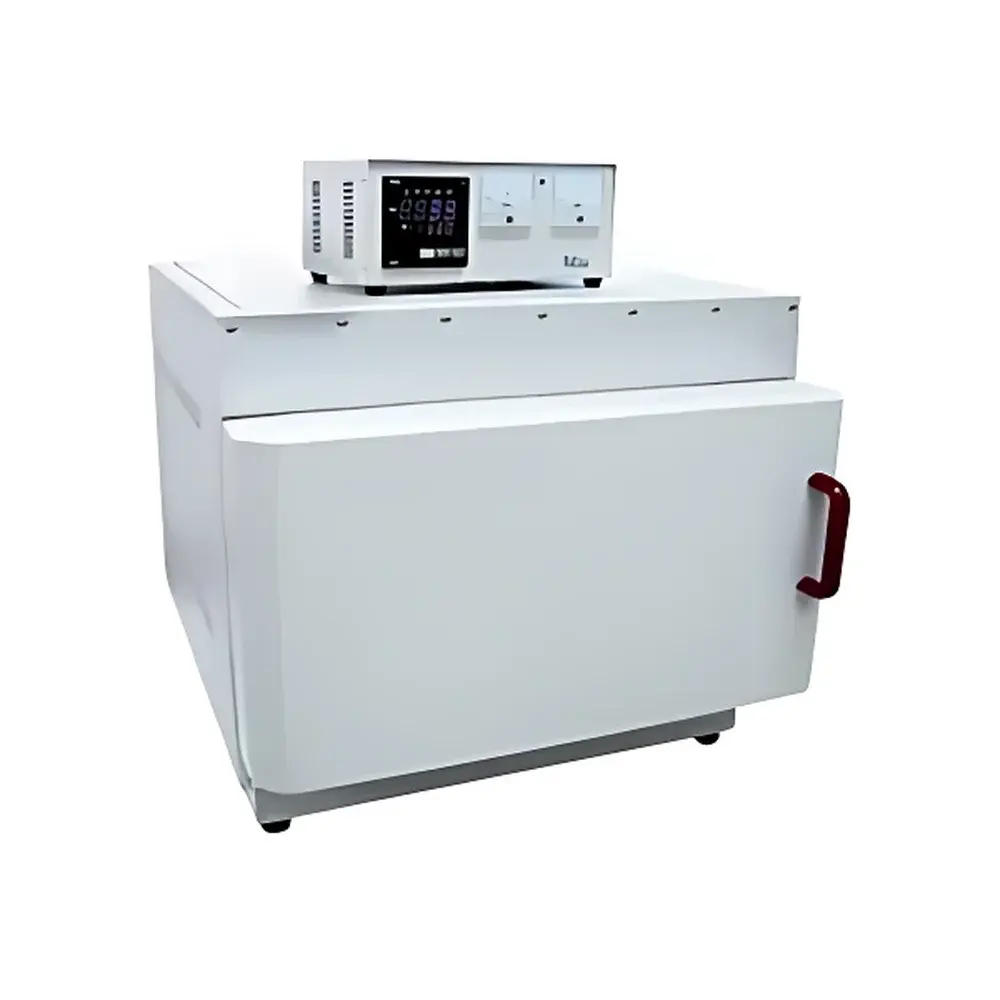
MICHEM TM Series Ceramic Fiber Muffle Furnace
| Brand | MICHEM |
|---|---|
| Origin | Beijing, China |
| Instrument Type | Box-Type Muffle Furnace |
| Heating Element | Resistance Wire (up to 1400 °C) / Silicon Molybdenum Rod (1700 °C) |
| Temperature Range | 100–1700 °C |
| Chamber Volume | 4–30 L |
| Power Input | 2–7 kW |
| Max. Insulation Thickness | 140 mm |
| External Power Supply | 220 V/16–25 A or 380 V/16 A (3-phase) |
| Temperature Uniformity | ±2 °C at setpoint |
| Controller | PID-based multi-step programmable controller (30 segments), stability ≤0.2% FS |
| Thermocouple Types | K (≤1200 °C), S (≤1400 °C), B (≤1700 °C) |
| Weight | 52–110 kg |
| Internal Dimensions (W×D×H) | 160×170×150 mm to 300×400×250 mm |
| External Dimensions (W×D×H) | 550×530×430 mm to 710×760×640 mm |
Overview
The MICHEM TM Series Ceramic Fiber Muffle Furnace is a high-performance, energy-efficient box-type furnace engineered for precision thermal processing in analytical laboratories, metallurgical research, materials science, and quality control environments. Utilizing advanced low-density ceramic fiber insulation—characterized by exceptional thermal resistance, low heat storage, and minimal thermal mass—the furnace achieves rapid heating rates and superior temperature stability. Its core operating principle relies on resistive heating elements (Fe-Cr-Al alloy wire for models up to 1400 °C; silicon molybdenum rods for 1700 °C variants) embedded within a fully insulated chamber, ensuring uniform radial and axial temperature distribution. Designed to meet rigorous demands of ashing, calcination, sintering, annealing, and fusion testing, the TM series supports both routine and high-temperature applications under controlled atmospheric conditions (ambient air). The 1700 °C model represents a domestic technical milestone, validated per national “Tenth Five-Year Plan” R&D standards, and functions as a traceable high-temperature reference source compliant with metrological requirements for calibration laboratories.
Key Features
- Rapid thermal response: Achieves 100–1000 °C in <30 minutes (6–9 L models); 100–1700 °C in <90 minutes (6–9 L, 1700 °C variant)
- Ultra-lightweight construction: Ceramic fiber insulation reduces unit mass—e.g., 52 kg for 6 L/1000 °C model—enabling flexible lab placement without structural reinforcement
- High-temperature capability: Certified operation up to 1700 °C with B-type thermocouple feedback and MoSi₂ heating elements, supporting refractory material testing and high-purity oxide synthesis
- Scalable chamber volume: Configurable internal volumes from 4 L to 30 L, including oversized 20 L and 30 L variants for bulk sample processing or multi-position crucible arrangements
- Energy optimization: Power consumption reduced by ~60% versus conventional brick-lined furnaces; 6–9 L units operate on standard 220 V/16 A circuits; larger units integrate balanced 380 V/16 A three-phase supply
- Low external surface temperature: Ceramic fiber insulation limits outer casing temperature to ≤60 °C after 1 h at 1000 °C, minimizing ambient thermal load and enhancing operator safety
- Programmable multi-step control: P-type 30-segment PID controller enables precise ramp/soak profiles, adjustable slope rates, and auto-initiated hold timers upon reaching target temperature
- Safety-integrated design: Automatic power cutoff upon door opening prevents thermal shock, element oxidation, and accidental exposure—fully compliant with IEC 61000-6-2 EMC and IEC 61010-1 safety directives
Sample Compatibility & Compliance
The TM furnace accommodates standard ceramic, alumina, quartz, and platinum crucibles (up to Ø100 mm × 80 mm height), as well as custom fixtures for wire, pellet, or powder samples. Its inert air atmosphere—free of combustion byproducts—ensures contamination-free ash residue for gravimetric analysis (ASTM E180–22, ISO 1171). For regulatory compliance, the system supports GLP/GMP workflows through audit-trail-capable controllers (optional data logging interface), aligns with USP heavy metal testing thermal protocols, and meets temperature uniformity requirements specified in ASTM E220 for thermocouple calibration furnaces. The 1700 °C model has been formally accredited as a secondary high-temperature reference source by provincial metrology institutes under JJG 368–2002.
Software & Data Management
While the base configuration features a front-panel 30-segment programmable controller with LED display, optional RS485/Modbus RTU or USB-to-serial interfaces enable integration with laboratory information management systems (LIMS) and SCADA platforms. Logged parameters—including actual vs. setpoint temperature, elapsed time per segment, power draw, and fault codes—are exportable as CSV files for traceability. Firmware supports configurable alarm thresholds (deviation >±2 °C for >60 s triggers audible/visual alert), event-driven data capture, and password-protected parameter editing to satisfy FDA 21 CFR Part 11 requirements when paired with validated software clients.
Applications
- Gravimetric analysis: Quantitative ash content determination in food, pharmaceuticals, and environmental matrices (AOAC 942.05, EPA Method 1695)
- Metallurgical fusion: Lithium metaborate/tetraborate flux fusion for XRF sample preparation (ISO 29541)
- Materials processing: Sintering of advanced ceramics (ZrO₂, SiC), annealing of thin-film substrates, and thermal cycling validation per IPC-9701
- Calibration services: High-temperature fixed-point verification (Co–C, Pt–C) and thermocouple drift assessment per ISO/IEC 17025
- Quality assurance: Heat treatment validation for aerospace alloys (AMS 2750E Zone 1/2 compliance achievable with optional Class 1 sensor calibration)
FAQ
What is the maximum recommended continuous operating temperature for the 1700 °C model?
Continuous operation at 1700 °C is rated for up to 4 hours per cycle; extended dwell times require derating to 1650 °C to preserve heating element service life.
Can the furnace be used under inert gas purge?
Yes—two 6 mm NPT inlet/outlet ports are standard on all models ≥9 L; gas flow rate must be maintained at ≥1 L/min to prevent oxidation of MoSi₂ elements.
Is third-party calibration documentation available?
Factory calibration certificates (as-found/as-left) traceable to NIM (National Institute of Metrology, China) are provided; full UKAS-accredited calibration is available as an add-on service.
How does the ceramic fiber insulation affect maintenance intervals?
Ceramic fiber modules require no periodic replacement under normal use; however, visual inspection for cracking or compression is recommended annually—unlike refractory brick linings, fiber degradation is gradual and non-catastrophic.
Does the controller support remote monitoring via Ethernet or Wi-Fi?
Native Ethernet/Wi-Fi is not integrated; however, industrial protocol gateways (e.g., Modbus TCP converters) can bridge the RS485 interface to networked infrastructure with proper IT security segmentation.
Related Products



