
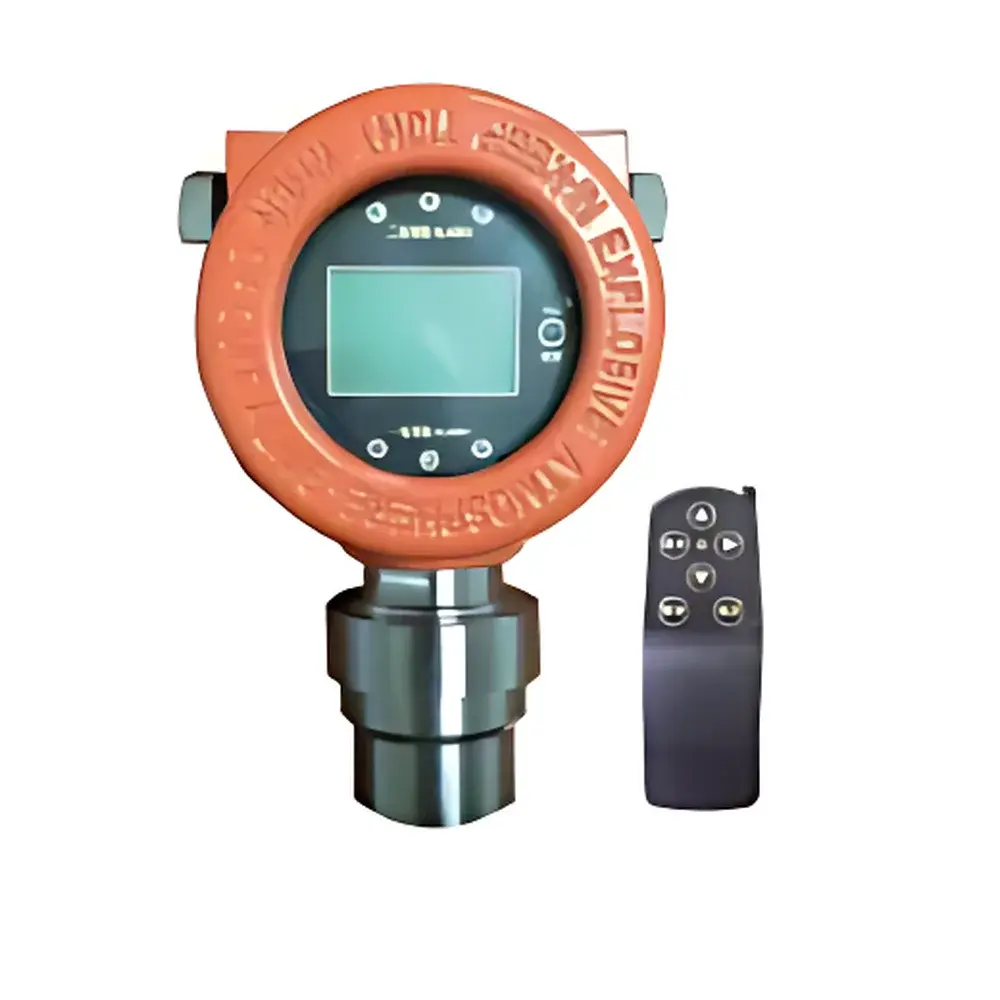
LESHI THY-FDM Fixed-Mount VOC Gas Detector
| Brand | Leshi |
|---|---|
| Origin | USA |
| Model | THY-FDM |
| Detection Principle | Photoionization Detection (PID) |
| Instrument Type | Online Continuous Monitoring Detector |
| Configuration | Total Volatile Organic Compounds (TVOC) Analyzer |
| Detection Ranges | 0–10 ppm, 0–100 ppm, 0–1000 ppm, 0–10000 ppm (selectable full-scale) |
| Resolution | 0.01 ppm (at 0–10 ppm range), 0.1 ppm (at 0–100 ppm), 1 ppm (at 0–1000 ppm), 10 ppm (at 0–10000 ppm) |
| Accuracy | ±5% of Full Scale (FS) |
| Repeatability | ±5% FS |
| Response Time | T90 ≤ 30 seconds |
| Operating Temperature | −30 °C to +50 °C |
| Operating Humidity | 10–95% RH (non-condensing) |
| Atmospheric Pressure Range | 86–115 kPa |
| Power Supply | 24 VDC (18–28 VDC), current draw ≤ 100 mA |
| Power Consumption | <2.5 W |
| Enclosure Material | Die-cast aluminum with epoxy-polyester powder coating |
| Ingress Protection | IP66 |
| Explosion Protection | Ex d IIC T6 Gb |
| Dimensions (L×W×H) | 144 mm × 99 mm × 108.5 mm |
| Weight | 1.4 kg |
| Installation Options | Wall-mount, pipe-insertion, or gas-injection mounting |
| Output Signals | 4–20 mA (3-wire), RS-485 Modbus RTU (4-wire) |
| Cable Specifications | RVVP 3×1.0 mm² (4–20 mA), RVVP 4×1.0 mm² (RS-485) |
| Maximum Signal Transmission Distance | ≤ 1000 m |
| Sensor Lifetime | 2–3 years |
| Compatibility | Integrates with third-party DCS, PLC, and analog-input gas alarm controllers |
Overview
The Leshi THY-FDM Fixed-Mount VOC Gas Detector is an industrial-grade, continuous online monitoring instrument engineered for reliable, long-term detection of total volatile organic compounds (TVOC) in ambient air or process streams. It employs a high-stability ultraviolet photoionization detector (PID) sensor—optimized for broad-spectrum response across C2–C12 hydrocarbons, aromatics, ketones, aldehydes, and other photoionizable VOCs—with ionization energy of 10.6 eV. Unlike catalytic bead or electrochemical sensors, the PID principle enables non-destructive, real-time quantification without cross-sensitivity to CO₂, methane, or humidity-induced drift. The detector integrates a dedicated microcontroller unit (MCU) for embedded signal conditioning, temperature compensation, and digital linearization, ensuring consistent performance across its four selectable measurement ranges (0–10 ppm to 0–10,000 ppm). Designed for permanent installation in demanding environments, the THY-FDM delivers stable baseline operation under variable pressure (86–115 kPa), wide thermal conditions (−30 °C to +50 °C), and high-humidity exposure (up to 95% RH, non-condensing).
Key Features
- Explosion-proof housing certified to Ex d IIC T6 Gb per IEC 60079-1 and ATEX 2014/34/EU—suitable for Zone 1 and Zone 2 hazardous areas in petrochemical, refinery, and solvent-handling facilities.
- Ingress protection rated IP66 per IEC 60529—fully sealed against dust ingress and powerful water jets, enabling outdoor or washdown-area deployment.
- Dual-output interface: isolated 4–20 mA analog output (3-wire) compliant with NAMUR NE43, plus RS-485 Modbus RTU (4-wire) for bidirectional communication with SCADA, DCS, or centralized safety systems.
- Robust die-cast aluminum enclosure with UV-resistant epoxy-polyester coating—resistant to corrosion from H₂S, Cl₂, SO₂, and common industrial solvents.
- Configurable dual-stage alarm logic with visual LED indicators (pre-alarm and alarm), supporting integration into external gas alarm controllers or emergency shutdown systems.
- Low-power design (<2.5 W) compatible with intrinsically safe barriers and redundant 24 VDC power supplies; operates within 18–28 VDC input tolerance.
Sample Compatibility & Compliance
The THY-FDM is validated for continuous sampling of ambient air, ducted ventilation exhaust, and low-velocity process gas streams. Its PID sensor responds to over 1,000 VOC species—including benzene, toluene, xylene, acetone, isopropanol, ethyl acetate, and formaldehyde—with sensitivity thresholds appropriate for occupational exposure limit (OEL) monitoring (e.g., OSHA PEL, ACGIH TLV) and environmental compliance (EPA Method 21, ISO 16000-6). While not intended for quantitative speciation, the instrument meets functional requirements for TVOC screening per ISO 16017-1 and EN 13725. Its construction and documentation support traceability under ISO 9001 quality management systems, and its alarm outputs are configurable to align with SIL 2-capable safety instrumented systems (SIS) when integrated via certified gateways. The device does not require calibration gases for routine operation but supports span-check verification using certified isobutylene or n-hexane standards.
Software & Data Management
The THY-FDM operates autonomously without host software; however, its RS-485 Modbus RTU interface enables seamless integration into enterprise-level data acquisition platforms such as Siemens Desigo CC, Honeywell Experion PKS, or custom LabVIEW/Python-based dashboards. All configuration parameters—including range selection, alarm thresholds, damping time, and zero/span offset correction—are programmable remotely via Modbus registers. Event logging (alarm activation, fault codes, sensor saturation) is retained in non-volatile memory for post-event forensic analysis. While the detector itself does not store historical trend data, it supports time-synchronized polling at user-defined intervals (1–60 s), allowing third-party historians to reconstruct concentration profiles with timestamp accuracy better than ±100 ms. For regulated environments (e.g., pharmaceutical cleanrooms or EPA Title V reporting), the system architecture supports audit-trail-ready implementations when paired with 21 CFR Part 11-compliant data servers and electronic signature workflows.
Applications
- Continuous leak detection in chemical storage tanks, loading arms, and vapor recovery units (VRUs)
- Indoor air quality (IAQ) monitoring in laboratories, paint booths, printing facilities, and semiconductor fabrication cleanrooms
- Process safety monitoring upstream of thermal oxidizers or carbon adsorption beds
- Compliance verification for fugitive emissions under EPA LDAR programs (40 CFR Part 60, Subpart VV)
- Real-time exposure assessment for workers handling solvents, adhesives, or cleaning agents
- Integration into fire and gas (F&G) systems for early warning of solvent vapor accumulation in confined spaces
FAQ
What VOC compounds does the THY-FDM detect?
It detects photoionizable VOCs with ionization potentials below 10.6 eV—including aromatic hydrocarbons (e.g., benzene, xylenes), aliphatic hydrocarbons (C2–C12), ketones (e.g., acetone, MEK), aldehydes (e.g., formaldehyde), and chlorinated solvents (e.g., chloroform, trichloroethylene). Methane, ethane, and CO₂ are not detected.
Is field calibration required?
Zero calibration is performed automatically during power-up or via manual command; span calibration using certified isobutylene (or equivalent) is recommended every 3–6 months depending on exposure history and regulatory requirements.
Can the THY-FDM be installed in outdoor environments?
Yes—its IP66-rated enclosure and −30 °C to +50 °C operating range permit direct outdoor mounting, though shelter from prolonged solar radiation is advised to minimize thermal stress on the sensor window.
Does it support HART protocol?
No—the THY-FDM provides only 4–20 mA (NAMUR-compliant) and RS-485 Modbus RTU interfaces. HART functionality is not implemented.
How is sensor lifetime managed?
The PID lamp and electrode assembly are rated for 2–3 years under typical industrial use. End-of-life is indicated by sustained signal drift >10% FS or failure to respond to calibration gas; replacement modules are field-swappable without recalibration tools.







