
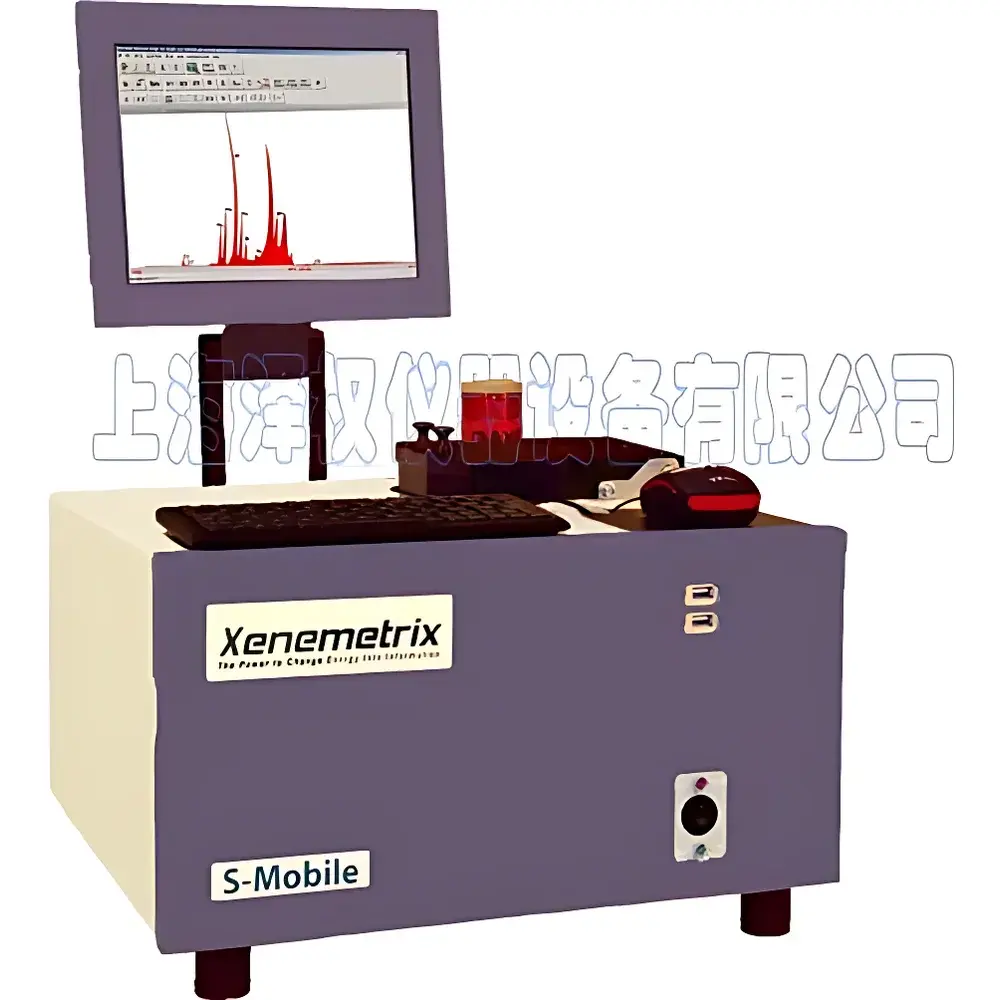
Xenemetrix S-Mobile PD/SDD Portable Energy Dispersive X-Ray Fluorescence Spectrometer
| Brand | Xenemetrix |
|---|---|
| Origin | Israel |
| Model | S-Mobile PD/SDD |
| Element Range | C(6)–Fm(100) |
| Detection Limit | sub-ppm |
| Energy Resolution | <130 eV (FWHM at 5.9 keV) |
| Repeatability | 0.1% |
| X-ray Tube | Rh anode, 50 kV / 50 W |
| Detector Options | Peltier-cooled PIN diode or Silicon Drift Detector (SDD) |
| Sample Chamber Dimensions | 121 × 112 × 45 cm |
| Weight | 25 kg |
| Compliance | ASTM D4294, D7217, ISO 20847, IP 531 |
Overview
The Xenemetrix S-Mobile PD/SDD is a field-deployable, benchtop-to-mobile energy dispersive X-ray fluorescence (ED-XRF) spectrometer engineered for quantitative and qualitative elemental analysis across a broad atomic number range—from carbon (Z = 6) to fermium (Z = 100). Utilizing direct excitation geometry with selectable Rh-target X-ray tube (50 kV, 50 W) and optional vacuum- or helium-compatible sample chamber, the system delivers laboratory-grade precision in non-destructive, ambient-air measurement environments. Its modular architecture supports both PIN diode and high-performance silicon drift detector (SDD) configurations—enabling optimized trade-offs between detection limit, count rate throughput, and spectral resolution. The instrument is purpose-built for applications requiring regulatory compliance in fuel sulfur analysis, environmental screening, alloy verification, geological surveying, and RoHS/WEEE materials compliance testing.
Key Features
- Full-spectrum elemental coverage from C to Fm—enabling light-element analysis without vacuum or helium purge in standard configuration; ULS (Ultra-Low Sulfur) variant achieves sub-1 ppm S detection in diesel, gasoline, and distillates per ASTM D4294 and ISO 20847.
- Rh-anode microfocus X-ray tube operating at 50 kV/50 W, coupled with three-position manual filter selection for optimized excitation of specific element groups (e.g., transition metals, halogens, or light elements).
- Two detector options: thermoelectrically cooled PIN diode (PD) for cost-sensitive field use, or high-resolution SDD (129 eV FWHM at 5.9 keV) supporting >500,000 cps count rates and improved peak separation for overlapping K/L lines.
- Integrated Windows-based computing platform with embedded nEXt™ analytical software suite—featuring fundamental parameters (FP) quantification, empirical calibration, and automated spectral deconvolution.
- Robust mechanical design: 25 kg total mass, shock-absorbing chassis, and optional vehicle-mounting hardware—including 12 V DC inverter support and vibration-damping base plate for mobile lab deployment.
- Go/No-go mode via optional Easy nEXt™ software—ideal for rapid pass/fail screening in production QA, scrap sorting, or field enforcement scenarios.
Sample Compatibility & Compliance
The S-Mobile accommodates solid, powder, liquid, and irregularly shaped samples up to 121 × 112 × 45 cm within its sealed sample chamber. No sample preparation is required for most homogeneous matrices; flat-surface solids can be analyzed directly, while powders and liquids are measured in disposable cups or sealed cells. The system meets stringent regulatory requirements for fuel analysis—including ASTM D4294 (sulfur in petroleum), D7217 (low-sulfur diesel), ISO 20847 (petroleum products), and IP 531 (determination of sulfur content)—without mandatory helium purging. All firmware and data handling modules comply with GLP/GMP documentation principles, supporting audit-ready reporting and full traceability of acquisition parameters, calibration history, and user actions.
Software & Data Management
nEXt™ software provides a unified interface for instrument control, spectrum acquisition, real-time processing, and report generation. Core capabilities include FP-based matrix correction, multi-layer thin-film analysis, and empirical calibration with internal standardization. Data files are stored in vendor-neutral formats (e.g., .csv, .txt, .rpt) with embedded metadata (date/time, operator ID, measurement conditions). Optional FDA 21 CFR Part 11-compliant module enables electronic signatures, role-based access control, and immutable audit trails—essential for regulated laboratories undergoing ISO/IEC 17025 accreditation or pharmaceutical QC validation. Software updates are delivered via secure HTTPS channel with cryptographic signature verification.
Applications
- Fuel quality assurance: Ultra-low sulfur monitoring in diesel, jet fuel, marine gasoil, and refinery streams.
- Environmental field screening: Soil, sediment, and sludge analysis for heavy metals (Pb, As, Cd, Hg) and nutrients (P, K, Ca).
- Metallurgical QA/QC: Rapid grade identification of stainless steels, aluminum alloys, and high-temperature superalloys.
- Geosciences: In-situ rock and ore characterization during exploration campaigns or core logging.
- Consumer product safety: Screening for restricted substances (Br, Cl, Pb, Cd, Cr, Hg) per RoHS 3, POPs, and CPSIA directives.
- Archaeological and forensic material provenance: Non-invasive pigment, glass, and ceramic composition mapping.
FAQ
Does the S-Mobile require helium or vacuum for light-element analysis?
No—the standard configuration uses an ultra-thin beryllium window and optimized Rh-tube excitation to achieve reliable C–F detection in ambient air. Helium purge is optional and only recommended for sub-ppm carbon or fluorine quantification in specialized applications.
What is the difference between PD and SDD detector versions?
The PD version employs a Peltier-cooled PIN diode with ~155 eV resolution at 5.9 keV and moderate count-rate capability; the SDD version offers 500 kcps), and superior peak-to-background ratio—critical for complex multi-element spectra or low-concentration trace analysis.
Can the instrument be calibrated for custom matrices?
Yes—nEXt™ supports user-defined FP models, empirical calibrations using certified reference materials (CRMs), and hybrid approaches combining both. Calibration libraries can be exported/imported and validated per ISO 11097 or ASTM E1621 protocols.
Is remote diagnostics and firmware update supported?
Yes—via encrypted Ethernet or Wi-Fi connection, technicians can perform real-time performance diagnostics, spectral health checks, and over-the-air firmware upgrades with rollback capability and version-controlled release notes.
How is data integrity ensured during field operation?
All acquisitions are timestamped, digitally signed, and written to write-once-read-many (WORM) storage partitions. Audit logs record operator login, method selection, parameter changes, and result exports—fully compliant with ALCOA+ (Attributable, Legible, Contemporaneous, Original, Accurate, Complete, Consistent, Enduring, Available) data governance principles.
Related Products





