
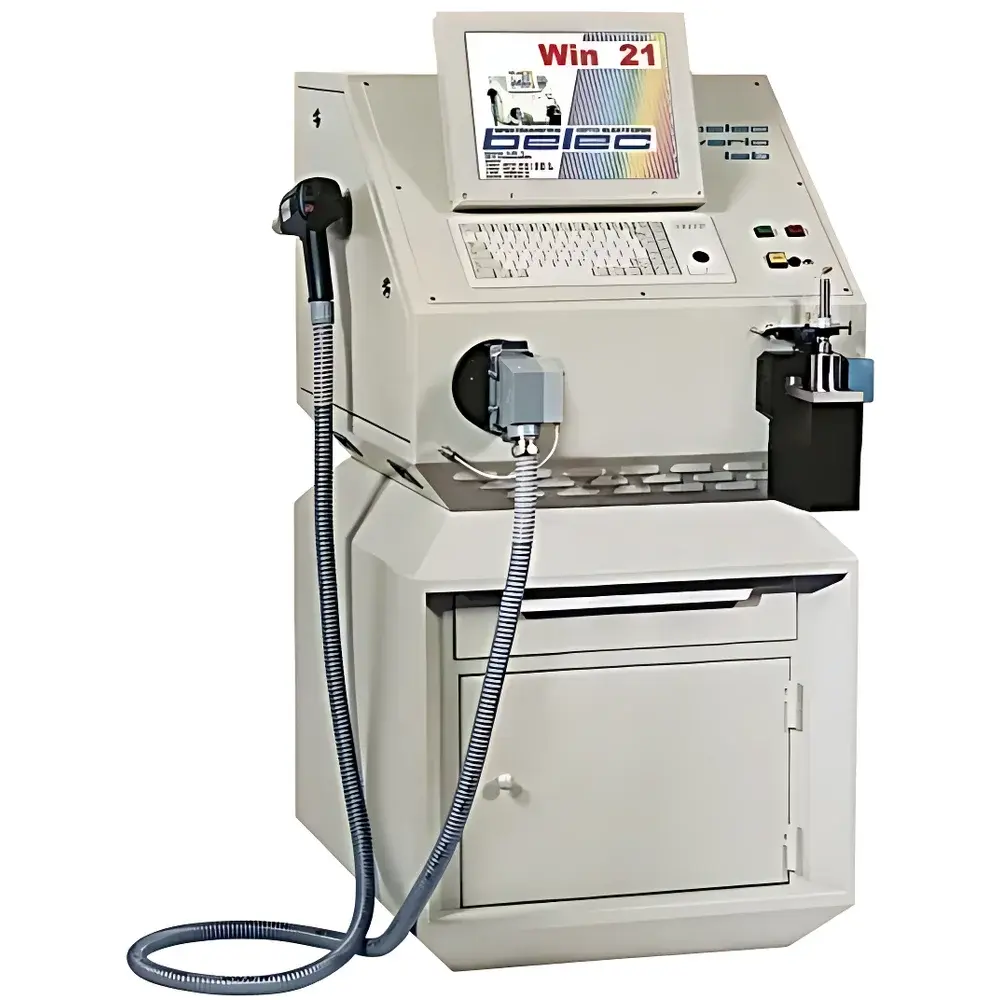
Belec Vario Lab Floor-Standing Direct-Reading Optical Emission Spectrometer
| Brand | Belec |
|---|---|
| Origin | Germany |
| Model | Belec Vario Lab |
| Instrument Type | Floor-standing |
| Excitation Method | Spark |
| Detector Type | Charge-Coupled Device (CCD) |
| Focal Length | 500 mm |
| Grating Groove Density | 3600 lines/mm |
| Wavelength Range | 120–430 nm |
| Number of Channels | 108 |
Overview
The Belec Vario Lab is a high-performance, floor-standing direct-reading optical emission spectrometer (OES) engineered for precise, multi-element quantitative analysis of metallic materials in laboratory and quality control environments. Based on spark source atomic emission spectroscopy (Spark-OES), the instrument excites solid metal samples using controlled high-voltage spark discharges, generating characteristic atomic line spectra that are dispersed by a high-resolution Czerny–Turner optical system and detected with a thermoelectrically cooled CCD array. Its 500 mm focal length Paschen–Runge mounting configuration—combined with a 3600 lines/mm holographic grating—delivers exceptional spectral resolution and signal-to-noise ratio across the vacuum ultraviolet to near-UV range (120–430 nm), enabling reliable detection and quantification of critical light elements including carbon (C), phosphorus (P), sulfur (S), and nitrogen (N). Designed and manufactured in Germany, the Vario Lab meets stringent engineering standards for long-term stability, thermal drift compensation, and reproducible plasma excitation.
Key Features
- Modular triple-spectrometer architecture: Supports up to three independent optical chambers, enabling simultaneous optimization for different spectral regions or analytical requirements.
- Multi-matrix capability: Configurable for up to 11 base materials (e.g., Fe, Al, Cu, Mg, Zn, Ni, Ti, Co, Pb, Sn, Cr), each with dedicated calibration curves and up to 108 fully programmable analytical channels.
- Dual independent spark stands: Physically isolated measurement stations allow rapid switching between dissimilar matrices (e.g., steel and aluminum) without cross-contamination or recalibration delays.
- Three interchangeable spark probes: Includes flat-surface, curved-surface, and micro-spot probes—enabling non-destructive or minimally invasive analysis of large, irregular, or heat-sensitive components without sample preparation.
- Flexible optical environment options: Selectable argon-purged or vacuum-sealed spectrometer chambers ensure optimal transmission below 190 nm for robust light-element analysis.
- Robust mechanical design: Heavy-duty floor-standing chassis with vibration-damping feet and temperature-stabilized optics housing ensures operational reliability under variable ambient conditions.
- High-precision spark generator: Digitally controlled discharge parameters (energy, frequency, pre-spark duration) support method-specific excitation protocols compliant with ASTM E415, ISO 11577, and EN 10052.
Sample Compatibility & Compliance
The Belec Vario Lab accommodates an extensive range of metallic specimens—from 0.5 mm diameter wire to oversized castings or structural components with no upper dimensional limit. Sample geometry flexibility is enhanced by motorized stage positioning and optional height-adjustable spark stands. The system supports full traceability and audit readiness: all measurements include timestamped metadata, user authentication logs, and configurable electronic signatures. Software workflows comply with GLP and GMP documentation requirements; data export formats (CSV, XML, PDF) facilitate integration into LIMS and ERP systems. Optional 21 CFR Part 11-compliant software modules provide electronic record integrity, audit trails, and role-based access control.
Software & Data Management
The Belec Analytical Software Suite provides intuitive, context-aware operation via a fully localized interface (10+ languages, including English, German, French, Spanish, Chinese, Japanese). Core functions include automated calibration validation, drift correction using internal reference lines, matrix-matched standardization, and real-time interference correction. All analytical methods are stored as encrypted, version-controlled templates with embedded uncertainty estimates. Raw spectral data (intensity vs. pixel position) and processed results are archived in vendor-neutral HDF5 format. Remote diagnostics, firmware updates, and method synchronization are supported over secure TLS-enabled network connections.
Applications
The Vario Lab serves metallurgical laboratories, foundries, aerospace component suppliers, and third-party testing facilities requiring certified elemental composition data for incoming material inspection, process control, and final product release. Typical use cases include low-carbon steel grade verification (C ≤ 0.005%), sulfur segregation mapping in stainless steels, phosphorus content control in bearing alloys, nitrogen determination in duplex stainless steels and superalloys, and rapid sorting of scrap metal streams. Its dual-stand configuration significantly reduces turnaround time in high-mix production environments where multiple alloy families are routinely tested.
FAQ
What light elements can the Belec Vario Lab reliably quantify?
Carbon (C), phosphorus (P), sulfur (S), and nitrogen (N) are routinely measured with sub-ppm detection limits in optimized configurations—particularly when using vacuum optics or high-purity argon purge.
Is the instrument suitable for regulatory compliance reporting?
Yes—when configured with validated methods and 21 CFR Part 11 software options, it supports FDA, ISO/IEC 17025, and EN 10002-1 accredited reporting workflows.
Can the system be integrated into an existing laboratory network?
It supports standard Ethernet (TCP/IP), OPC UA, and MODBUS TCP protocols for bidirectional communication with LIMS, MES, and SCADA systems.
What maintenance intervals are recommended?
Optical chamber purging gas filters require replacement every 6 months; spark stand electrodes are consumables with typical lifespans of 5,000–10,000 sparks depending on matrix and excitation energy.
Does Belec offer application support for method development?
Yes—Belec’s global application labs provide remote and on-site method transfer, custom calibration development, and ISO 17025-compliant validation documentation.




