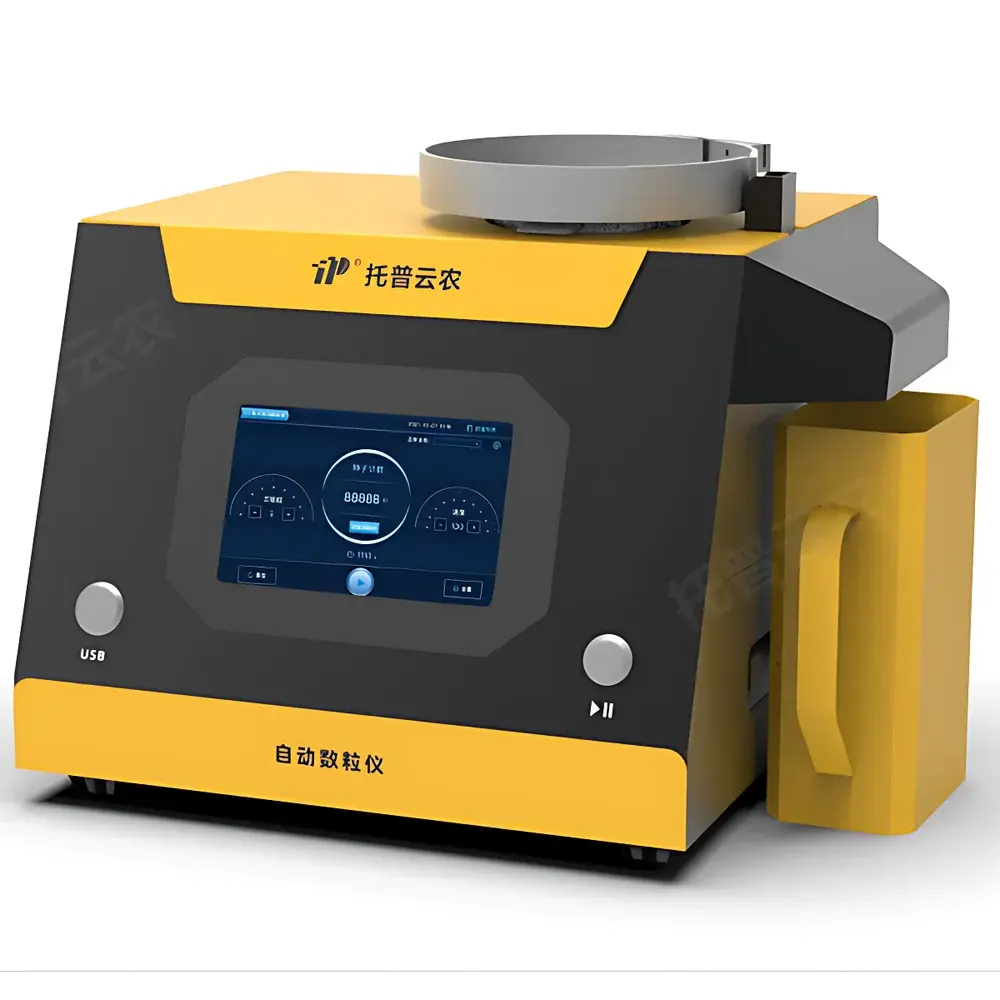
Top Cloud-agri SLY-D Electronic Automatic Seed Counter
| Brand | Top Cloud-agri |
|---|---|
| Origin | Zhejiang, China |
| Manufacturer Type | Direct Manufacturer |
| Country of Origin | China |
| Model | SLY-D |
| Pricing | Upon Request |
| Touchscreen | 7-inch Color TFT LCD |
| Pre-set Counting | Yes (Auto-stop at target) |
| Data Logging | Yes (Variety name, count, timestamp) |
| Export Format | Excel via USB drive |
| Seed Length Range | 1–23 mm |
| Counting Accuracy | ±0.2% (subject to seed morphology, vibration-induced chaff loss) |
| Counting Speed | ≥1,000 seeds / 3 min (e.g., sesame) |
| Noise Level | ≤80 dB(A) |
| Max Count Capacity | 1–99,999 |
| Dimensions (L×W×H) | 370 × 365 × 315 mm |
| Net Weight | 19.5 kg |
| Power Input | Dual-voltage compatible — 220 VAC/50 Hz or 110 VAC/60 Hz |
| Power Consumption | 15 W |
Overview
The Top Cloud-agri SLY-D Electronic Automatic Seed Counter is a precision-engineered, microprocessor-controlled instrumentation system designed for high-throughput, repeatable seed enumeration in agricultural research, seed certification laboratories, breeding programs, and quality control environments. Based on optical detection coupled with controlled vibratory feed mechanics, the instrument identifies individual seeds as they pass through a defined sensing zone via synchronized LED illumination and high-sensitivity photodiode array detection. This principle ensures reliable discrimination of intact seeds within the specified 1–23 mm length range—covering major cereal, oilseed, horticultural, and ornamental species including rice, wheat, maize, rapeseed, sesame, vegetables, and flower varieties. Unlike manual counting or basic mechanical counters, the SLY-D integrates real-time motion compensation algorithms to minimize miscounts caused by overlapping, adhesion, or debris—a critical requirement for GLP-compliant seed lot testing and ISTA-certified germination assay preparation.
Key Features
- 7-inch full-color TFT touchscreen interface with intuitive icon-based navigation and dynamic visual feedback—optimized for glove-compatible operation in field labs and greenhouse environments.
- Programmable target counting with auto-halt functionality: users define a precise seed count (1–99,999); the device stops feeding and signals completion upon reaching the threshold, enabling unattended batch processing.
- Integrated data logger captures timestamped records per measurement session—including cultivar identifier, counted quantity, start/end time, operator ID (optional), and system diagnostics.
- USB-host port supports direct export of all logged entries to standard .xlsx format, facilitating traceability, audit readiness, and integration with LIMS or seed management databases.
- Dual-voltage universal power supply (110 VAC/60 Hz or 220 VAC/50 Hz) ensures operational flexibility across international field stations and collaborative research networks.
- Low-noise (<80 dB[A]) vibration motor and acoustic-dampened chassis enable use in shared laboratory spaces without compromising adjacent instrumentation stability.
Sample Compatibility & Compliance
The SLY-D accommodates a broad morphological spectrum of dry, free-flowing seeds—from small, spherical sesame (1–3 mm) to elongated maize kernels (up to 23 mm). Performance validation follows ISO 5725-2 (accuracy and precision of measurement methods) and aligns with ISTA Rules Section 5 (Seed Sampling and Testing), particularly for purity analysis workflows requiring rapid, objective seed quantification prior to germination or vigor assays. While not an analytical balance, its ±0.2% counting accuracy meets routine QC thresholds for certified seed lots under national regulatory frameworks (e.g., China’s NY/T 2212-2012, USDA-FSA seed certification protocols). The device does not require calibration against reference standards but recommends periodic verification using NIST-traceable seed reference samples.
Software & Data Management
Firmware is embedded and non-upgradable via external network; all configuration and data handling occur locally on-device. Each record includes ISO 8601-formatted timestamps, user-defined variety codes (up to 32 characters), and cycle metadata. Exported Excel files contain structured columns compliant with FAO’s Seed Information System (SIS) minimum data fields. No cloud connectivity or remote access is implemented—ensuring full data sovereignty and compliance with institutional IT security policies. Audit trails are retained in volatile memory only during active sessions; permanent logs reside solely in exported files, supporting 21 CFR Part 11-aligned documentation practices when paired with institutional electronic signature protocols.
Applications
- Pre-germination seed counting for ISTA-standardized purity analysis and thousand-kernel weight (TKW) determination.
- High-volume seed packaging line verification and batch reconciliation in commercial seed production facilities.
- Phenotypic screening in plant breeding programs where rapid enumeration of segregating populations (e.g., F₂ or BC₁ progeny) is required.
- Teaching laboratories for agronomy and plant science curricula—demonstrating statistical sampling theory, measurement uncertainty, and metrological traceability.
- Seed bank inventory audits and long-term storage viability monitoring via periodic sample re-counting.
FAQ
What seed types have been validated for use with the SLY-D?
Rice, wheat, maize, rapeseed, sesame, soybean, tomato, lettuce, and petunia seeds have undergone internal repeatability testing; performance on irregularly shaped or highly textured seeds (e.g., cotton lint, flax) may require manual pre-screening.
Is the counting accuracy affected by seed moisture content?
Yes—optimal performance requires seeds at equilibrium moisture content (typically 5–12% w.b.); excessively dry or damp seeds increase static adhesion or clumping, elevating error rates beyond ±0.2%.
Can the device be integrated into a laboratory information management system (LIMS)?
Direct API or HL7 integration is not supported; however, exported Excel files can be ingested programmatically via Python/Pandas or ETL pipelines configured by the end-user’s IT team.
Does the SLY-D meet any international electromagnetic compatibility (EMC) or safety standards?
It complies with GB 4793.1-2007 (China’s equivalent to IEC 61010-1) for electrical safety and GB/T 18268.1-2010 (IEC 61326-1) for EMC in laboratory environments.