
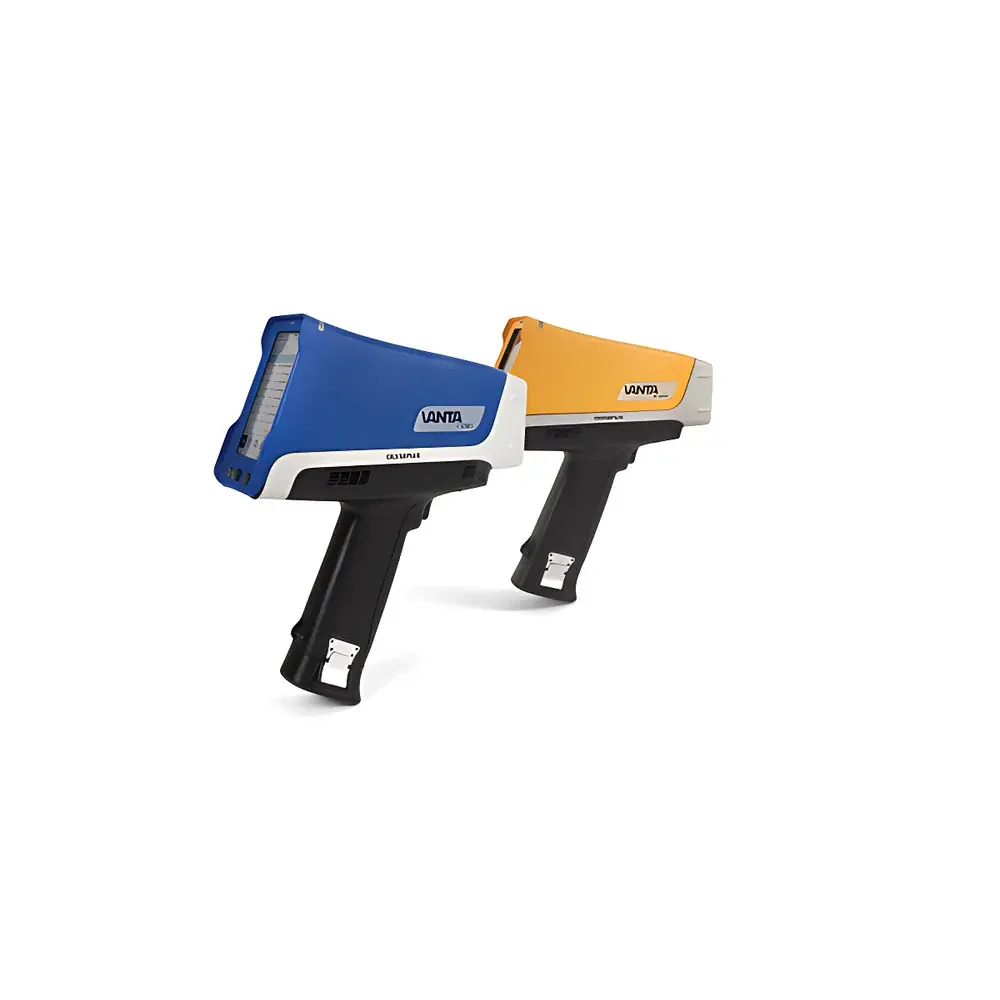
Olympus Vanta Handheld Energy Dispersive X-Ray Fluorescence Spectrometer
| Brand | Olympus |
|---|---|
| Origin | USA |
| Manufacturer Type | Authorized Distributor |
| Origin Category | Imported |
| Model | Vanta |
| Application | Handheld / Portable |
| Industry Type | General Purpose |
| Elemental Range | Mg to U |
| Detection Range | 1 ppm – 99.99% |
| Energy Resolution | <140 eV |
| Repeatability | 0.1% |
Overview
The Olympus Vanta Handheld Energy Dispersive X-Ray Fluorescence (ED-XRF) Spectrometer is an industrial-grade, field-deployable elemental analyzer engineered for laboratory-grade accuracy under real-world operating conditions. Based on the fundamental principle of energy-dispersive X-ray fluorescence—where primary X-rays excite sample atoms, causing emission of characteristic secondary X-rays—the Vanta delivers quantitative and qualitative elemental composition data across the Mg–U range (atomic number 12–92). Its ruggedized architecture supports continuous operation in ambient temperatures from –10 °C to +50 °C, making it suitable for outdoor, plant-floor, scrap yard, mining, and environmental site investigations where portability, speed, and analytical reliability are critical. Unlike benchtop ED-XRF systems, the Vanta integrates source stability, detector shielding, and spectral deconvolution algorithms into a single handheld platform compliant with ISO 8596:2020 (XRF performance verification) and aligned with ASTM E1621–22 (standard guide for elemental analysis by portable XRF).
Key Features
- Ruggedized hardware certified to MIL-STD-810G for drop resistance (up to 1.5 m onto concrete), ensuring mechanical integrity during field deployment.
- IP65-rated enclosure providing full protection against dust ingress and low-pressure water jets—validated per IEC 60529.
- Axon Technology: proprietary ultra-low-noise electronics enabling high-count-rate spectral acquisition (>100,000 cps typical), improved peak-to-background ratio, and enhanced light-element sensitivity (Mg, Al, Si, P, S).
- Integrated quad-core processor accelerating spectrum processing, calibration application, and real-time quantification—reducing analysis time to under 1–3 seconds for alloy identification and under 10–30 seconds for trace-level soil or ore screening.
- Optional 5-megapixel wide-angle camera with geotagging; captures contextual images synchronized with XRF spectra and GPS coordinates (±3 m CEP) for spatial data correlation.
- Field-configurable user interface with customizable home screen widgets, glove-compatible tactile controls, and sunlight-readable capacitive touchscreen (800 × 480 resolution, 262K colors).
- Onboard Wi-Fi 802.11n and Bluetooth 4.2 modules supporting secure data streaming to local networks or cloud-hosted LIMS platforms via TLS 1.2 encryption.
Sample Compatibility & Compliance
The Vanta accommodates heterogeneous solid samples—including metals, ores, soils, slags, catalysts, coatings, and electronic components—without requiring pelletization or vacuum environments. Its collimated X-ray beam (3 mm or 8 mm spot size, depending on model) minimizes matrix effects while enabling micro-area analysis. Detector shutter mechanisms (standard on C and M series) protect the silicon drift detector (SDD) from physical contact damage when analyzing rough or irregular surfaces. The system supports method-based analysis workflows compliant with ISO 17025:2017 (general requirements for competence of testing and calibration laboratories) and facilitates audit-ready documentation required for EPA Method 6200, RoHS Directive 2011/65/EU, and WEEE compliance screening. All firmware and calibration files maintain version-controlled revision history for GLP/GMP traceability.
Software & Data Management
Vanta instruments run on Olympus’ proprietary Olympus Scientific Software (OSS), which supports configurable analysis modes: Alloy ID, Mining Mode, Soil Mode, Consumer Goods Screening, and Custom Quantitative Methods. OSS includes embedded spectral library matching (NIST SRM reference libraries), fundamental parameters (FP) quantification, and empirical calibration tools. Data export options include CSV, PDF reports, and XML metadata packages compatible with LabWare LIMS, Thermo Fisher SampleManager, and custom SQL database ingestion. Audit trail functionality logs all user actions—including method changes, calibration updates, and result edits—with timestamps and operator IDs, satisfying FDA 21 CFR Part 11 electronic record/electronic signature requirements. Cloud synchronization enables remote fleet management, over-the-air firmware updates, and centralized calibration validation across multi-site deployments.
Applications
- Positive Material Identification (PMI) for piping, valves, and pressure vessels in oil & gas and power generation facilities.
- Grade sorting and scrap metal recycling with rapid pass/fail decision logic based on UNS, EN, or GB standards.
- Geochemical exploration and mine face mapping using real-time elemental ratios (e.g., Cu/Zn, Ni/Co, REE patterns).
- Environmental site assessment for heavy metals (Pb, As, Cd, Hg) in soils and sediments per EPA Region 9 protocols.
- RoHS/WEEE compliance screening of electronics, plastics, and painted surfaces for restricted substances.
- Archaeological and art conservation analysis of pigments, ceramics, and metal artifacts without sampling.
FAQ
Does the Vanta require external cooling or vacuum pumping?
No. The Vanta uses a Peltier-cooled silicon drift detector and operates at atmospheric pressure—no liquid nitrogen or vacuum pumps are needed.
Can the instrument be calibrated in-house?
Yes. OSS supports user-defined calibrations using certified reference materials (CRMs); calibration verification checks are performed automatically before each analysis session.
Is radiation safety certification required for operators?
The Vanta complies with ANSI N43.3–2022 and IEC 62495:2010 for handheld XRF devices. In most jurisdictions, no operator license is required, but site-specific radiation safety plans must be implemented per local regulatory authority guidance.
How is data integrity maintained during wireless transmission?
All Wi-Fi and Bluetooth communications use AES-256 encryption and certificate-based authentication; raw spectral data remains unaltered during transfer and retains original acquisition metadata.
What is the expected lifetime of the X-ray tube?
The rhodium-anode microfocus X-ray tube is rated for ≥10,000 hours of operational life under standard duty cycles, with predictive maintenance alerts triggered via OSS diagnostics.





