
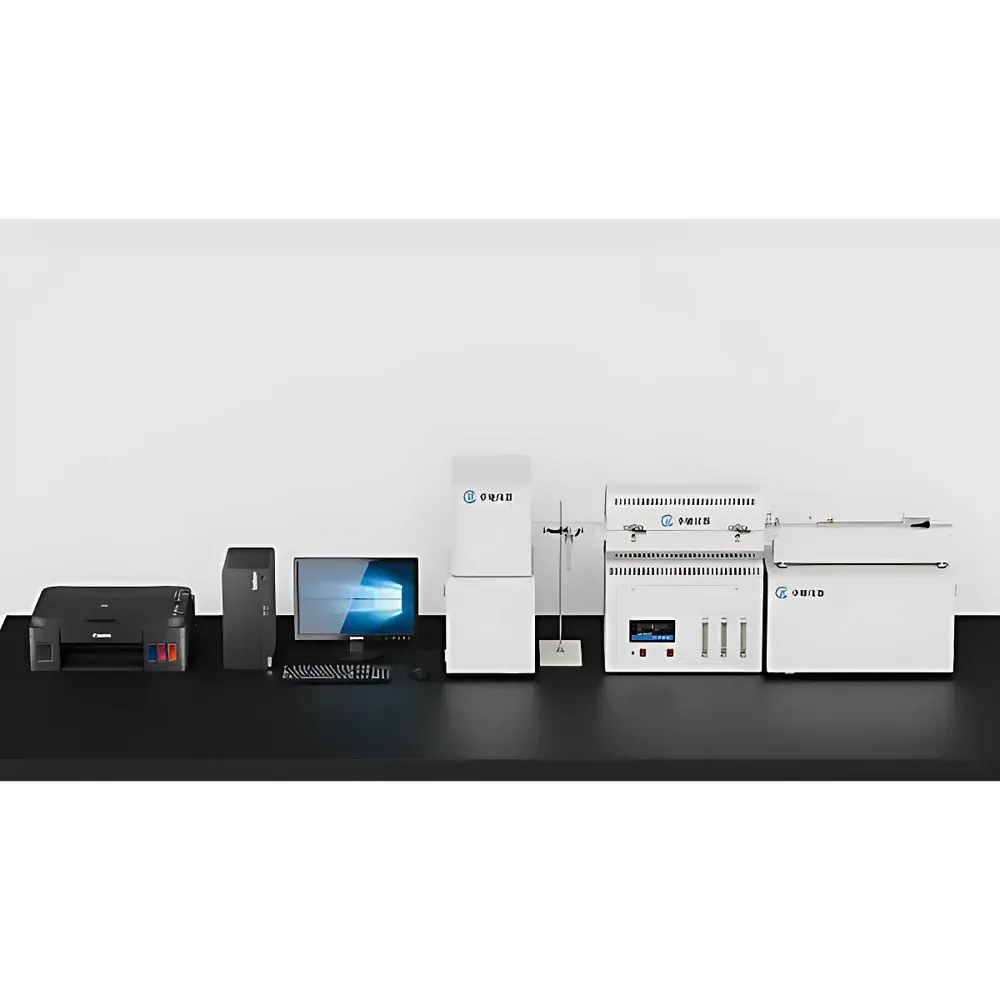
Zhuochi AOX-WK-3 Halogen Analyzer for Paper & Pulp Industry
| Brand | Zhuochi |
|---|---|
| Origin | Zhejiang, China |
| Model | AOX-WK-3 |
| Measurement Principle | Combustion-Microcoulometric Titration |
| Detection Range | 0.02 mg/kg – 2 mg/kg |
| Accuracy | ±1 µg Cl |
| Repeatability | ≤10% RSD at sample concentration <2 mg/kg |
| Limit of Detection (LOD) | 0.028 mg/L |
| Resolution | 1 µg Cl |
| Compliance | GB/T 34845-2017, GB/T 22904-2008, GB/T 35613-2017, GB/T 39084-2020, GB/T 35611-2017, GB/T 41533-2022 |
Overview
The Zhuochi AOX-WK-3 Halogen Analyzer is a dedicated microcoulometric system engineered for the precise quantification of adsorbable organic halogens (AOX) in paper, pulp, tissue, packaging materials, and related cellulose-based substrates. It operates on the internationally recognized combustion-microcoulometric titration principle: samples are thermally combusted in a high-temperature quartz furnace (≥950 °C) under controlled oxygen flow, converting all organic halogens (Cl, Br, I) into hydrogen halides (HX). The gaseous effluent is then absorbed in an alkaline solution, and the resulting halide ions are quantified via constant-current coulometric titration using silver electrodes — a method delivering inherent linearity, high sensitivity, and trace-level reproducibility without reliance on calibration curves. Designed specifically for compliance-driven laboratories in the paper industry, the AOX-WK-3 meets the full analytical workflow requirements of GB/T 34845-2017 (determination of AOX in household paper), GB/T 22904-2008 (total and organic chlorine in pulp and paper), and multiple green product evaluation standards including GB/T 35613-2017 and GB/T 39084-2020.
Key Features
- Integrated dual-module architecture: independent high-temperature combustion furnace (AOX-specific quartz tube design) and microcoulometric titration unit with Ag/Ag⁺ reference electrode system
- Optimized sample introduction: automated sample boat handling via precision ceramic drag boat and quartz sample cup assembly, minimizing carryover and thermal degradation artifacts
- Robust gas management: integrated vacuum pump, activated carbon adsorption trap (for SO₂/NOₓ removal), moisture-scavenging drying tube, and calibrated gas flow control (O₂ purity ≥99.995%)
- High-fidelity electrochemical detection: digital coulometer with 1 µg Cl resolution, real-time current integration, and auto-zero compensation to eliminate baseline drift
- Dedicated hardware accessories: includes AOX-compliant sample preparation workstation (fume hood-integrated), filtration assembly, certified quartz consumables (combustion tubes, sample cups), and pre-packed reagent-grade activated carbon
- Stable thermal environment: furnace temperature uniformity ±5 °C across 800–1000 °C operating range, verified per GB/T 34845-2017 Annex B
Sample Compatibility & Compliance
The AOX-WK-3 is validated for solid matrices requiring extraction-free direct combustion, including unbleached/bleached pulps, printing/writing papers, tissue products, corrugated board, molded fiber packaging, and nonwoven cellulose substrates. Liquid extracts (e.g., leachates from paper migration testing) may be introduced via absorbent filter paper pre-loading. All operational parameters align with the mandatory procedural specifications of GB/T 34845-2017, including sample mass (0.1–1.0 g), combustion temperature ramp profile, absorption solution composition (0.1 mol/L NaOH), and titration endpoint criteria (current decay threshold). The system supports full traceability documentation required under Chinese Green Product Certification frameworks (GB/T 35613, GB/T 39084) and fulfills technical evaluation criteria outlined in State Post Bureau Document No. 62 [2020] for eco-friendly express packaging.
Software & Data Management
The analyzer operates via embedded firmware with local touchscreen interface; data acquisition, titration curve visualization, peak integration, and result calculation (mg AOX/kg or mg/L) are performed in real time. Raw coulometric current vs. time datasets are exportable in CSV format for secondary analysis. While no cloud connectivity or multi-user LIMS integration is provided, the system maintains complete audit trails: each analysis record stores operator ID (manually entered), sample ID, date/time stamp, furnace temperature log, titration charge (Coulombs), calculated mass of Cl⁻, and final AOX concentration. This satisfies basic GLP documentation requirements and enables retrospective review during internal quality audits or regulatory inspections under CNAS-CL01 or CMA accreditation scopes.
Applications
- Quality control of elemental chlorine-free (ECF) and totally chlorine-free (TCF) bleaching processes in pulp mills
- Verification of AOX content in recycled fiber-based packaging to meet EU Directive 2009/48/EC and China’s Green Packaging Standard
- Supporting environmental declarations under Type III EPDs (Environmental Product Declarations) for paper products
- Monitoring halogenated contaminant carryover during deinking or waste paper repulping operations
- Method validation and interlaboratory comparison studies aligned with ISO/IEC 17025:2017 clause 7.2.2 (validation of non-standard methods)
- Research into formation mechanisms of chlorinated dioxins/furans in thermal processing of lignin-rich biomass
FAQ
What standards does the AOX-WK-3 directly support?
It is fully configured and factory-validated for GB/T 34845-2017, GB/T 22904-2008, GB/T 35613-2017, GB/T 39084-2020, and GB/T 41533-2022.
Is the instrument compliant with international equivalents such as ISO 9562 or EPA Method 1650?
While not pre-certified to ISO 9562 or EPA 1650, its combustion-titration methodology is technically equivalent; method adaptation and laboratory-specific validation per ISO/IEC 17025 are required for cross-standard use.
Can it measure bromine or iodine separately from chlorine?
No — the system reports total halogen (as Cl⁻-equivalent); speciation requires coupling with IC-MS or HR-GC/MS downstream.
What maintenance intervals are recommended for routine operation?
Quartz combustion tubes should be replaced after 200–300 analyses; activated carbon traps require replacement every 50 runs or when breakthrough is observed in blank tests.
Does the system include data integrity safeguards per 21 CFR Part 11?
No — it lacks electronic signatures, role-based access control, or audit trail encryption; it is intended for environments where paper-based SOPs and manual record verification are accepted practice.
Related Products







