
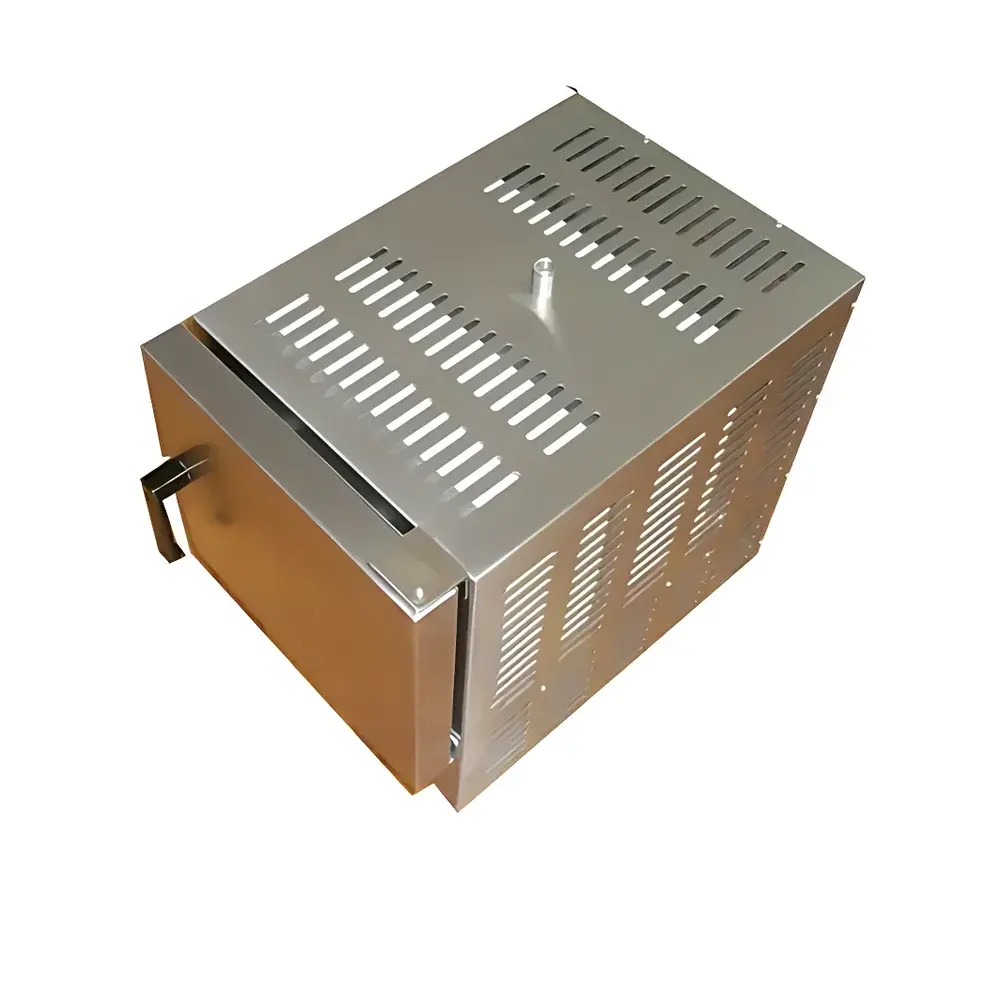
Zhuochi GMP3-10 Pharmaceutical Calcination Furnace (Box-Type Muffle Furnace)
| Brand | Zhuochi |
|---|---|
| Origin | Zhejiang, China |
| Model | GMP3-10 |
| Instrument Type | Box-Type Muffle Furnace |
| Max Temperature | 1000 °C |
| Temperature Uniformity | ±1 °C |
| Max Power | 3 kW |
| Heating Rate | ≤60 °C/min (adjustable) |
| Internal Chamber Dimensions | 300 × 200 × 150 mm |
| Heating Element | High-Temperature Resistance Wire |
| Thermocouple Type | K-Type (Chromel–Alumel) |
| Control System | LTDE Programmable PID Controller with Digital Display (1 °C resolution) |
| Safety Features | Dual-Stage Over-Temperature Protection |
| Power Supply | 220 V, 50 Hz |
| Insulation | Lightweight High-Radiation Ceramic Fiber Board (Six-Sided Modular Construction) |
| Exhaust Port | Top-Mounted Flue Outlet |
| Optional Enclosure | Cold-Rolled Steel with Epoxy Powder Coating OR 304 Stainless Steel Sealed Casing |
Overview
The Zhuochi GMP3-10 Pharmaceutical Calcination Furnace is a precision-engineered box-type muffle furnace designed for controlled thermal processing of herbal medicinal materials, mineral-based pharmaceuticals, and industrial chemical feedstocks under Good Manufacturing Practice (GMP)-compliant conditions. It operates on the principle of resistive heating via high-stability nickel-chromium resistance wire embedded within a low-thermal-mass, high-radiation ceramic fiber insulation chamber. This architecture ensures rapid thermal response, minimal energy hysteresis, and exceptional temperature homogeneity across the working zone—critical for reproducible calcination outcomes in pharmacopoeial processing (e.g., Chinese Pharmacopoeia ChP 2020 Appendix XIIC, USP Heavy Metals, and ISO 8573-1 for thermal stability validation). The furnace supports open-air calcination (ming duan), covered calcination (an duan), and quenching post-calcination (duan cui), enabling full compliance with traditional processing protocols for materials such as hematite, magnetite, oyster shell (Ostrea gigas), and mother-of-pearl (Nacre).
Key Features
- Programmable PID temperature control system (LTDE series) with 1 °C digital resolution and adjustable ramp/soak profiles—enabling precise replication of multi-stage calcination cycles (e.g., 300 °C → hold 30 min → ramp to 850 °C → hold 60 min).
- Dual-stage over-temperature protection: primary controller cutoff + independent mechanical safety limiter, certified per IEC 61000-6-2 EMC immunity and IEC 61000-6-4 emission standards.
- Modular six-sided ceramic fiber chamber (density: ~220 kg/m³, service temperature: 1260 °C) providing thermal inertia <0.8 kJ/K and heat loss <1.2 kW/m² at 1000 °C—validated per ASTM C177 for guarded-hot-plate thermal conductivity.
- Top-mounted flue port (Ø60 mm) compatible with standard laboratory fume extraction ducting; optional connection to activated carbon or alkaline scrubber systems for sulfur- or ammonia-bearing volatiles.
- Two enclosure variants: electrophoretically coated cold-rolled steel (RAL 7035) or fully welded 304 stainless steel (ASTM A240, Ra ≤ 0.8 µm surface finish)—both meet ISO 14644-1 Class 8 cleanroom compatibility requirements when installed in controlled environments.
- Integrated stainless steel flat-bottom calcination pan (included), optimized for uniform heat transfer and mechanical handling of granular or fragmented botanical/mineral samples.
Sample Compatibility & Compliance
The GMP3-10 accommodates solid-phase samples up to 5 kg batch mass, including brittle mineral matrices (e.g., limonite, calcite), biogenic carbonates (oyster shell, cuttlebone), and organometallic complexes requiring oxidative decomposition. Its chamber geometry (300 × 200 × 150 mm) permits simultaneous processing of multiple standardized porcelain crucibles (max Ø80 mm × 60 mm height) without airflow obstruction. The furnace meets structural and operational prerequisites for GLP-compliant thermal validation per FDA 21 CFR Part 58 and EU Annex 11 (Computerized Systems), supporting IQ/OQ/PQ documentation packages. All electrical components—including solid-state relays (Crydom D2425), contactors (Schneider TeSys LC1D), and cooling fans (NMB-MAT 4010KL-04W-B50)—carry CE, UL Recognized Component, and RoHS 2011/65/EU certifications.
Software & Data Management
While the LTDE controller operates as a standalone programmable unit (no PC interface required), its RS485 Modbus RTU output enables integration with third-party SCADA platforms (e.g., Ignition, Siemens Desigo CC) for centralized thermal log archival. Data logging includes timestamped setpoint/actual temperature pairs, soak duration, power consumption (via external kWh meter), and alarm event codes (E01 = thermocouple break, E02 = over-temp trigger). Audit trails comply with 21 CFR Part 11 requirements when paired with validated electronic signature modules and role-based access controls on host systems. Raw thermal profiles are exportable as CSV for statistical process control (SPC) analysis using JMP or Minitab.
Applications
- Pharmaceutical manufacturing: Calcination of raw herbal materials per ChP monographs (e.g., Sheng Mu Li → Chao Mu Li; Zhe Bei Mu → Chao Zhe Bei Mu) to reduce toxicity, enhance solubility, or modify crystal lattice structure.
- Quality control laboratories: Thermal degradation studies of excipients (e.g., calcium carbonate, magnesium stearate) under accelerated aging protocols (ICH Q1A).
- Materials research: Pre-sintering of ceramic precursors, ash content determination (AOAC 942.05), and catalyst support activation (e.g., γ-Al₂O₃ calcination at 550 °C).
- Chemical synthesis: Solvent-free pyrolysis of organometallic compounds, metal oxide nanoparticle synthesis (e.g., ZnO, Fe₃O₄), and residue ignition for sulfate ash testing (USP ).
- Educational use: Demonstrating phase transitions (e.g., CaCO₃ → CaO + CO₂), kinetics of thermal decomposition, and furnace calibration methodology (ASTM E220).
FAQ
What GMP-relevant design elements does the GMP3-10 incorporate?
The furnace features seamless 304 stainless steel casing option (electropolished finish), traceable component sourcing (certified thermocouples, UL-listed SSRs), and dual independent temperature monitoring paths—meeting Annex 15 qualification expectations for critical process equipment.
Can the GMP3-10 be validated for regulatory submissions?
Yes. Full IQ/OQ documentation templates—including chamber mapping (9-point thermocouple grid), recovery time verification, and load-dependent uniformity testing—are available upon request and align with WHO TRS 986 Annex 6 and EU GMP Annex 15.
Is exhaust gas treatment integrated or external?
Exhaust is vented via top flue port to external abatement systems; no internal scrubbing module is included, preserving thermal integrity and simplifying maintenance per ISO 13485 clause 7.5.10.
What maintenance intervals are recommended for sustained accuracy?
Thermocouple calibration every 6 months (per ISO/IEC 17025), ceramic fiber integrity inspection annually, and SSR performance verification quarterly using clamp-on power analyzer (IEC 61000-4-30 Class A).



