
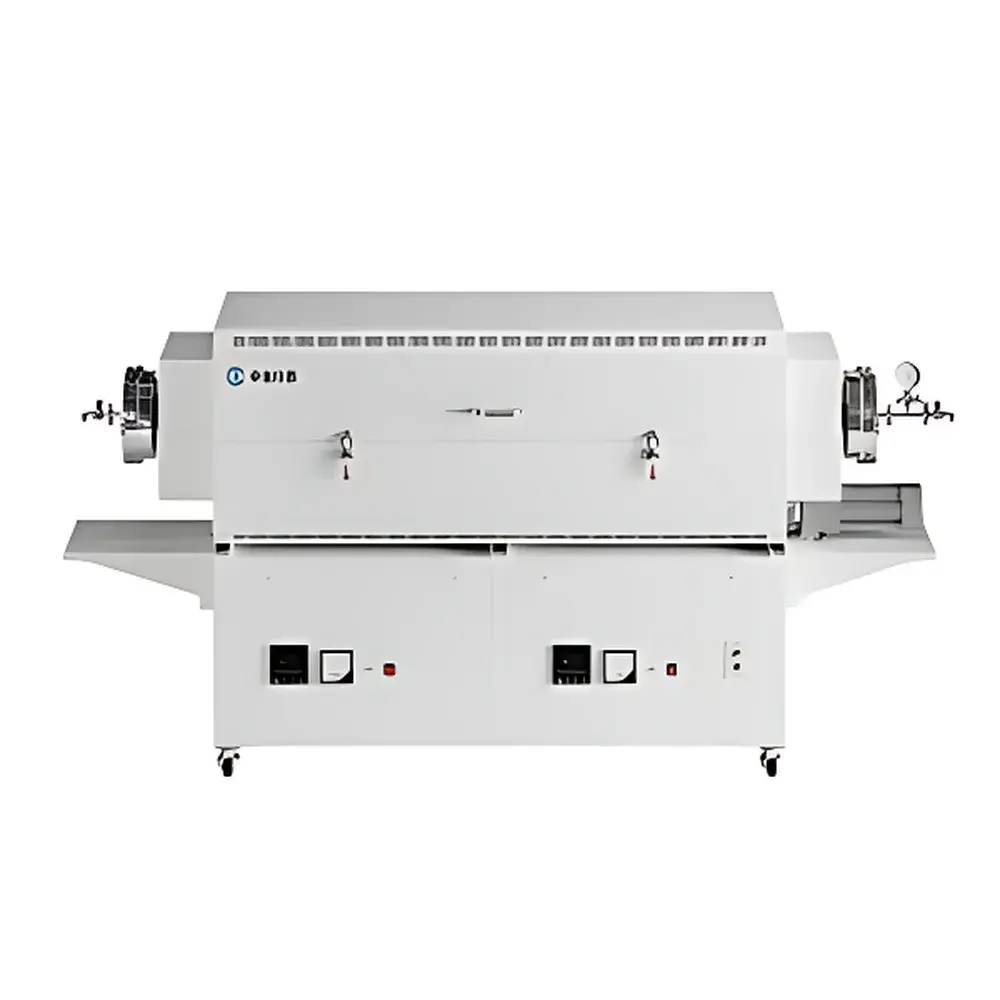
Zhuochi SG-1200K-2 Powder Sintering Tube Furnace
| Brand | Zhuochi |
|---|---|
| Origin | Zhejiang, China |
| Manufacturer Type | General Distributor |
| Product Category | Domestic |
| Model | SG-1200K-2 |
| Instrument Type | Tube Furnace |
| Max Temperature | 1200 °C |
| Temperature Control Accuracy | ±1 °C |
| Max Power | 2.5 kW |
| Heating Rate (to Max Temp) | ≤30 °C/min |
| Heating Method | Resistance Wire Heating |
| Internal Chamber Dimensions | 60 mm (ID) × 400 mm (Heating Zone Length) |
| Nominal Volume | 240 L |
| Tube Diameter | 60 mm (Standard Quartz Tube, Straight) |
| Vacuum Capability | –0.1 MPa |
| Temperature Range | 100–1200 °C |
| Thermocouple Type | S-Type Platinum-Rhodium |
| Control System | LTDE Programmable PID Controller (50-Stage Ramp/Soak) |
| Tilting Angle | 15° |
| Rotatable Tube | Yes |
| Cooling | Forced-air rapid cooling |
| Sealing | Stainless Steel Flanges with Float Flowmeters |
| Gas Compatibility | Multi-gas inlet (optional gas mixer available) |
Overview
The Zhuochi SG-1200K-2 Powder Sintering Tube Furnace is a precision-engineered high-temperature thermal processing system designed for controlled atmosphere sintering, annealing, calcination, and chemical vapor deposition (CVD) applications in academic research laboratories, materials science R&D centers, and advanced manufacturing QA/QC environments. It operates on the principle of resistive heating via high-purity 0Cr27Al7Mo2 alloy wire embedded within a low-thermal-mass alumina polycrystalline fiber furnace chamber. The furnace features a horizontal tube configuration with axial gas flow management, enabling reproducible thermal treatment of powder compacts, ceramic green bodies, battery electrode precursors, and thin-film substrates under inert, reducing, or reactive atmospheres. Its dual-shell construction—comprising a phosphated and electrostatically coated cold-rolled steel outer casing and an ultra-lightweight, high-purity fiber insulation core—ensures surface temperatures below 60 °C at maximum operating temperature while maintaining thermal stability and energy efficiency.
Key Features
- 50-segment programmable temperature controller (LTDE series) with PID algorithm, supporting ramp-soak profiles, real-time data logging, and user-defined thermal cycles
- Double-layer shell structure with phosphate conversion coating and high-temperature epoxy-polyester powder coating (computer gray finish) for corrosion resistance and mechanical durability
- Alumina polycrystalline fiber furnace lining with embedded heating elements, offering rapid thermal response, minimal thermal lag, and excellent resistance to thermal shock
- Motor-driven tilting mechanism (±15°) and optional tube rotation assembly for uniform particle exposure and enhanced densification during sintering
- Quick-access front-opening design with stainless steel flanged quartz tube (standard Ø60 mm, 400 mm heated length), compatible with custom tapered tubes (e.g., Ø60/Ø100 mm transition)
- Integrated forced-air cooling system enabling controlled cooldown rates from 1200 °C to 200 °C in under 45 minutes
- Dual-stage overtemperature protection: primary limit set at 1250 °C and secondary hardware cutoff at 1300 °C, compliant with IEC 61000-6-2 EMC and IEC 61000-6-4 emission standards
Sample Compatibility & Compliance
The SG-1200K-2 accommodates powdered samples in crucibles (alumina, graphite, or silicon carbide), pressed pellets, fiber mats, and substrate wafers up to 60 mm in diameter. Its vacuum-tight quartz tube assembly (rated to –0.1 MPa) supports processes requiring oxygen exclusion, such as oxide reduction or nitride synthesis. Gas delivery is managed via calibrated float-type flowmeters (0–1000 mL/min per channel), with provisions for up to three independent gas lines (N₂, Ar, H₂, NH₃, etc.) and optional integration of a precision mass-flow-controlled gas mixing module. The system meets fundamental safety requirements outlined in EN 60519-1 (electrical safety for industrial electroheating equipment) and is suitable for use in GLP-compliant laboratories when paired with validated calibration protocols and audit-trail-enabled software (see Software section). All electrical components—including solid-state relays, branded contactors, and thermocouple compensation wiring—are rated for continuous operation at 1200 °C ambient.
Software & Data Management
While the standard LTDE controller provides local display and manual profile editing, optional RS485/Modbus RTU or USB-to-serial interfaces enable integration with third-party SCADA systems or custom Python-based acquisition platforms. When used with Zhuochi’s optional PC software suite (v3.2+), users gain access to full-cycle data export (CSV/TXT), real-time temperature curve overlay, alarm event timestamping, and electronic signature-capable report generation—features aligned with FDA 21 CFR Part 11 readiness when deployed with network-authenticated user roles and audit trail configuration. Calibration certificates traceable to NIM (National Institute of Metrology, China) are available upon request for ISO/IEC 17025-accredited labs.
Applications
- Sintering of metal and ceramic powders (e.g., TiO₂, Al₂O₃, Fe–Ni alloys) under controlled partial pressure conditions
- Thermal annealing of CVD-grown 2D materials (graphene, MoS₂) and perovskite thin films
- Carbonization and graphitization of polymer-derived ceramics and biomass precursors
- High-temperature purification of battery cathode materials (LiCoO₂, NMC) via oxidative or reductive treatments
- Heat treatment of dental and orthopedic bioceramic implants to achieve phase-stable microstructures
- Research-scale synthesis of metal-organic frameworks (MOFs) and zeolitic imidazolate frameworks (ZIFs)
FAQ
What is the maximum recommended continuous operating temperature?
The furnace is rated for continuous operation at 1200 °C; prolonged use above this temperature will accelerate degradation of the heating element and insulation matrix.
Can the system be configured for hydrogen atmosphere processing?
Yes—when equipped with H₂-compatible stainless steel flanges, leak-tested quartz tubing, and appropriate gas safety interlocks (e.g., H₂ concentration monitoring and automatic purge sequence), it complies with NFPA 55 and CGA G-5.5 guidelines.
Is the temperature uniformity across the 400 mm heating zone specified?
At 1200 °C, axial temperature deviation is ≤±5 °C over the central 300 mm segment, verified per ASTM E220-19 using three-point thermocouple mapping.
Does the furnace support vacuum pumping without auxiliary equipment?
The standard configuration includes vacuum-rated O-rings and flange ports; however, a separate vacuum pump (e.g., two-stage rotary vane or dry scroll) must be connected externally to achieve –0.1 MPa.
What maintenance intervals are recommended for long-term reliability?
Inspect heating element continuity and insulation integrity every 200 operational hours; replace quartz tube after 100 high-temperature cycles (>1000 °C) or upon visible devitrification or cracking.



