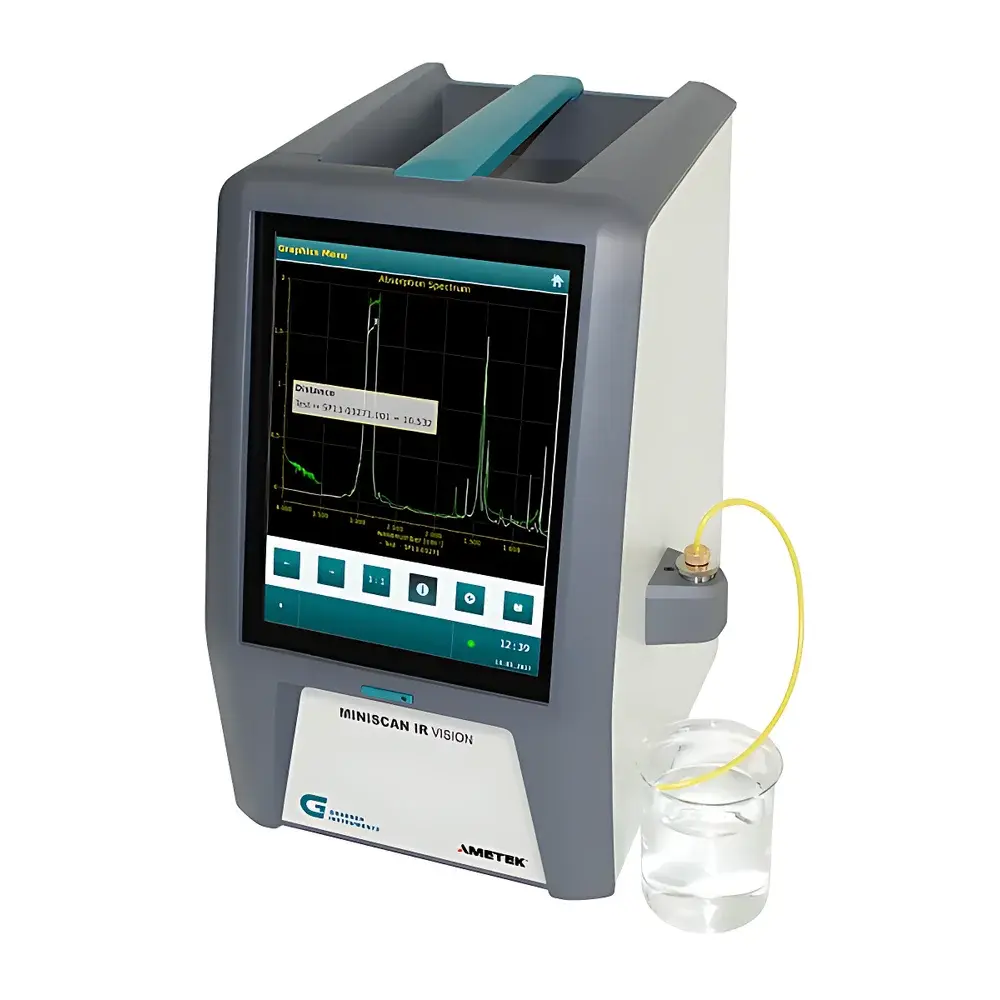
Grabner MINISCAN IR Vision Professional Mid-Infrared Fuel Analyzer for Gasoline, Diesel, and Aviation Turbine Fuel
| Brand | Grabner |
|---|---|
| Origin | Austria |
| Manufacturer Type | Manufacturer |
| Origin Category | Imported |
| Model | MINISCAN IR Vision Professional |
| Measurement Parameters | Gasoline Octane Number (RON/MON), Diesel Cetane Number |
| Portability | Portable |
| Detection Principle | Mid-Infrared Spectroscopy |
| Measurement Range | 70–110 (Octane/Cetane scale) |
| Accuracy | ±0.1 |
| Analysis Time | ≤60 seconds |
| Sample Volume | 6 mL |
Overview
The Grabner MINISCAN IR Vision Professional is a field-deployable, mid-infrared (MIR) fuel analyzer engineered for precise, real-time quantification of critical hydrocarbon quality parameters in gasoline, diesel, and aviation turbine fuel (Jet A-1). It operates on the fundamental principle of Fourier-transform infrared (FTIR) spectroscopy—specifically utilizing a temperature-stabilized dual interferometer with KBr-coated germanium (Ge) beamsplitter—to acquire high-fidelity, full-spectrum absorbance data across the 4000–600 cm−1 range. This spectral fingerprint is processed via chemometric modeling—primarily Partial Least Squares (PLS) regression—calibrated against reference methods per ASTM E1655 and GB/T 29858, enabling simultaneous prediction of over 100 fuel properties without reconfiguration. Designed for operational continuity in non-laboratory environments, it integrates thermal management at three critical points—sample cell, density module, and injection system—to ensure volumetric and mass-based concentration accuracy under variable ambient conditions.
Key Features
- Portable industrial-grade platform (12 kg, 293 × 390 × 280 mm) certified for shock and vibration resistance (IEC 60068-2 series)
- 10-inch sunlight-readable industrial touchscreen with oversized UI controls and multi-language support (English, Chinese, German)
- Thermoelectrically regulated sample cell and integrated density meter (±0.0001 g/cm³ resolution, 4-digit display)
- Bubble-free metallic autosampler with pressure-controlled flow path—validated for >100,000 cycles
- Dual-interferometer architecture with automatic mirror alignment compensation after mechanical disturbance
- Laser-referenced wavelength stability and temperature-controlled optical bench for long-term spectral reproducibility
- 2+1 smart sample cell design: two dedicated cells for routine analysis plus one for calibration verification or outlier screening
- Onboard storage for ≥50,000 full-spectrum records with metadata (timestamp, operator ID, environmental T/P)
- Comprehensive I/O: dual USB 2.0, dual Gigabit Ethernet, optional LIMS integration via ASTM E1578-compliant data export
- Flexible power operation: 100–264 V AC (47–63 Hz, 130 W) or 12 V DC vehicle adapter for mobile deployment
Sample Compatibility & Compliance
The MINISCAN IR Vision Professional is validated for undiluted liquid hydrocarbon samples meeting ISO 4259 precision criteria and compliant with regulatory testing protocols including ASTM D5845 (oxygenates), ASTM D6277 / EN 238 / SH/T 0797 (benzene), EN 14078 / ASTM D7806 / GB/T 23801 (FAME in biodiesel blends), and GB/T 33648–2017 (non-conventional additives in automotive gasoline). Its PLS models are built exclusively on SGS-verified reference datasets comprising >12,000 real-world fuel samples—including reformulated gasoline, ultra-low-sulfur diesel, synthetic jet fuels, and illicit additive-spiked batches (e.g., dimethyl carbonate, methylal, sec-butyl acetate). Calibration traceability adheres to ISO/IEC 17025 requirements, with documented uncertainty budgets for all reported parameters. The instrument supports audit-ready data integrity through time-stamped, operator-locked result logs and optional 21 CFR Part 11-compliant electronic signature modules.
Software & Data Management
Embedded firmware runs Grabner’s proprietary IRVision Suite v5.x, featuring intuitive workflow-driven analysis, automated baseline correction, and real-time spectral QC flags (e.g., moisture interference, cell contamination, signal-to-noise ratio < 1000:1). All raw interferograms and processed spectra are stored in vendor-neutral .SPA format (compatible with GRAMS/AI and OPUS), while quantitative results export as CSV or XML for ERP/LIMS ingestion. Remote access is enabled via secure HTTPS interface supporting role-based user permissions, firmware OTA updates, and diagnostic telemetry. Data archiving complies with GLP/GMP documentation standards: each test record includes full spectral history, calibration validation status, environmental sensor logs (T, RH), and digital chain-of-custody metadata. Optional cloud synchronization enables centralized fleet monitoring across refinery, terminal, and field inspection sites.
Applications
- Real-time blending control at refineries and terminals—monitoring octane/cetane response during component injection
- Quality assurance in fuel distribution networks—rapid verification of specification compliance prior to dispatch
- Regulatory enforcement and customs inspection—on-site detection of adulterants and oxygenate fraud
- R&D of alternative fuels—quantitative tracking of bio-blendstock composition (e.g., FAME, HVO, alcohol ethers)
- Aviation fuel certification—simultaneous measurement of aromatic content, naphthalenes, and thermal stability indicators per ASTM D1655
- Forensic fuel analysis—identification and quantification of non-approved additives violating GB/T 17930 or EN 228
FAQ
Does the MINISCAN IR Vision Professional require external calibration standards for daily use?
No—it employs factory-installed, matrix-matched calibrations traceable to NIST SRMs and ISO-certified reference fuels. Routine verification uses built-in reference cells; no consumable standards are needed for standard operation.
Can the instrument differentiate between ethanol and methanol in gasoline?
Yes—its high-resolution MIR spectra resolve distinct C–O and O–H vibrational bands, enabling selective quantification of both alcohols at detection limits ≤0.1 vol% per ASTM D7371.
Is density measurement performed simultaneously with spectral acquisition?
Yes—the integrated Pycnometric module operates in parallel with FTIR measurement, eliminating sequential delays and ensuring mass/volume consistency for concentration calculations.
How is spectral drift corrected during extended field operation?
The dual-interferometer design continuously cross-validates optical path length using HeNe laser referencing, while thermal stabilization maintains detector and optics within ±0.1°C of setpoint—ensuring <0.02 cm−1 wavenumber drift over 8-hour shifts.
What cybersecurity protocols are implemented for network-connected units?
All Ethernet interfaces support TLS 1.2 encryption, configurable firewall rules, disabled default credentials, and audit logging of all remote sessions per IEC 62443-3-3 Level 1 requirements.