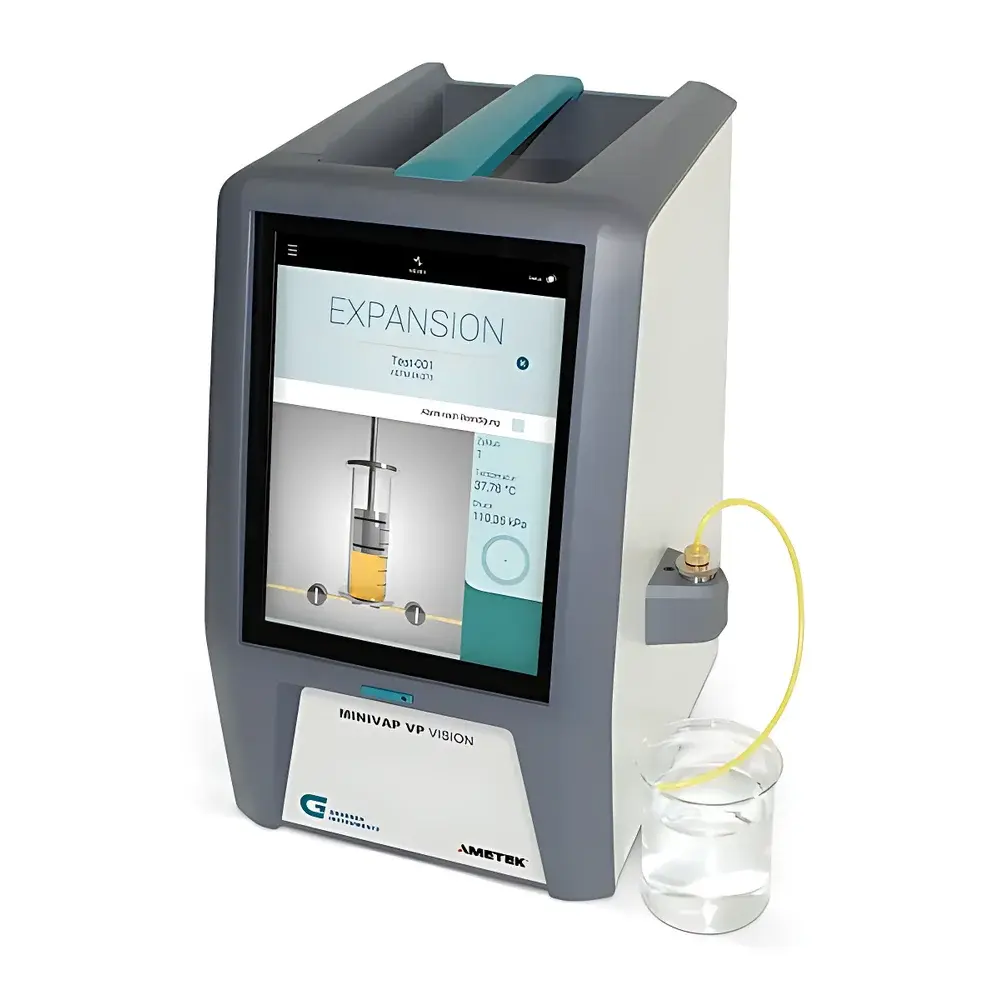
Grabner MINIVAP VP Vision Automated Micro Vapor Pressure Analyzer
| Brand | Grabner |
|---|---|
| Origin | Austria |
| Manufacturer Type | Manufacturer |
| Origin Category | Imported |
| Model | MINIVAP VP Vision |
| Analysis Method | Three-Stage Expansion Method |
| Pressure Range | 0–2000 kPa |
| Temperature Range | 0–120 °C |
Overview
The Grabner MINIVAP VP Vision is an automated, micro-volume vapor pressure analyzer engineered for precision, regulatory compliance, and operational robustness in petroleum, chemical, and regulatory testing laboratories. It operates on the internationally validated three-stage expansion method—a thermodynamic equilibrium technique that precisely determines vapor pressure by controlled stepwise expansion of a liquid–vapor mixture within a sealed, temperature-regulated chamber. This principle ensures traceable, reproducible results aligned with fundamental physical chemistry requirements for volatile hydrocarbon characterization. Designed to meet stringent global regulatory mandates—including U.S. EPA Method 58 Fed. Reg. 14478 (1993), ASTM D6377/D6378 (for gasoline and distillates), EN 13016-1+2, and China’s SH/T 0769–2005—the instrument delivers certified performance for RVP (Reid Vapor Pressure), TVP (True Vapor Pressure), and bubble point determination across gasoline, jet fuel, crude oil, LPG, solvents, and hazardous chemicals. Its compact, field-deployable architecture supports both fixed-lab and mobile/military applications without compromising metrological integrity.
Key Features
- Three-stage expansion methodology compliant with ASTM D6377, D6378, D5191, D6897, and EN 13016-1+2
- Extended pressure range of 0–2000 kPa (0–290 psi) with resolution of 0.01 kPa and repeatability ≤ 0.13 kPa (pure substance at 37.8 °C)
- 2D-Correction™ calibration technology (273-point matrix) ensuring full-scale accuracy across temperature and pressure domains
- Integrated oscillation module enabling rapid phase equilibration for crude oil and V/L ratio testing
- Sampling Pro™ valve system with wear-resistant piston design—validated for >100,000 cycles and proven to minimize carryover between samples
- Self-lubricating mechanical architecture eliminating routine oil maintenance and disassembly
- 10-inch industrial-grade capacitive touchscreen with glove-compatible UI, multilingual support (English, Chinese, German, French, Russian, Japanese), and template-driven method creation
- Fast Mode™ method combining ASTM D5191 and D5188 protocols for accelerated screening without sacrificing compliance
- Ultra-low vapor-to-liquid (V/L) ratio capability (0.02/1 to 100/1), enabling accurate TVP and bubble point measurement per ASTM D6897
- Robust environmental certification per EN 60068-2-1 (cold), EN 60068-2-78 (damp heat), EN 60068-2-14 (thermal cycling), EN 60068-2-6 (vibration), and EN 60068-2-27 (shock)
Sample Compatibility & Compliance
The MINIVAP VP Vision accommodates diverse petroleum and chemical matrices with minimal sample volume (1 mL test / 2.2 mL clean). It is validated for gasoline, aviation turbine fuel (Jet A/A-1), crude oil, liquefied petroleum gas (LPG), naphthas, aromatic solvents, and halogenated compounds. Its measurement protocol satisfies classification requirements under GHS, EU REACH Annex VII, and OSHA HCS for volatility hazard assessment. All methods are preloaded and configurable to match regional regulatory frameworks—including U.S. EPA Tier 3 gasoline specifications, EU Directive 98/70/EC, and China’s GB/T 11509 and SH/T 0794. Instrument firmware and calibration records comply with GLP and GMP data integrity expectations; audit trails, electronic signatures, and user-level access control align with FDA 21 CFR Part 11 readiness when deployed with Cockpit™ software.
Software & Data Management
Cockpit™ PC software serves as the central laboratory management platform, supporting multi-instrument connectivity over LAN or secure VPN. It enables remote configuration, real-time diagnostics, firmware updates, and centralized calibration history backup—including full traceability of correction matrices and sensor drift logs. Test results are stored locally (>100,000 records) with timestamped metadata, graphical trend plots, and raw expansion curves. Export formats include CSV (for LIMS integration) and PDF reports containing method parameters, raw data, statistical summaries, and compliance flags. Role-based user management (administrator, operator, reviewer) enforces procedural accountability. The system supports direct interfacing with major LIMS platforms via standard TCP/IP and RS-232 protocols.
Applications
- Reid Vapor Pressure (RVP) testing of motor gasoline per ASTM D323 and D5191
- True Vapor Pressure (TVP) and bubble point determination of crude oil per ASTM D6897 and D5482
- Vapor pressure of aviation fuels per ASTM D6377 and D6378
- Hazard classification of chemical substances under GHS and CLP Regulation
- Quality control of LPG blends and hydrocarbon solvents per IP 394 and EN 13016-2
- Field-based volatility screening in upstream operations, refinery terminals, and customs inspection labs
- Regulatory submission support for EPA, ECHA, and NMPA dossier requirements
FAQ
What standards does the MINIVAP VP Vision support out-of-the-box?
It includes fully implemented, pre-validated methods for ASTM D5191, D6377, D6378, D6897, D5188, EN 13016-1+2, IP 394/409/481, JIS K2258-2, GOST 52340, SH/T 0769, SH/T 0794, and GB/T 8017–2012.
Is the instrument suitable for field use?
Yes—certified for operation in ambient temperatures from 0 °C to 50 °C, humidity up to 93% non-condensing, and equipped with optional 12 V DC power conversion for vehicle or generator deployment.
How is cross-contamination prevented between samples?
The Sampling Pro™ valve employs a hardened stainless-steel piston with integrated purge cycle and metal reusable filter; independent validation confirms <0.001% carryover across high-volatility matrices.
Does it require external cooling or vacuum systems?
No—temperature control is self-contained (±0.01 °C stability); no vacuum pump, chiller, or external gas supply is needed for standard operation.
Can calibration data be backed up and restored?
Yes—full calibration profiles, including 2D-Correction™ matrices, sensor offsets, and historical verification logs, are exportable and restorable via USB or Cockpit™ network sync.
Related Products