
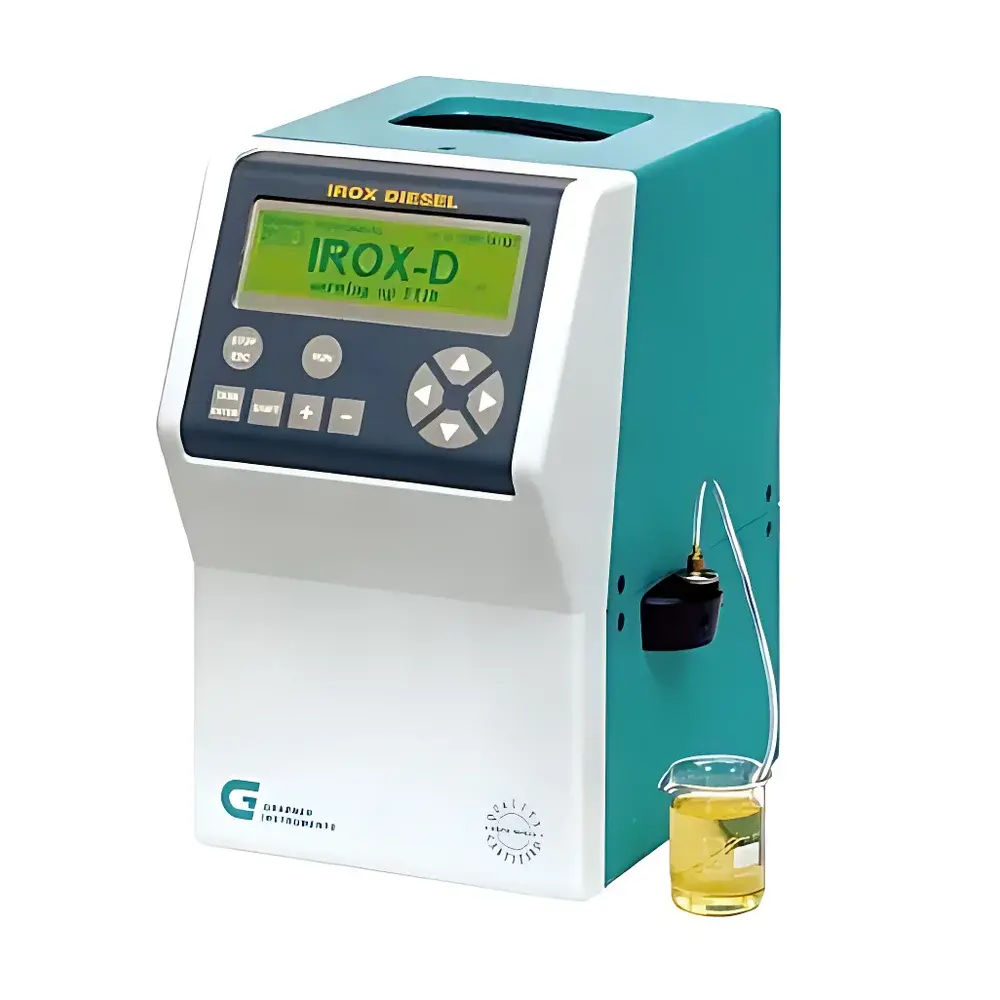
Grabner IROX DIESEL Portable Mid-Infrared FTIR Cetane Number Analyzer
| Brand | Grabner |
|---|---|
| Origin | Austria |
| Manufacturer | Grabner Instruments GmbH |
| Type | Imported |
| Model | IROX DIESEL |
| Measurement Parameters | Cetane Number (CN), Cetane Index (CI), FAME Content (0–40 v%), Polycyclic Aromatic Hydrocarbons (PNA), Total Aromatics, Distillation Temperatures (T85/T90/T95), Density (via integrated Anton Paar DMA) |
| Portability | Portable |
| Detection Principle | Mid-Infrared Fourier Transform Spectroscopy (FTIR) |
| Spectral Resolution | 4 cm⁻¹ |
| Measurement Range | Cetane Number 25–75, Cetane Index 30–70, FAME 0–40 v% |
| Repeatability | CN ±0.8, CI ±0.4, FAME SD = 0.04–1.20 v% (dependent on concentration) |
| Measurement Time | ≤180 s per sample |
| Sample Volume | 7 mL |
| Preheat Time | 10 min |
| Power Supply | 100–230 V AC, 50/60 Hz, 65 W or 12 V DC / 4 A (vehicle battery) |
| Dimensions | 200 × 320 × 220 mm |
| Weight | 11 kg |
| Data Interface | RS-232 |
| Display | Backlit LCD |
Overview
The Grabner IROX DIESEL is a portable, mid-infrared Fourier transform infrared (FTIR) spectrometer engineered for rapid, laboratory-grade analysis of diesel fuel properties in both fixed and field environments. Unlike conventional combustion-based ASTM D613 cetane engines—which require extensive sample preparation, skilled operation, and 30+ minutes per test—the IROX DIESEL applies chemometric modeling to high-resolution IR spectral data (4 cm⁻¹ resolution) to quantify critical fuel parameters non-destructively and without reagents. Its core measurement principle relies on the characteristic vibrational absorption bands of functional groups in hydrocarbon molecules: the ester carbonyl stretch at 1745 cm⁻¹ for low-concentration FAME (≤7.0 v%) and the C–O–C asymmetric stretch at 1195 cm⁻¹ for higher FAME levels (7.0–30 v%). Secondary derivatives of these peaks, combined with cluster analysis (CA) and multilinear regression (MLR) algorithms trained on extensive reference databases, enable trace-level quantification and high reproducibility across diverse diesel matrices—including ultra-low-sulfur diesel (ULSD), biodiesel blends (B5–B20), and fuels containing cetane improvers.
Key Features
- Portable benchtop design (11 kg, 200 × 320 × 220 mm) with dual-power capability: AC mains or 12 V DC vehicle battery—enabling deployment at refinery gates, terminals, depots, or roadside inspection points.
- Integrated Anton Paar density module enabling automatic conversion between volume % and mass % for FAME and other components—fully compliant with EN 14214 and ASTM D7467 reporting requirements.
- Automated sample aspiration: no pre-filtration, dilution, or derivatization required; simply immerse the sampling probe into the container and press RUN.
- Full spectral acquisition and chemometric processing completed in ≤180 seconds—delivering certified-equivalent results for CN, CI, PNA, total aromatics, and distillation endpoints (T85/T90/T95).
- Onboard calibration management: users may perform field recalibration using certified reference standards; calibration constants are auto-computed and stored with full audit trail.
- Robust optical architecture with temperature-stabilized interferometer and sealed, purged sample compartment—ensuring long-term stability under variable ambient conditions (10–40 °C operating range).
Sample Compatibility & Compliance
The IROX DIESEL is validated for use with all common diesel fuel types: petroleum-derived diesel (ASTM D975), hydrotreated vegetable oil (HVO), fatty acid methyl ester (FAME) blends up to B40, and synthetic diesel (e.g., GTL, CTL). It meets the performance criteria of multiple international standards through correlation—not direct equivalence—including ASTM D613 (cetane number), ASTM D976 (cetane index), ASTM D5186 (PNA and total aromatics), and ASTM D86 (distillation characteristics). All spectral data and calibration records are timestamped and user-annotated, supporting GLP-compliant workflows. The instrument’s software architecture complies with FDA 21 CFR Part 11 requirements for electronic records and signatures when used with MINIWIN IROX-PC software and appropriate access controls.
Software & Data Management
MINIWIN IROX-PC is the dedicated Windows-based control and analysis suite, providing full spectral visualization, method editing, database expansion, and report generation. Each measurement stores raw interferograms, processed absorbance spectra, second-derivative overlays, and quantitative results in a structured binary format (.irox). Data export supports CSV, PDF, and XML for LIMS integration. Audit trails log all user actions—including calibration updates, method modifications, and result overrides—with immutable timestamps and operator IDs. Optional 6-position autosampler enables unattended batch analysis, while RS-232 connectivity allows direct integration with plant SCADA systems or central QA/QC databases.
Applications
- Quality assurance at fuel production facilities: real-time verification of cetane compliance prior to shipment.
- Regulatory monitoring of biodiesel blending ratios at distribution terminals—ensuring adherence to EN 590, ASTM D7467, and national mandates.
- Forensic fuel analysis: detection of adulteration, mislabeling, or unauthorized additives via spectral fingerprint deviation analysis.
- R&D support for alternative fuel formulation: rapid screening of novel oxygenates, synthetic hydrocarbons, or co-processing streams.
- Field verification during customs inspections or emergency response scenarios—reducing reliance on off-site lab turnaround.
FAQ
Does the IROX DIESEL require daily calibration?
No. Factory calibration remains stable for ≥6 months under normal use; however, users may perform optional field verification or recalibration at any time using certified reference samples.
Can it analyze diesel containing ethanol or other oxygenates?
The instrument is optimized for FAME and hydrocarbon diesel; ethanol or other non-FAME oxygenates require custom model development and validation using representative reference materials.
Is method validation documentation available for regulatory submissions?
Yes—Grabner provides full IQ/OQ documentation, ASTM correlation reports, and method transfer protocols upon request to support ISO/IEC 17025 accreditation and regulatory audits.
What maintenance is required beyond routine cleaning?
Annual interferometer alignment and detector performance verification are recommended; no consumables or gas supplies are needed.
How does it handle water-contaminated or highly viscous samples?
Samples must be free of suspended water and particulates; viscosity is not a limiting factor due to positive-pressure aspiration—but filtration through a 0.8 µm syringe filter is advised for cloudy or aged fuels.




