
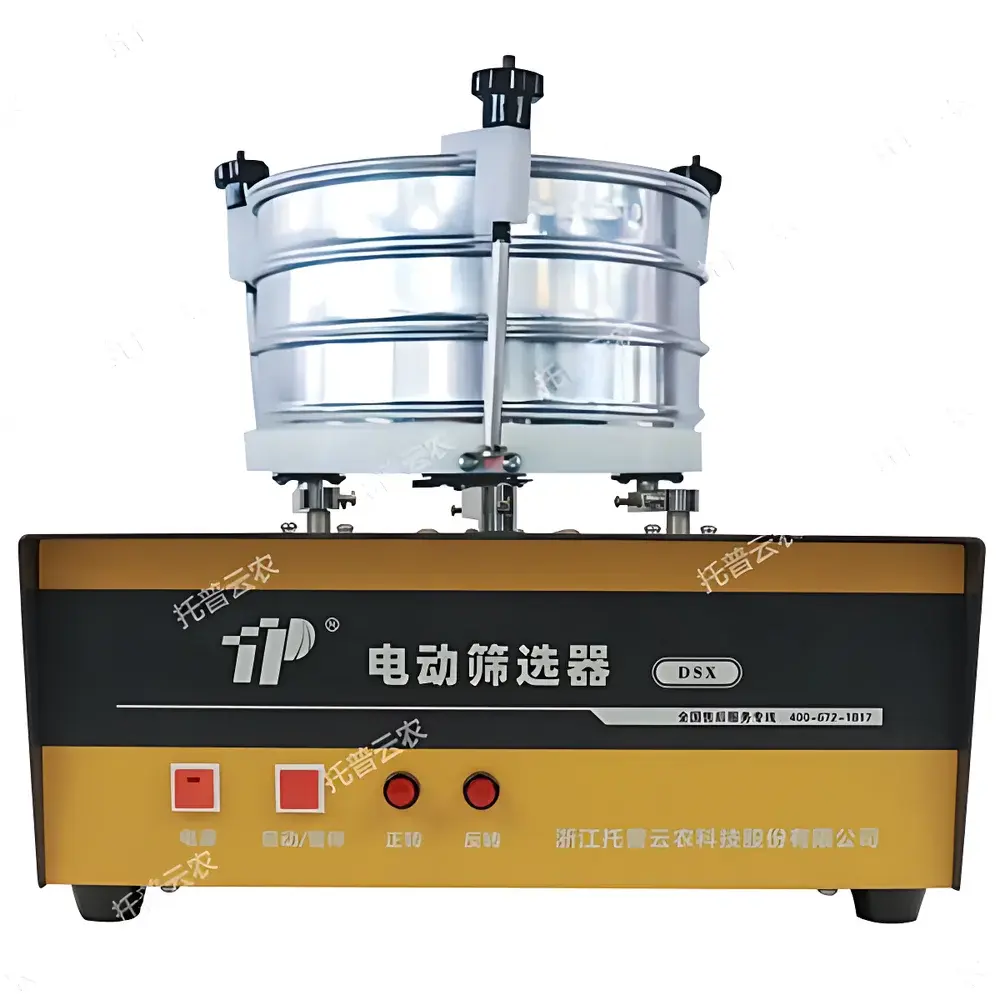
Top Cloud-agri DSX Desktop Grain Sieve
| Brand | Top Cloud-agri |
|---|---|
| Origin | Zhejiang, China |
| Manufacturer Type | Direct Manufacturer |
| Country of Origin | China |
| Model | DSX |
| Pricing | Available Upon Request |
| Maximum Sample Capacity | 500 g |
| Sieve Stack Layers | 3 (Optional) |
| Oscillation Amplitude | 100 mm |
| Rotational Speed | 115 ± 5 rpm |
| Compatible Sieve Outer Diameter | 200–220 mm |
| Motor Power | 60 W |
| Power Supply | AC 220 V, 50 Hz |
| Net Weight | 12 kg |
| Control System | Microcontroller-based bidirectional motor control with high-precision timing |
Overview
The Top Cloud-agri DSX Desktop Grain Sieve is a precision-engineered, semi-automatic mechanical sifting instrument designed for standardized particle size classification of agricultural commodities—primarily cereal grains, oilseeds, and related botanical materials. It operates on the principle of planar circular motion generated via an eccentric linkage mechanism, driven by a worm-gear speed-reduction transmission system. The sieve body is supported on three-point planar mounts to ensure stable, low-vibration operation during continuous sieving cycles. Unlike vibratory or ultrasonic sieves, the DSX employs controlled rotational oscillation—ideal for preserving sample integrity while achieving reproducible separation across defined sieve fractions. Its design aligns with routine quality control protocols in seed breeding programs, grain quality laboratories, and agri-food R&D facilities where consistent, operator-independent fractionation is required under GLP-aligned workflows.
Key Features
- Compact desktop footprint (suitable for benchtop use in confined lab environments)
- Worm-gear transmission system ensuring smooth, low-noise speed reduction and long-term torque stability
- Three-point planar support structure minimizing base resonance and enhancing mechanical repeatability
- Microcontroller-based bidirectional motor control enabling precise forward/reverse timing sequences—critical for preventing material stratification and improving sieve efficiency
- Adjustable feed regulation mechanism supporting uniform lateral distribution of sample across the full sieve width
- Modular sieve stack configuration (up to 3 layers, optional) compatible with standard 200–220 mm outer-diameter test sieves per ISO 3310-1 and ASTM E11 specifications
- Integrated maintenance indicators—including visual access to rubber cleaning balls, suspension elastomers, and bearing housings—for proactive component inspection
Sample Compatibility & Compliance
The DSX is validated for dry, free-flowing granular agricultural materials including wheat, rice, barley, soybean, rapeseed, and maize kernels. It is not intended for sticky, fibrous, or moisture-sensitive samples without prior drying or conditioning. While the instrument itself does not carry CE or UL certification, its electrical architecture complies with IEC 61000-6-3 (EMC emission limits) and IEC 61000-6-2 (immunity requirements) when operated within specified ambient conditions (temperature: 10–35°C; relative humidity: ≤80% RH, non-condensing). For regulatory submissions (e.g., USDA FGIS, ISO 7971-2, or national grain grading standards), users must validate sieve calibration using certified reference standards traceable to NIST or equivalent NMIs. The absence of built-in data logging requires manual documentation of run parameters per GLP Annex 11 or internal SOPs.
Software & Data Management
The DSX operates without embedded software or network connectivity. All operational parameters—including direction sequence, dwell time, and cycle count—are configured via front-panel push-button interface with LED status feedback. No firmware updates or driver installation are required. Data recording is manual: users must log sieve set configuration, sample mass, run duration, and retained/fractionated weights in laboratory notebooks or LIMS-integrated spreadsheets. For audit readiness, laboratories deploying the DSX in regulated environments (e.g., ISO/IEC 17025-accredited grain testing labs) are advised to maintain version-controlled SOPs covering calibration frequency, sieve certification logs, and preventive maintenance records—including rubber ball replacement intervals and bearing lubrication schedules.
Applications
- Seed purity analysis and varietal classification in plant breeding stations
- Grain damage assessment (e.g., broken kernels, shriveled seeds) per AACC Method 55-10 and ICC Standard No. 118
- Oilseed sizing for optimal crushing efficiency evaluation
- Feed ingredient particle distribution profiling prior to pelleting
- Research-scale fractionation for rheological or compositional sub-sampling
- Compliance testing against national grain grading standards (e.g., GB/T 5494–2019 for Chinese wheat, or USDA SRG for U.S. No. 2 Yellow Corn)
FAQ
Does the DSX include sieves in the standard configuration?
No. Sieves are sold separately and must be selected according to applicable standards (e.g., ISO 3310-1, ASTM E11) and desired aperture range.
What maintenance intervals are recommended for the eccentric linkage and motor bearings?
Lubrication of worm-gear assembly and motor bearings is advised every 500 operating hours or annually—whichever occurs first—using ISO VG 68 mineral oil.
Can the DSX be integrated into an automated lab workflow?
Not natively. It lacks digital I/O, RS-232/USB ports, or Ethernet capability. Integration requires external PLC interfacing via dry-contact relay outputs (optional accessory).
Is the DSX compliant with FDA 21 CFR Part 11 for electronic records?
No. As a standalone electromechanical device with no electronic record generation, it falls outside Part 11 scope—but supporting documentation must adhere to ALCOA+ principles.
What is the expected service life of the rubber cleaning balls under typical usage?
Under normal operation (≤4 hrs/day, 5 days/week), replacement is recommended every 12–18 months or when surface wear reduces bounce height by >30% as measured against baseline.






