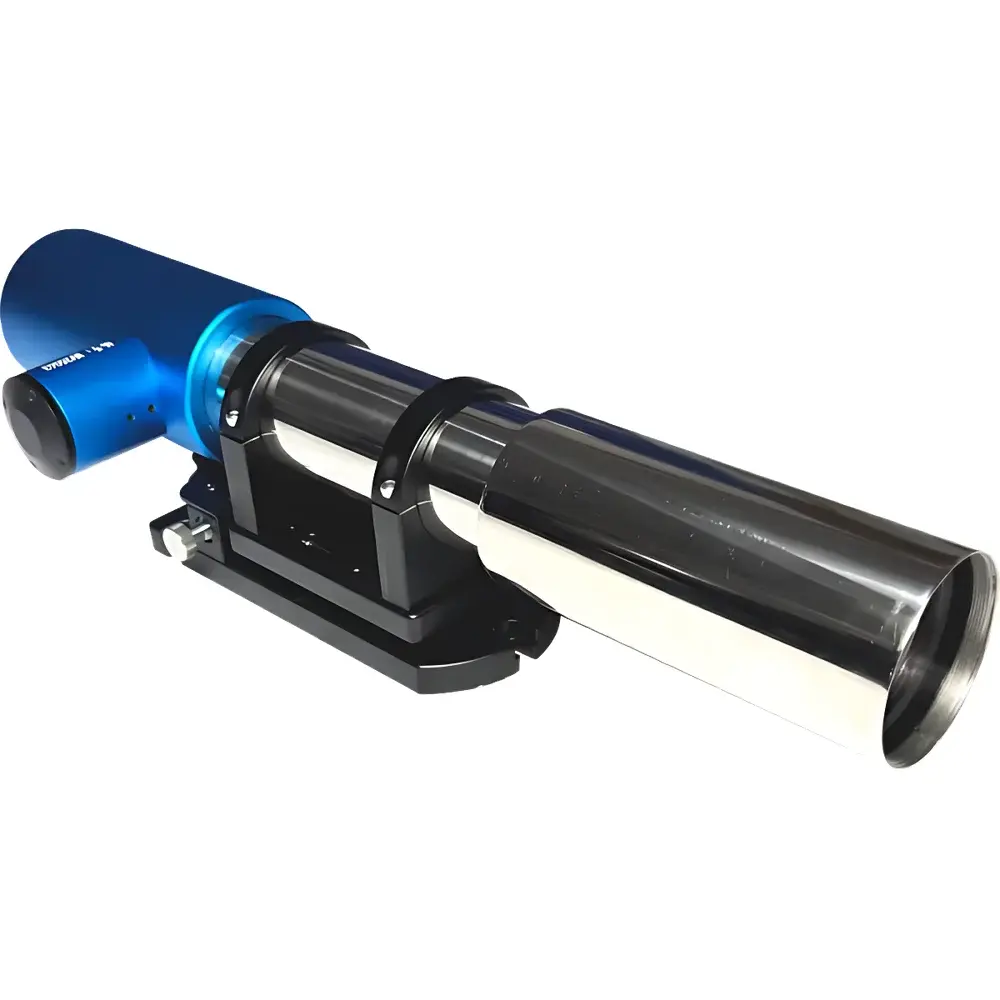
YANRUN MC030-LD350/60/1 Precision Photoelectric Autocollimator
| Brand | YANRUN |
|---|---|
| Origin | Shanghai, China |
| Manufacturer Type | Direct Manufacturer |
| Model | MC030-LD350/60/1 |
| Dimensions | 346 × 122 × 115 mm |
| Objective Focal Length | 350 mm |
| Objective Aperture | 60 mm |
| Light Source | High-Stability Semiconductor LED |
| Measurement Range | 0–40 m |
| Detector | High-Resolution Photodiode Array Sensor |
| Display Resolution | Adjustable to 0.1″ / 0.01″ / 0.001″ / 0.0001″ (arc seconds) |
| Field of View (X/Y) | 1800″ × 1500″ (arc seconds) |
| Accuracy (Center) | ±600″ ±1″ (arc seconds) |
| Sampling Frequency | ≤30 Hz (typ.) |
| Interface | USB 2.0 |
| OS Compatibility | Windows 7 or later, 64-bit |
| Compliance | Chinese Utility Model Patent Certified |
Overview
The YANRUN MC030-LD350/60/1 is a high-precision photoelectric autocollimator engineered for non-contact angular metrology in industrial metrology labs, precision assembly facilities, and optical R&D environments. It operates on the fundamental principle of optical autocollimation: a collimated beam—generated by projecting a reticle located at the focal plane of a 350 mm focal length objective lens—is directed toward a reflective surface. When the surface deviates by an angle α, the reflected beam undergoes a 2α angular displacement upon re-imaging onto a co-focal photodetector array. This linear displacement (ΔS) is measured with sub-microradian resolution, enabling traceable angular quantification down to 0.0001 arc seconds (4.85 nrad). The instrument’s 60 mm aperture objective supports high light throughput and signal-to-noise ratio across extended working distances up to 40 meters, while its rigid mechanical architecture minimizes thermal drift and vibration-induced error—critical for long-duration alignment tasks in aerospace component verification or synchrotron beamline setup.
Key Features
- Simultaneous dual-axis (X and Y) angular measurement with real-time digital display and automatic error calculation.
- Electronic eyepiece technology eliminates parallax and observer-dependent aiming uncertainty inherent in manual optical autocollimators.
- High-stability imported semiconductor LED illumination ensures consistent luminance over >50,000 hours, eliminating filament degradation and thermal drift common in halogen sources.
- Adjustable angular resolution modes (0.1″ to 0.0001″) allow optimization for coarse alignment (e.g., rotary table leveling) or ultra-fine calibration (e.g., mirror tilt in interferometric cavities).
- Modular design supports interchangeable accessories—including retroreflector mounts, kinematic mirror holders, and multi-point alignment kits—for flexible integration into custom metrology workflows.
- Native USB 2.0 interface enables direct communication with host PCs running Windows 7+ (64-bit), supporting deterministic data acquisition at up to 30 Hz sampling rate.
- Multi-language UI (English, Chinese, Russian, Korean) facilitates international deployment without localization overhead.
Sample Compatibility & Compliance
The MC030-LD350/60/1 is compatible with any optically flat, specularly reflective surface meeting minimum reflectivity requirements (>85% at 635 nm). It has been validated for use with fused silica, BK7, silicon, and aluminum-coated mirrors under ambient laboratory conditions (20 ± 2 °C, <50% RH). Its measurement methodology aligns with ISO 21098:2017 (Optics and photonics — Test methods for autocollimators) and supports traceability to national angle standards via documented calibration procedures. The device incorporates hardware-level safeguards against electromagnetic interference (EMI) per IEC 61326-1:2013 and meets CE marking requirements for electromagnetic compatibility and low-voltage safety. While not FDA 21 CFR Part 11 certified out-of-the-box, its data export architecture (CSV/Excel) allows integration into validated GLP/GMP environments when paired with controlled software validation protocols.
Software & Data Management
The included Windows-based application provides real-time vector visualization of angular deviations, statistical process control (SPC) charting, and automated report generation in native Microsoft Excel format (.xlsx). Raw time-series data are timestamped and stored with metadata including system configuration, environmental notes, and operator ID. Export options include ASCII tab-delimited files for import into MATLAB, Python (NumPy/Pandas), or Minitab. Audit trail functionality logs all parameter changes, measurement triggers, and file exports—enabling compliance with internal quality management systems requiring revision control and data integrity assurance. No cloud connectivity or remote telemetry is implemented; all data remain resident on the user’s local machine unless explicitly exported.
Applications
- Precision alignment of CNC machine tool spindles, hydrostatic bearings, and large-format coordinate measuring machine (CMM) guideways.
- Verification of straightness, flatness, perpendicularity, and parallelism per ASME B89.3.7 and ISO 1101 geometric tolerancing standards.
- Dynamic characterization of piezoelectric stage hysteresis and creep behavior via high-speed angular tracking.
- Calibration of angular encoders and goniometers used in semiconductor lithography steppers.
- Alignment of primary and secondary mirrors in astronomical telescope assemblies and laser cavity optics.
- Teaching and research applications in undergraduate and graduate optics laboratories, particularly in experimental wavefront analysis and adaptive optics prototyping.
FAQ
What is the maximum recommended working distance for optimal accuracy?
For measurements within the ±1 arc second accuracy specification, the recommended maximum distance is 25 meters. At 40 meters, angular sensitivity remains valid but requires careful environmental stabilization (air turbulence mitigation and temperature control) to maintain repeatability.
Can the instrument measure dynamic angular motion?
Yes—the system supports continuous acquisition at up to 30 Hz, suitable for characterizing low-frequency mechanical oscillations (e.g., torsional vibrations in drive shafts or thermal expansion-induced mirror drift) when synchronized with external triggers.
Is NIST-traceable calibration available?
YANRUN provides factory calibration certificates referencing internal angular standards verified against national metrology institute artifacts. End-user NIST-traceable recalibration services are available through authorized regional metrology partners upon request.
Does the software support scripting or API access?
The standard distribution does not expose a public API. However, DLL-based SDKs for C/C++ and .NET environments can be licensed separately for OEM integration and automated test system development.
How is thermal drift compensated during extended measurements?
The optical bench employs low-expansion aluminum alloy construction, and the LED driver incorporates closed-loop current regulation to stabilize output intensity. Users are advised to perform a zero-reference measurement every 30 minutes under critical metrology conditions.