
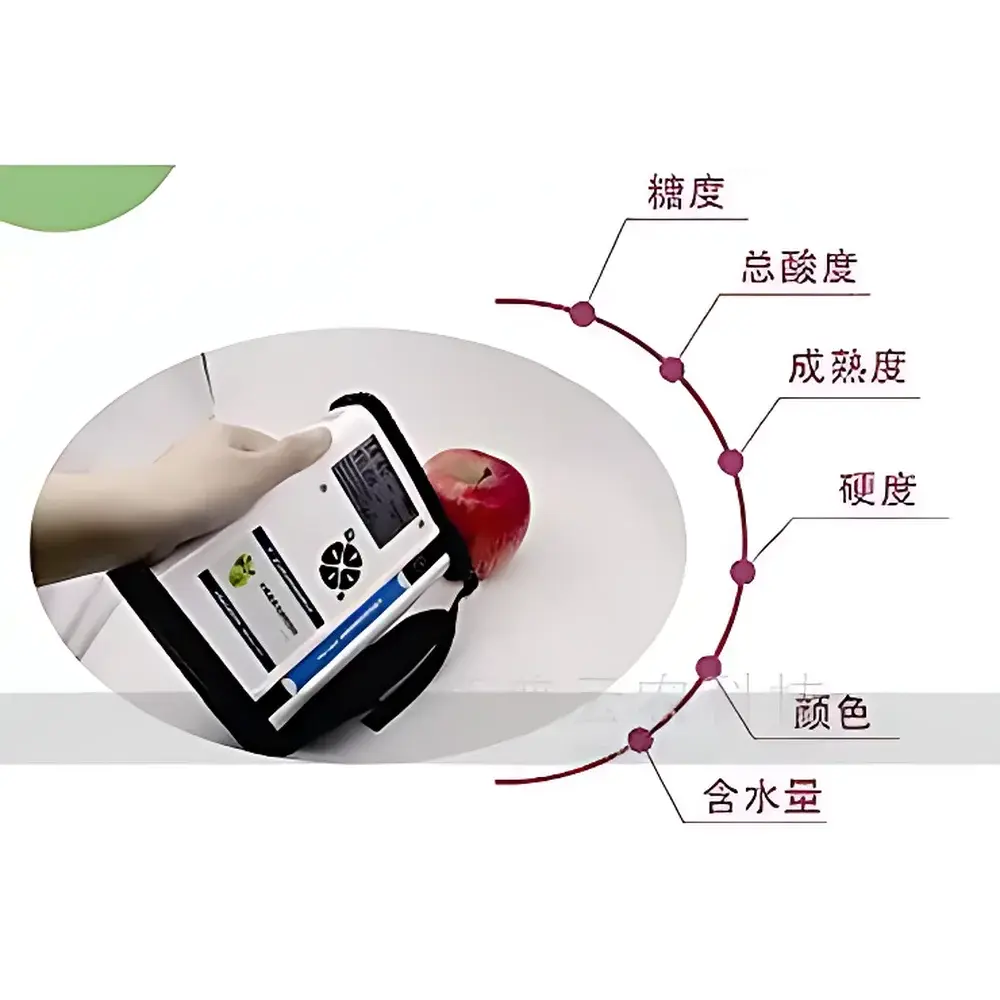
Top Cloud-agri TPF-750 Non-Destructive Fruit Quality Analyzer
| Brand | Top Cloud-agri |
|---|---|
| Origin | Zhejiang, China |
| Manufacturer Type | OEM Manufacturer |
| Country of Origin | China |
| Model | TPF-750 |
| Price | ¥90,000 CNY |
| Measurement Principle | Near-Infrared (NIR) Spectroscopy |
| Sample Throughput | 1 fruit per 2–6 seconds |
| Measured Parameters | Soluble Solids Content (SSC/Brix), Titratable Acidity (TA), Internal & External Color Indices, Dry Matter Content, Moisture Estimation, Firmness Proxy |
| Calibration Flexibility | Customizable PLS regression models for up to 200 fruit species |
| Data Storage | Removable SD card |
| Display | LCD screen |
| Weight | 1.5 kg |
| Operating Temperature | 10–30 °C |
| Power Supply | Removable rechargeable battery |
| Max Power Consumption | 2.5 W |
| Connectivity | USB, SD card slot, Wi-Fi |
| Built-in GPS | Yes |
| Compliance Context | Designed for GLP-aligned field and lab workflows |
Overview
The Top Cloud-agri TPF-750 Non-Destructive Fruit Quality Analyzer is a handheld, field-deployable near-infrared (NIR) spectrometer engineered for rapid, non-invasive assessment of key physicochemical quality attributes in intact fruits. Unlike destructive refractometric or titrimetric methods, the TPF-750 employs diffuse reflectance NIR spectroscopy (700–1100 nm range) to quantify compositional and structural parameters without skin penetration or tissue removal. Its optical architecture features a stabilized light source, precision collimated probe head, and thermally compensated detector array—optimized to minimize spectral drift under variable ambient conditions. The instrument operates on chemometric principles: pre-built and user-customizable Partial Least Squares (PLS) regression models correlate spectral signatures with reference laboratory measurements (e.g., AOAC 972.25 for SSC, AOAC 942.15 for titratable acidity). This enables traceable, repeatable quantification across diverse horticultural matrices—including thin-skinned berries, thick-rinded melons, and waxy citrus—while preserving post-harvest integrity and shelf-life potential.
Key Features
- Non-destructive measurement: Contact-based NIR probe delivers reliable spectra from intact fruit surfaces without bruising, puncturing, or cross-contamination.
- Rapid analysis cycle: Full spectral acquisition and model-based inference completed in ≤2 seconds per sample; typical reporting latency <6 s including display refresh and GPS tagging.
- Multivariate parameter output: Simultaneously estimates soluble solids content (°Brix), titratable acidity (g/L citric acid equiv.), dry matter (% w/w), internal chroma (a*, b*, L*), external surface color, moisture proxy, and firmness-correlated density indices.
- Species-adaptive calibration: Supports development and deployment of fruit-specific PLS models via integrated software; validated for >200 cultivars including apple, pear, tomato, mango, litchi, strawberry, and Hami melon.
- Field-hardened design: IP54-rated enclosure, removable high-capacity Li-ion battery (8+ hr runtime), integrated GPS geotagging for spatially referenced orchard mapping and harvest logistics tracking.
- Regulatory-aware data handling: Timestamped, GPS-stamped results stored locally on encrypted SD cards; USB and Wi-Fi interfaces enable secure transfer to LIMS or farm management platforms compliant with ISO 22000 and FAO Good Agricultural Practice (GAP) frameworks.
Sample Compatibility & Compliance
The TPF-750 accommodates fruits ranging from 25 mm (strawberry) to 200 mm (watermelon) in diameter. Probe geometry and pressure-sensitive contact mechanism ensure consistent optical coupling across curved, irregular, or hairy surfaces (e.g., peach fuzz, kiwifruit epidermis). Calibration models are developed and verified against ISO 21527-1 (microbiological analysis), AOAC Official Methods, and national standards for fruit quality grading (e.g., NY/T 2637-2014 for Chinese fruit SSC). While not FDA 21 CFR Part 11-certified as a standalone device, its data export protocols—supporting CSV/Excel with full metadata (operator ID, location, timestamp, instrument serial)—are structured to satisfy GLP documentation requirements for agricultural research institutions and breeding programs subject to national science fund audits.
Software & Data Management
Bundled PC software (Windows/macOS) provides full spectral preprocessing (Savitzky-Golay smoothing, multiplicative scatter correction, first-derivative transformation), PLS model training/validation, outlier detection, and batch report generation. All measurements include embedded EXIF-like metadata: GPS coordinates (WGS84), ambient temperature/humidity (via optional external sensor), operator ID, and calibration version hash. Data exports comply with ASTM E1447-22 (Standard Practice for Exchange of Analytical Data) and support direct ingestion into QbD-oriented platforms such as JMP Clinical, SAS Farm Intelligence, or custom Python-based agronomic dashboards using Pandas and Scikit-learn pipelines.
Applications
- Pre-harvest decision support: Real-time SSC/TA profiling across orchard zones informs selective harvesting windows, irrigation scheduling, and canopy management interventions.
- Post-harvest quality grading: Enables automated sorting line integration (via Wi-Fi API) for dynamic pricing tiers based on objective sweetness-acidity balance—not subjective visual inspection.
- Cultivar development: Accelerates phenotyping cycles in breeding programs by replacing destructive sampling with longitudinal, in-tree monitoring of ripening kinetics across hundreds of seedlings.
- Supply chain traceability: Georeferenced quality metrics linked to blockchain-enabled lot records improve transparency for export certification (e.g., EU Regulation (EC) No 543/2011) and retailer sustainability reporting.
FAQ
Does the TPF-750 require daily recalibration?
No—factory-installed reference standards and thermal stabilization eliminate need for daily hardware recalibration. However, periodic validation (weekly or per batch) against NIST-traceable sucrose/glycerol phantoms is recommended for critical QC applications.
Can it measure through fruit wax or plastic packaging?
The probe requires direct skin contact; commercial wax coatings (≤10 µm thickness) do not significantly attenuate NIR signal, but polyethylene film or vacuum-sealed bags must be removed prior to measurement.
Is spectral data export supported for third-party chemometrics?
Yes—raw absorbance spectra (.csv) and processed PLS loadings (.json) are fully accessible via USB or Wi-Fi, enabling reprocessing in Unscrambler, Pirouette, or open-source tools like scikit-spectra.
What is the minimum sample size for reliable prediction?
Fruits ≥25 mm in diameter yield robust predictions; smaller items (e.g., blueberries) require specialized cradle fixtures (sold separately) to ensure stable probe alignment and pressure uniformity.
How is measurement uncertainty quantified?
Each result displays RMSEP (Root Mean Square Error of Prediction) derived from cross-validation during model deployment—typically ±0.2–0.5 °Brix for apple and citrus, ±0.4–0.8 °Brix for soft fruits—aligned with ISO 5725-2 repeatability criteria.





