
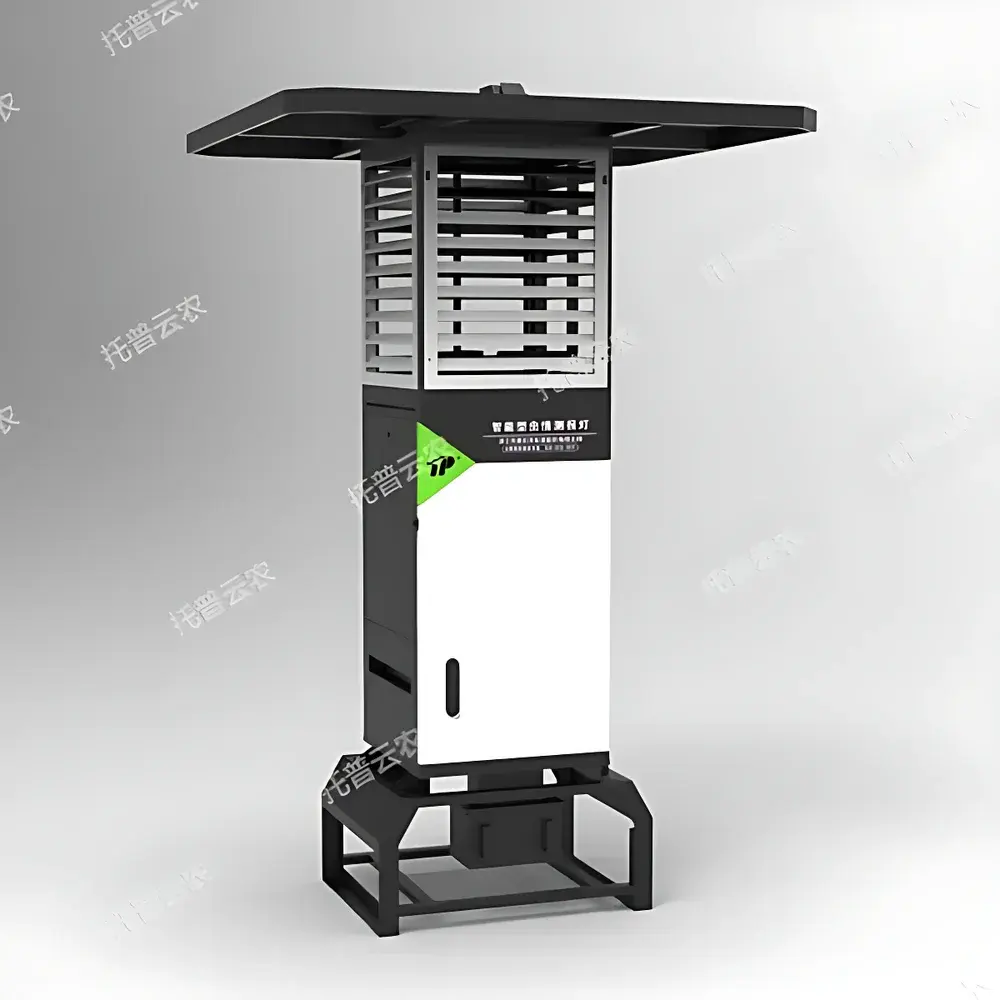
Top Cloud-agri TPCB-III-C7.0plus Smart Remote Imaging Pest Monitoring Trap
| Brand | Top Cloud-agri |
|---|---|
| Origin | Zhejiang, China |
| Manufacturer Type | OEM/ODM Manufacturer |
| Country of Origin | China |
| Model | TPCB-III-C7.0plus |
| Instrument Category | Pest Forecasting Instrument |
| Power Supply | AC 220 V / DC 12 V (300 W solar panel compatible) |
| Camera Resolution | 20 MP industrial-grade CMOS sensor |
| Display | 7-inch capacitive touch screen (Android 4.0/5.1 OS) |
| Network Options | 4G LTE / RJ45 Ethernet |
| Operating Temperature | 0–70 °C |
| Relative Humidity | ≤95% RH |
| Insect Mortality Rate | ≥98% |
| Specimen Integrity Rate | ≥95% |
| Heating Chamber Temp | 85 ±5 °C (dual-zone far-infrared) |
| Image Capture Interval | Adjustable from 10 min to 3 h per frame |
| Data Upload Speed | ≥1 Mbps |
| GPS Positioning | Built-in module with geotagging & anti-theft tracking |
Overview
The Top Cloud-agri TPCB-III-C7.0plus Smart Remote Imaging Pest Monitoring Trap is an autonomous, solar-compatible field instrument engineered for continuous, unattended monitoring of agricultural insect populations. It operates on the principle of phototactic attraction combined with digital imaging and edge-enabled image analysis—leveraging high-resolution visible-light capture, controlled thermal processing, and time-synchronized transport mechanics to deliver standardized, traceable insect specimens for both automated classification and manual verification. Designed specifically for rice-growing regions and other cereal-based agroecosystems, the system supports regulatory compliance in integrated pest management (IPM) programs by generating auditable, timestamped image datasets aligned with FAO-recommended monitoring protocols. Its dual-mode power architecture (AC 220 V or DC 12 V via 300 W solar array) ensures operational resilience across off-grid paddy fields, orchards, and remote monitoring stations.
Key Features
- Stainless steel 304 chassis with IP65-rated enclosure, rain-shielded louvers, and integrated rain-drain chamber for all-weather operation—including active rain-insect separation during precipitation events.
- Dual-zone far-infrared heating unit with independent temperature control (up to 85 ±5 °C), achieving ≥98% mortality while preserving ≥95% morphological integrity for downstream taxonomic validation.
- 20-megapixel industrial CMOS camera with adjustable focus and LED-assisted illumination; captures images at user-defined intervals (10 minutes to 3 hours), optimized for distinguishing morphological features of target species including Nilaparvata lugens, Sogatella furcifera, Scirpophaga incertulas, and Cnaphalocrocis medinalis.
- Vibratory specimen dispersion mechanism and precision conveyor belt ensure uniform monolayer distribution of captured insects prior to imaging—minimizing occlusion and maximizing feature visibility for AI-assisted recognition algorithms.
- On-device Android 4.0/5.1 operating system with 7-inch capacitive touchscreen interface; supports local configuration, real-time preview, manual triggering, and firmware updates over secure OTA channels.
- Built-in GPS module with geotagged metadata embedding; enables spatial mapping of trap locations in cloud platforms and provides anti-theft tracking capability through coordinate reporting.
- Multi-protocol connectivity: simultaneous support for 4G LTE (Cat.1), wired Ethernet (RJ45), and optional wireless bridge integration—ensuring reliable data transmission under variable rural network conditions.
Sample Compatibility & Compliance
The TPCB-III-C7.0plus is validated for consistent capture and imaging of small-to-medium sized flying insects (<5 mm body length) commonly associated with staple cereal crops. Its inlet filter mesh (aperture ≤2.5 mm) excludes non-target macro-arthropods while permitting entry of key lepidopteran and hemipteran pests. All hardware components conform to IEC 60529 (IP65), IEC 61000-4 (EMC immunity), and GB/T 2423 (environmental testing) standards. The system’s data acquisition workflow aligns with GLP-aligned field monitoring practices—supporting traceability through embedded timestamps, device IDs, environmental metadata (ambient temperature/humidity), and SHA-256 hashed image archives. While not FDA 21 CFR Part 11-certified as a standalone medical device, its audit trail functionality satisfies internal QA requirements for national agricultural extension services and research institutions adhering to ISO/IEC 17025 documentation frameworks.
Software & Data Management
Data flows from the trap to the Top Cloud-agri Smart Agriculture Cloud Platform via encrypted HTTPS POST requests. Each uploaded image includes EXIF metadata (GPS coordinates, UTC timestamp, exposure settings) and is stored in redundant AWS S3-compatible object storage. The web-based dashboard supports multi-user role assignment (admin, technician, agronomist), configurable alert thresholds (e.g., >50 N. lugens/night), and export of CSV-formatted count logs with ISO 8601 timestamps. Image annotation tools allow supervised correction of AI classifications; corrected labels feed back into model retraining pipelines using transfer learning on ResNet-50 architectures. All user actions—including parameter changes, remote reboot commands, and heater activation—are logged with immutable audit records compliant with ISO 27001 access control principles.
Applications
- Real-time regional pest outbreak early warning systems coordinated by provincial agricultural bureaus.
- Longitudinal phenological studies correlating trap catch dynamics with degree-day models and satellite-derived NDVI indices.
- Validation of biocontrol agent efficacy in randomized field trials where treatment plots are monitored against untreated controls.
- Curated digital reference libraries for entomology training programs—each verified specimen linked to morphological annotations and geographical occurrence maps.
- Integration with decision support systems (DSS) that recommend pesticide application timing based on cumulative catch thresholds defined in national phytosanitary guidelines.
FAQ
Does the TPCB-III-C7.0plus require a constant internet connection to function?
No. Local operation—including insect capture, killing, drying, imaging, and onboard storage—is fully autonomous. Connectivity is required only for data upload, remote configuration, and cloud-based recognition; offline image buffers retain up to 30 days of captures.
Can the system differentiate between live and dead insects in the image?
Not directly. The system identifies species and counts individuals based on morphological features visible in static images. Post-capture viability is inferred from thermal treatment parameters (time/temperature profiles), which are logged and exportable.
Is the AI identification model customizable for non-standard pest species?
Yes. Customers may submit annotated image sets to Top Cloud-agri’s technical team for inclusion in custom model builds—subject to minimum dataset size (≥500 labeled images per class) and morphological distinctness criteria.
What maintenance intervals are recommended for field deployment?
Bi-weekly visual inspection of lens cleanliness, inlet mesh integrity, and heating chamber residue accumulation. Quarterly calibration of temperature sensors and annual replacement of UV lamp (if installed as supplementary attractant).
How is data security ensured during transmission and storage?
All communications use TLS 1.2+ encryption. Stored images are encrypted at rest using AES-256. User authentication employs OAuth 2.0 with mandatory two-factor verification for administrative accounts.




