
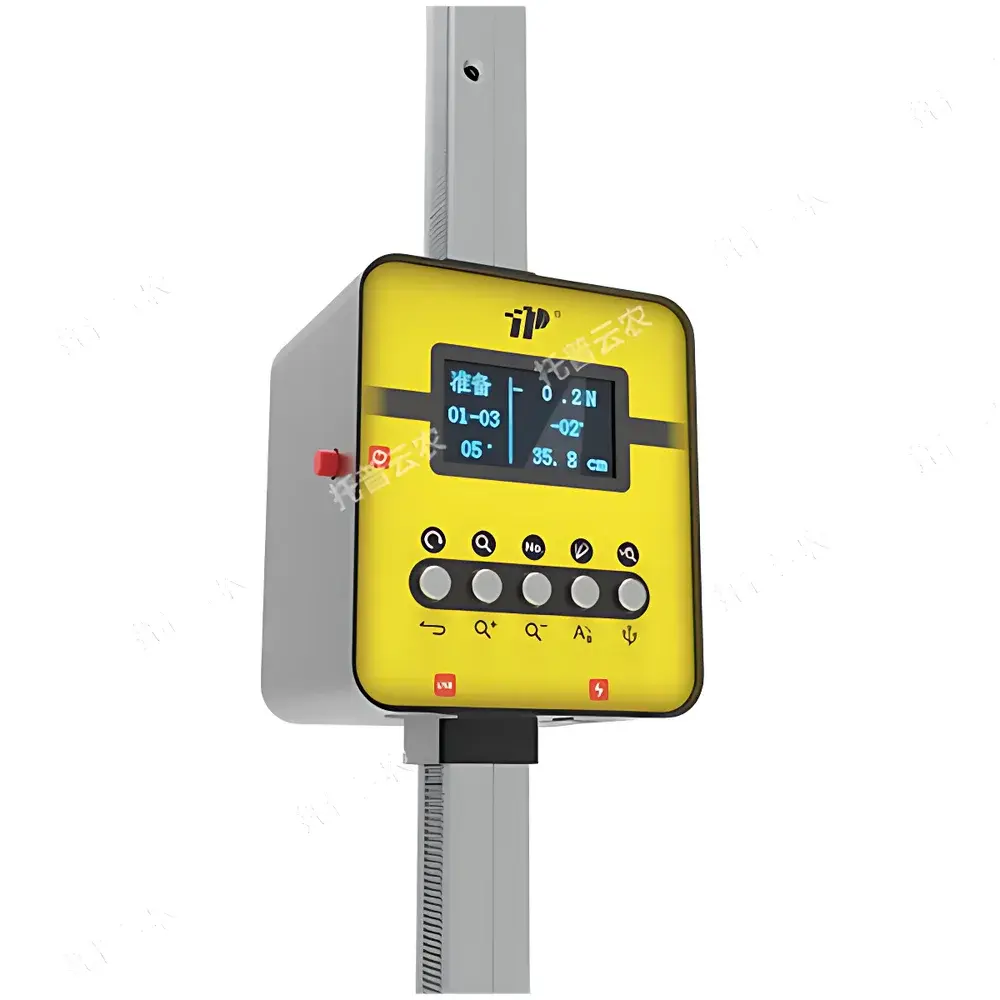
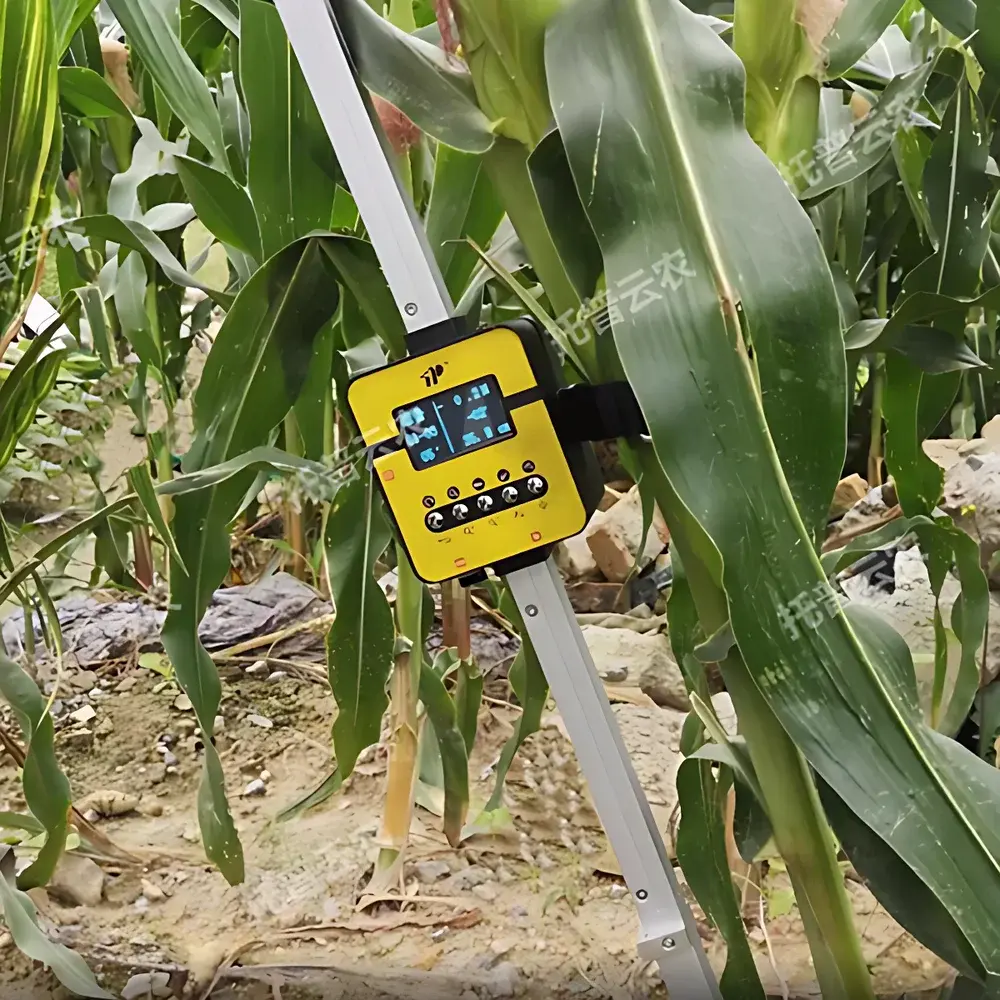
Top Cloud-agri TPDF-1 In Vivo Lodging Resistance Analyzer
| Brand | Top Cloud-agri |
|---|---|
| Origin | Zhejiang, China |
| Manufacturer Type | Direct Manufacturer |
| Country of Origin | China |
| Model | TPDF-1 |
| Price | Upon Request |
| Upright Pole Dimensions | 25 × 25 × 1751 mm |
| Host Unit Dimensions | 98 × 120 × 74 mm |
| Lodging Resistance Range | 0–100 N |
| Resolution | 0.1 N |
| Accuracy | ±2% (≥10 N), ±10% (<10 N) |
| Tilt Angle Range | 0°–90° |
| Angle Resolution | 1° |
| Angle Accuracy | ±2° |
| Center-of-Mass Height Range | 36–150 cm |
| Resolution | 0.1 cm |
| Accuracy | ±0.5% |
| Angle Step Options | 5°, 10°, or 15° |
| Power Supply | Rechargeable Li-ion Battery (8.4 V, 1.8 Ah) |
| Data Storage | 16 GB USB Flash Drive |
Overview
The Top Cloud-agri TPDF-1 In Vivo Lodging Resistance Analyzer is an engineered field-deployable instrument designed for non-destructive, real-time mechanical phenotyping of crop lodging resistance under natural growing conditions. It operates on the principle of controlled angular displacement and force transduction: a precision-machined aluminum upright pole serves as a stable reference frame, while a motorized or manually actuated loading mechanism applies incremental lateral torque to the plant stem at predefined tilt angles. Integrated high-fidelity load cells and dual-axis inclinometers simultaneously record the resisting force (N), angular displacement (°), and vertical center-of-mass height (cm). Unlike destructive bending tests or static push assays, the TPDF-1 captures dynamic force-angle response curves—effectively simulating wind-induced lateral loading—and quantifies both structural stiffness (initial slope of curve) and post-yield flexibility (area under curve), enabling biomechanical interpretation of stem integrity across developmental stages.
Key Features
- In vivo, non-invasive measurement: Enables repeated longitudinal monitoring of individual plants without tissue damage, supporting time-series analysis of lodging resistance development from vegetative to reproductive stages.
- Single-operator field portability: Compact host unit (98 × 120 × 74 mm) and lightweight anodized aluminum pole (25 × 25 × 1751 mm) allow rapid deployment in diverse field environments—including uneven terrain and dense canopy stands—without auxiliary support structures.
- Multi-parameter synchronous acquisition: Simultaneously records lodging resistance force (0–100 N, 0.1 N resolution), tilt angle (0°–90°, 1° resolution), and center-of-mass height (36–150 cm, 0.1 cm resolution) with timestamped logging.
- Configurable angular stepping: User-selectable tilt increments (5°, 10°, or 15°) facilitate protocol alignment with standardized biomechanical test methods or species-specific morphological constraints.
- On-device data visualization & export: Built-in LCD interface displays real-time force-angle plots; raw datasets are stored on a removable 16 GB USB drive compatible with Windows/macOS/Linux for downstream statistical modeling (e.g., R, Python, MATLAB).
- Battery-powered autonomy: Integrated 8.4 V / 1.8 Ah rechargeable lithium-ion battery supports ≥8 hours of continuous operation per charge, eliminating dependency on external power sources in remote agricultural sites.
Sample Compatibility & Compliance
The TPDF-1 is validated for monocot and woody dicot species exhibiting erect growth architecture and measurable stem rigidity. It accommodates single-stem measurements for maize (Zea mays), sorghum (Sorghum bicolor), sugarcane (Saccharum officinarum), and nursery stock (e.g., Populus, Fraxinus). For cereal canopies, optional multi-point anchoring enables aggregate resistance estimation for wheat (Triticum aestivum) and rice (Oryza sativa) stands using standardized spatial sampling grids. While not certified to ISO/IEC 17025, the system adheres to principles outlined in ASTM D1037 (Standard Test Methods for Properties of Panel Boards) for bending moment derivation and aligns with FAO-recommended protocols for field-based lodging assessment. Data traceability supports GLP-compliant trial documentation when paired with laboratory-managed metadata logs.
Software & Data Management
No proprietary software installation is required. Raw CSV files exported via USB contain columns for timestamp, applied angle (°), measured resistance (N), center-of-mass height (cm), and device status flags. These files are natively importable into spreadsheet applications and statistical platforms. For advanced biomechanical modeling, users may compute derived metrics—including flexural rigidity (EI), yield moment (My), and energy absorption capacity—from the force-angle hysteresis loop using open-source scripts (e.g., Python’s SciPy). Audit trails are maintained via file creation timestamps and sequential naming conventions; no electronic signature or 21 CFR Part 11 compliance is embedded, consistent with its role as a field data capture tool rather than a regulated clinical or pharmaceutical instrument.
Applications
- Quantitative evaluation of lodging resistance QTLs in maize and sorghum breeding programs.
- Field validation of CRISPR-edited alleles affecting lignin biosynthesis or vascular bundle density.
- Comparative phenotyping of dwarfing gene introgression lines under varying nitrogen regimes.
- Correlation analysis between stem anatomical traits (e.g., rind penetrometer values, cross-sectional area) and in vivo mechanical response.
- Calibration of crop simulation models (e.g., APSIM, DSSAT) with empirically derived mechanical thresholds for failure prediction.
- Extension services delivering on-farm resilience diagnostics to growers managing high-input production systems.
FAQ
Can the TPDF-1 measure lodging resistance in lodged or partially bent plants?
No—the instrument requires an upright, self-supporting stem to establish a valid mechanical baseline. Severely tilted or collapsed plants fall outside its operational scope.
Is calibration traceable to national metrology institutes?
Load cell and inclinometer calibrations follow internal factory procedures aligned with ISO 9001; however, no NIST-traceable certificate is supplied by default. Third-party recalibration services are available upon request.
What environmental conditions limit field use?
Operation is rated for ambient temperatures from 0 °C to 45 °C and relative humidity ≤90% non-condensing. Rain exposure must be avoided during active measurement due to sensor housing IP rating limitations.
Does the system support wireless data transmission?
No—data transfer relies exclusively on physical USB media to ensure signal integrity in electromagnetically noisy field environments and eliminate latency or pairing failures.
How is center-of-mass height determined without destructive dissection?
The operator positions the sensor head at the visually estimated centroid of aboveground biomass; height is measured from ground level using an integrated ultrasonic rangefinder referenced to the base plate, with manual verification recommended for heterogeneous canopies.



