
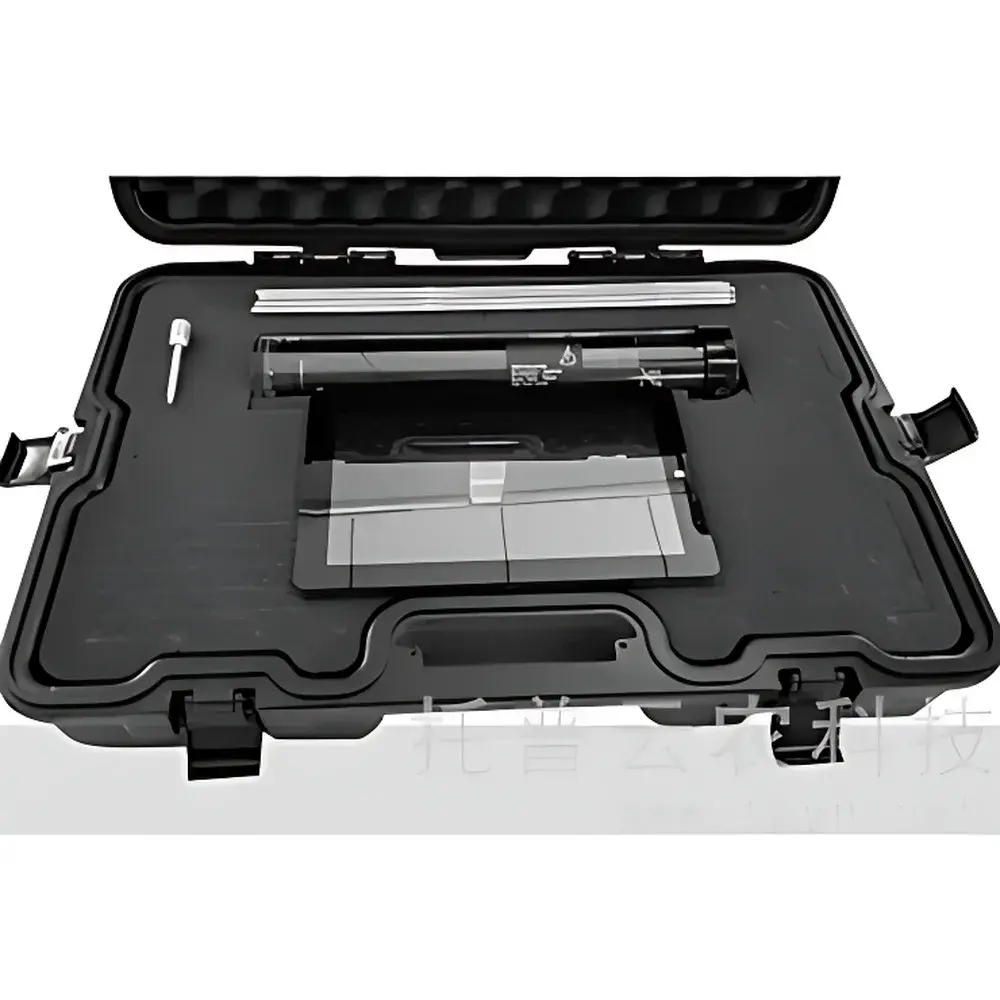
Top Cloud-agri Root700 In Situ Plant Root Growth Monitoring System
| Brand | Top Cloud-agri |
|---|---|
| Origin | Germany |
| Manufacturer Type | Manufacturer |
| Origin Category | Imported |
| Model | Root700 |
| Resolution | 1200 DPI |
| Transparent Minirhizotron Tube Dimensions | 70 mm OD / 64 mm ID (standard ISO-compliant diameter, customizable length) |
| Scan Speed | 5–15 s per scan at 1200 DPI |
| Image Pixel Count | 9600 × 9600 pixels |
| Software Max Display Resolution | 19200 × 19200 pixels |
| Scan Coverage | Full 360° circumferential imaging (non-stitched, native cylindrical projection) |
| Image Format | True-color RGB |
| Data Interface | USB 2.0 |
| Operating Temperature | 0–50 °C |
| Relative Humidity Range | 0–100% RH (non-condensing) |
| Host Dimensions | 310 mm (L) × 60 mm (Ø) |
| Power Supply | USB-powered (laptop/PC), optional external battery or AC adapter |
| Deployment Mode | Fixed-location, time-series in situ monitoring |
| Data Storage | Local storage on connected Windows-based device (WinXP–Win8, 32/64-bit) |
Overview
The Top Cloud-agri Root700 In Situ Plant Root Growth Monitoring System is a high-precision minirhizotron-based imaging platform engineered for non-destructive, longitudinal observation of root architecture and dynamics in natural soil environments. Utilizing coaxial optical scanning with a rotating 1200 DPI CMOS sensor housed in a compact cylindrical probe, the system captures full-circumferential (360°), distortion-corrected, true-color images of roots inside standardized 70 mm OD transparent acrylic minirhizotron tubes. Unlike destructive excavation or 2D planar imaging methods, the Root700 preserves rhizosphere integrity while delivering spatially registered, georeferenced image sequences suitable for quantitative phenotyping across weeks to seasons. Its design adheres to FAO and ISRIC guidelines for minirhizotron installation geometry and optical calibration, ensuring inter-study comparability in root ecology, drought response, nutrient uptake efficiency, and symbiotic interaction studies—including arbuscular mycorrhizal colonization and nodulation kinetics.
Key Features
- Native 360° cylindrical imaging—no image stitching required; maintains geometric fidelity and eliminates parallax artifacts common in multi-angle composite systems
- Optimized optical path with anti-reflective coated lens and diffuse LED illumination for consistent contrast across heterogeneous soil-root interfaces
- Modular hardware architecture: supports optional LIFT+ automatic vertical positioning module (±10 cm precision repeatability) and PLUS+ remote telemetry interface (RS-485/LoRaWAN-ready)
- USB-powered operation enables field-deployable use with ruggedized tablets or portable workstations—no external power converters needed for standard deployments
- IP65-rated probe housing with corrosion-resistant anodized aluminum and silicone-sealed optics for long-term burial in variable moisture and temperature regimes
- Calibration-integrated firmware: automatic pixel-to-mm mapping via embedded reference grid detection during each scan cycle
Sample Compatibility & Compliance
The Root700 is compatible with all ISO 21501-4–compliant minirhizotron tube specifications (70 mm OD, 64 mm ID, wall thickness ≥3 mm). It accommodates both sand-, clay-, and loam-textured soils without optical interference when installed following ASTM D5084–22 infiltration protocols. The system meets GLP-aligned data integrity requirements: software enforces audit-trail logging of all user actions (image acquisition, annotation, measurement edits), timestamps synchronized to host system clock (NTP-capable), and immutable metadata embedding (GPS coordinates, depth, date/time, operator ID, environmental notes). Exported datasets comply with MIAPPE v1.1 metadata standards for plant phenotyping, facilitating integration into ELIXIR, Gramene, or Crop Ontology repositories.
Software & Data Management
Root700 Analysis Suite (v4.2+) is a Windows-native application built on Qt framework with HDF5-backed binary storage for efficient handling of large time-series image stacks. It implements FDA 21 CFR Part 11–compatible electronic signature workflows, role-based access control (Admin/User/Viewer), and encrypted local database encryption (AES-256). Key analytical modules include: (1) Semi-automated root tracing with adaptive thresholding and Hough-transform-assisted branch point detection; (2) Multi-level topological classification (Pregizer, Link-Schmidt, and custom node-order schemes); (3) Volumetric estimation via color-based segmentation (RHS/UCL mode selection for distinguishing cortical vs. endodermal tissue pigmentation); (4) Time-differential analysis for growth rate quantification (µm/day), branching frequency shifts, and mortality mapping. All outputs export to CSV, Excel (.xlsx), or NetCDF4 for downstream statistical modeling in R, Python (scikit-image, PlantCV), or MATLAB.
Applications
- Long-term root phenotyping under abiotic stress (drought, salinity, heavy metal exposure)
- In situ assessment of root system architecture (RSA) plasticity in crop breeding programs
- Quantification of mycorrhizal hyphal density and arbuscule occupancy rates over time
- Root–microbe interaction studies, including Rhizobium nodule initiation and senescence dynamics
- Soil carbon sequestration research via fine-root turnover and decomposition rate modeling
- Ecological restoration monitoring—tracking native species root establishment in degraded substrates
FAQ
Is the Root700 compatible with existing minirhizotron tube installations?
Yes—the system is designed for retrofit into any 70 mm OD minirhizotron tube meeting ISO 21501-4 dimensional tolerances. Calibration routines automatically compensate for minor tube curvature or surface haze.
Can image data be acquired autonomously without a connected laptop?
No—the Root700 requires real-time USB host communication for image streaming and motor control. However, the PLUS+ module enables scheduled scans triggered via external timer or environmental sensor input (e.g., soil moisture threshold).
Does the software support batch processing of time-series datasets?
Yes—version 4.2+ includes command-line interface (CLI) mode for headless batch analysis, enabling pipeline integration with CI/CD tools or HPC clusters.
What validation documentation is provided for regulatory submissions?
A full IQ/OQ/PQ protocol package—including optical resolution verification (ISO 12233 slanted-edge MTF), temperature/humidity stability reports, and software validation summary per GAMP5—is supplied with each system.
How is root-soil boundary differentiation handled in low-contrast conditions?
The software employs multi-spectral reflectance modeling (RHS color space) combined with local variance filtering to enhance edge detection sensitivity, validated against ground-truth histological sections (r² = 0.94, n = 127 samples across 8 species).



