
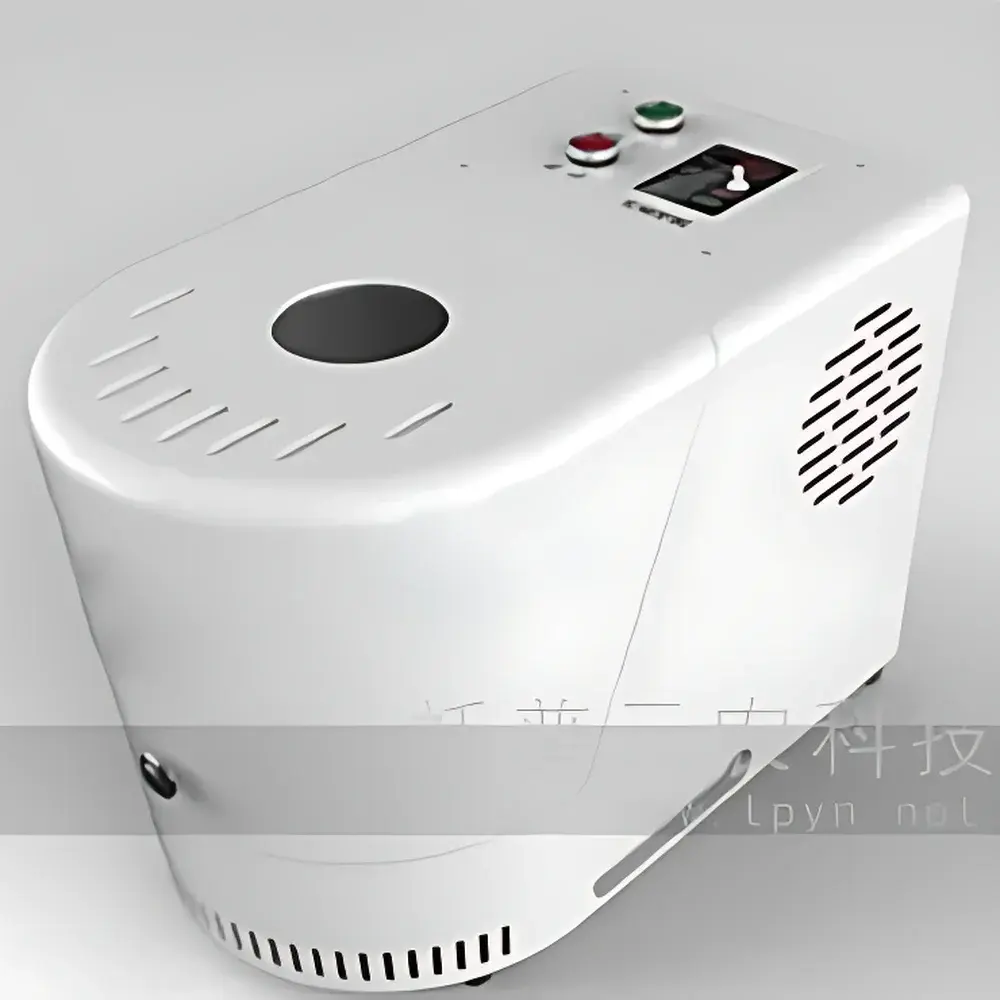
Top Cloud-agri TPYM-100G High-Capacity Planetary Soil Grinder
| Brand | Top Cloud-agri |
|---|---|
| Origin | Zhejiang, China |
| Manufacturer Type | Direct Manufacturer |
| Product Category | Domestic |
| Model | TPYM-100G |
| Instrument Type | Planetary Ball Mill |
| Sample Applicability | Soft to Moderately Hard Soils and Sediments |
| Final Particle Size | ≤5 µm |
| Minimum Sample Volume per Jar | 50 mL |
| Maximum Total Capacity | 4 × 100 mL Jars |
| Main Disc Speed | 50–400 rpm |
| Grinding Jar Speed | 100–800 rpm |
| Transmission Ratio (Main Disc | Jar): 1:−2 |
| Continuous Operation Time Range | 1–9999 min |
| Pause Interval Setting | 1–999 min |
| Grinding Vessel Materials | Stainless Steel, Agate, Zirconia, Alumina, Tungsten Carbide, Polyurethane (Optional) |
| Vessel Volume Options | 50 mL – 100 mL |
| Grinding Media Materials | Stainless Steel, Agate, Zirconia, Alumina, Nylon, PTFE (Optional) |
| Media Diameter Options | 3, 5, 10, 15, 20 mm |
| Media Mass per Jar | 100–400 g |
| Grinding Modes | Dry Grinding & Wet Grinding |
Overview
The Top Cloud-agri TPYM-100G High-Capacity Planetary Soil Grinder is a laboratory-scale planetary ball mill engineered for reproducible, high-efficiency size reduction of soil, sediment, and soft-to-moderately hard geological samples. It operates on the principle of high-energy planetary motion—where grinding jars rotate in the opposite direction to the sun wheel (main disc), generating intense centrifugal and Coriolis forces that accelerate impact, shear, and friction between grinding media and sample particles. This mechanism ensures uniform particle size distribution down to ≤5 µm, meeting stringent pre-analytical requirements for elemental analysis (e.g., ICP-OES/MS), X-ray fluorescence (XRF), loss-on-ignition (LOI), and physicochemical characterization. Designed for routine use in environmental monitoring labs, agricultural research centers, and geochemical testing facilities, the TPYM-100G integrates compact footprint, low acoustic emission (<65 dB(A)), and robust mechanical architecture suitable for unattended operation over extended cycles.
Key Features
- Four-jar configuration supporting simultaneous processing of up to 4 × 100 mL samples—enhancing throughput without compromising inter-batch consistency.
- Precisely adjustable rotational speeds: main disc (50–400 rpm) and jar (100–800 rpm), with programmable transmission ratio (1:−2) enabling fine-tuned energy input control.
- Flexible time programming: continuous grinding duration from 1 to 9999 minutes and customizable pause intervals (1–999 min) to manage thermal load and prevent sample degradation.
- Modular grinding vessel system compatible with six material options—stainless steel, agate, zirconia, alumina, tungsten carbide, and polyurethane—ensuring contamination-free processing for trace-metal or organic-sensitive applications.
- Interchangeable grinding media in multiple diameters (3–20 mm) and compositions (including PTFE and nylon) to optimize comminution efficiency across diverse soil textures—from clay-rich aggregates to sandy loams.
- Dual-mode operation (dry and wet grinding) with sealed jar design compliant with ISO 14687-1 for dust containment and operator safety during volatile or hygroscopic sample handling.
Sample Compatibility & Compliance
The TPYM-100G is validated for homogenization and particle size reduction of soils classified under ASTM D2216 (moisture content), ASTM D2487 (soil classification), and ISO 11277 (particle-size analysis). Its performance aligns with regulatory pre-treatment protocols required by EPA Method 3050B (acid digestion of sediments and soils) and ISO 11464 (pre-treatment of soil samples for chemical analysis). All contact materials comply with FDA 21 CFR §177.1520 (food-contact polymers) and EU Regulation (EC) No 1935/2004 where applicable. The instrument supports GLP-compliant workflows through deterministic parameter logging and audit-ready operation records when paired with optional external data capture systems.
Software & Data Management
While the TPYM-100G features an integrated digital control panel with LED display and membrane keypad, it does not include proprietary software or network connectivity. All operational parameters—including speed, duration, pause intervals, and cycle count—are stored locally in non-volatile memory and displayed in real time. For laboratories requiring electronic record retention, the device supports manual export of run logs via USB interface (optional firmware upgrade) and is compatible with LIMS integration through RS-232 or Modbus RTU protocols (external converter required). Parameter settings conform to ALCOA+ principles when documented alongside analytical batch records.
Applications
- Preparation of homogenized soil sub-samples for heavy metal quantification (Pb, Cd, As, Cr) by ICP-MS following EPA 6020B.
- Particle size standardization prior to cation exchange capacity (CEC) measurement per ISO 11260.
- Dispersion of aggregated clay fractions for XRD phase identification and mineralogical mapping.
- Routine grinding of certified reference materials (CRMs) such as NIST SRM 2710a or GBW07401 for method validation and QC/QA programs.
- Processing of contaminated site soils for leaching tests (e.g., TCLP, SPLP) under ASTM D5233 and ISO 14870.
- Supporting agronomic studies involving nutrient bioavailability assays where particle size directly influences dissolution kinetics.
FAQ
What types of soil matrices are compatible with the TPYM-100G?
It is optimized for soft to moderately cohesive soils—including loam, silt, clay, peat, and weathered sediments—with moisture content below 25% w/w. Highly abrasive or gravel-rich samples require pre-sieving and media selection adjustments.
Can the instrument be used for wet grinding with acidic or alkaline slurries?
Yes—when equipped with chemically resistant vessels (e.g., zirconia, PTFE-lined stainless steel) and inert media (zirconia, agate), it supports pH-stable wet milling for digestion-ready slurries.
Is the TPYM-100G compliant with ISO/IEC 17025 calibration requirements?
The unit itself is not a measuring instrument; however, its repeatability (RSD <3% for D50 across 5 replicate runs) meets ISO/IEC 17025 clause 7.7.1 for equipment suitability verification when validated per laboratory SOP.
How is cross-contamination prevented between sequential runs?
Vessels and media are fully removable and autoclavable or solvent-cleanable. Recommended cleaning protocols include ultrasonic bath treatment in dilute HNO₃ (for metal traces) or ethanol (for organics), followed by air-drying under laminar flow.
Does the system support GMP documentation for regulated environmental testing?
While the base model lacks built-in electronic signatures or 21 CFR Part 11 compliance, its deterministic parameter control and stable mechanical performance enable qualification (IQ/OQ) and integration into GMP-aligned workflows via external data loggers and procedural controls.



