
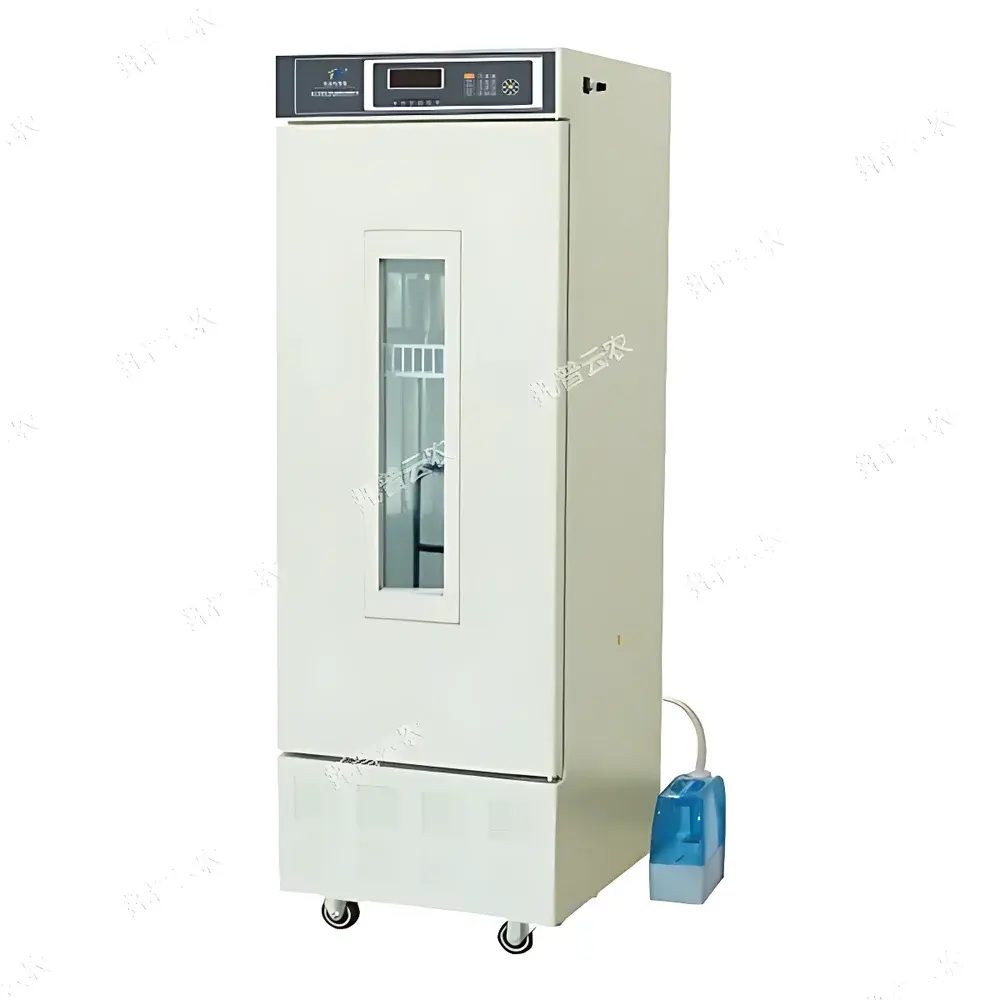
Top Cloud-agri HWS-300 Temperature and Humidity Controlled Incubator
| Brand | Top Cloud-agri |
|---|---|
| Origin | Zhejiang, China |
| Manufacturer Type | Direct Manufacturer |
| Product Category | Domestic |
| Model | HWS-300 |
| Temperature Range (with Humidification) | 0–50 °C |
| Temperature Uniformity | ±1 °C |
| Humidity Range | 50–95 %RH |
| Capacity | 300 L |
Overview
The Top Cloud-agri HWS-300 Temperature and Humidity Controlled Incubator is a precision-engineered environmental chamber designed for reproducible, long-term maintenance of biological and material samples under tightly regulated thermal and hygrometric conditions. It operates on a dual-loop control architecture: a PID-regulated refrigeration-heating system maintains temperature stability, while a dedicated ultrasonic or evaporative humidification module—coupled with feedback from high-accuracy capacitive humidity sensors—ensures dynamic RH modulation within the specified range. Unlike basic incubators, the HWS-300 integrates real-time ambient compensation logic (optional external temperature sensor input), enabling adaptive control in non-isothermal laboratory environments. Its robust stainless-steel inner chamber, double-layer insulated door, and sealed circulation ducting minimize thermal bridging and condensation risks—critical for sensitive microbiological assays and seed germination studies requiring low drift over multi-day cycles.
Key Features
- Microprocessor-based intelligent controller with backlit 4.3-inch LCD interface, supporting Chinese-language menu navigation and intuitive parameter configuration
- 99-segment programmable cycle function allowing time-temperature-humidity ramping profiles (e.g., diurnal simulation for plant phenotyping or circadian rhythm studies)
- Dual safety architecture: independent hardware overtemperature cutoff (user-configurable protection threshold) + software-based sensor fault detection and alarm lockout
- Power-loss recovery mode with non-volatile memory retention—automatically resumes pre-interruption setpoints and elapsed timing upon re-energization
- Compressor delay protection (≥180 s) to prevent mechanical stress during frequent cycling; acoustic noise level <70 dB(A) at 1 m distance
- Humidity control disabled below 10 °C to prevent condensation-induced corrosion and sensor saturation—compliant with ISO 17025 environmental monitoring guidance
Sample Compatibility & Compliance
The HWS-300 accommodates standard-sized culture vessels (e.g., Petri dishes, multi-well plates, flasks up to 2 L), insect rearing cages, and botanical growth trays. Its interior dimensions (666 × 630 × 1895 mm W×D×H) support modular shelving with adjustable spacing (standard configuration: 3 shelves, load capacity ≤15 kg/shelf). The unit meets GB/T 23777–2009 (Chinese National Standard for Environmental Test Equipment) and conforms to general-purpose requirements outlined in ISO 14644-1 (cleanroom air classification) for particulate control in non-sterile applications. While not certified for GMP manufacturing environments, its traceable calibration support (via optional NIST-traceable thermistor and RH probe validation kits) enables alignment with GLP documentation workflows in academic and regulatory research labs.
Software & Data Management
Data logging is performed internally at user-selectable intervals (1–60 min) with storage capacity for ≥30 days of continuous 3-channel records (chamber temperature, relative humidity, and optional ambient temperature). Export is supported via USB flash drive in CSV format for downstream analysis in MATLAB, Python pandas, or LIMS platforms. The embedded firmware supports audit trail functionality—including operator ID tagging (via alphanumeric login), parameter change timestamps, and alarm event logs—meeting foundational expectations of FDA 21 CFR Part 11 for electronic record integrity in non-clinical laboratory settings. Remote monitoring via RS-485 Modbus RTU protocol is available as an OEM option for integration into centralized building management systems.
Applications
- Microbial cultivation (bacteria, fungi, yeast) under standardized ISO/ASTM growth conditions (e.g., ISO 8589, ASTM D3273)
- Seed germination testing per ISTA Rules and phytosanitary quarantine protocols
- Stability assessment of pharmaceutical excipients and biologics per ICH Q1A(R2) guidelines
- Insect and small vertebrate acclimation studies in entomology and ecotoxicology
- Accelerated aging of polymer films and packaging materials per ASTM D3045
- Controlled deterioration trials for agricultural germplasm conservation
FAQ
What is the minimum operating temperature when humidity control is active?
Humidity regulation is automatically suspended below 10 °C to prevent internal condensation and ensure sensor longevity.
Does the HWS-300 support external data acquisition via analog outputs?
Yes—0–5 VDC or 4–20 mA isolated analog outputs are available as factory-installed options for integration with SCADA or PLC systems.
Is calibration certificate included with shipment?
A factory calibration report (covering temperature uniformity and humidity accuracy at three points) is provided; full ISO/IEC 17025-accredited calibration requires third-party service.
Can the incubator operate continuously for extended periods (e.g., >30 days)?
Yes—the design supports uninterrupted operation under specified ambient conditions (≤35 °C, ≤85 %RH, non-corrosive atmosphere) with scheduled maintenance every 6 months.
What is the maximum allowable ambient temperature for rated performance?
The unit maintains specification compliance only when installed in environments ≤35 °C; higher ambient temperatures degrade cooling capacity and increase humidity recovery time.




