
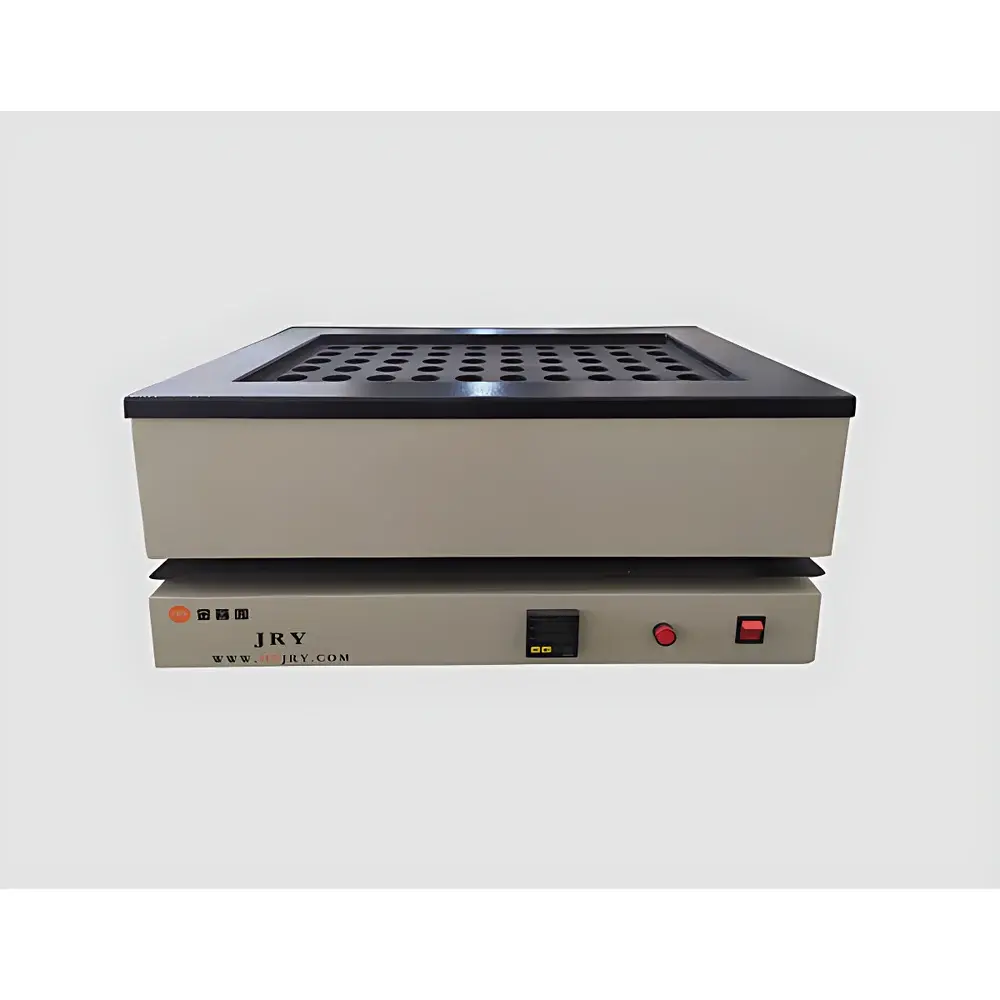
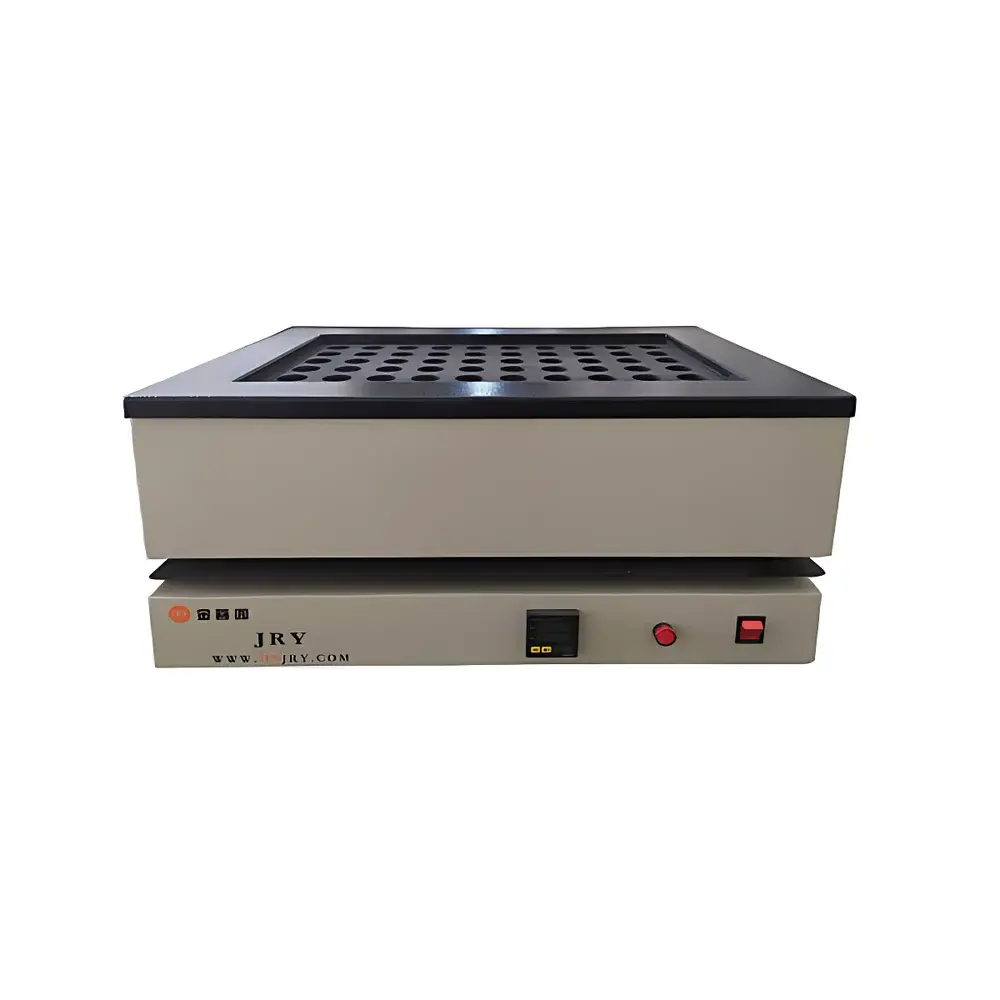
JRY X450 Series Graphite Block Digestion System
| Brand | JRY |
|---|---|
| Origin | Hunan, China |
| Manufacturer Type | Direct Manufacturer |
| Product Category | Domestic |
| Model | JRY-X450-24 / JRY-X450-36 / JRY-X450-60 |
| Digestion Positions | 24 / 36 / 60 |
| Max. Heating Temperature | 0–450 °C |
| Temperature Control Accuracy | ±0.1 °C |
| Heating Principle | High-Density Graphite Block with Uniform Thermal Mass |
| Reagent Channels | 24 / 36 / 60 (aligned with digestion positions) |
| Automation Level | Semi-Automatic |
| Power Rating | 4000 W |
| Control Method | PID-Based Digital Temperature Controller with Real-Time Display |
| Voltage/Frequency | AC 220 V / 50 Hz |
| Compliance | Designed for ASTM D3683, ISO 11047, EPA Method 3050B, and GB/T 5009 series sample preparation workflows |
Overview
The JRY X450 Series Graphite Block Digestion System is a laboratory-grade semi-automatic sample digestion instrument engineered for precision, reproducibility, and thermal stability in acidic microwave-assisted or open-vessel digestion workflows. Unlike conventional hot plates or ceramic heating blocks, the X450 utilizes a monolithic, high-purity graphite heating block — thermally isotropic and chemically inert — to deliver uniform conductive heating across all digestion positions. This architecture minimizes radial and axial temperature gradients (<±0.5 °C inter-position variance at 300 °C), ensuring consistent acid reflux kinetics and complete mineralization of complex organic matrices. The system operates within a calibrated range of ambient temperature to 450 °C, enabling robust decomposition using high-boiling-point reagents such as concentrated H₂SO₄, HClO₄, and aqua regia — critical for trace metal analysis in environmental, food safety, and clinical laboratories. Its design supports both standalone digestion and post-microwave acid removal (‘acid evaporation’ or ‘赶酸’), addressing a well-documented bottleneck in multi-step elemental analysis protocols.
Key Features
- Monolithic graphite heating block with optimized thermal mass and low heat loss — achieves >92% thermal efficiency versus ceramic or aluminum alternatives
- PID-controlled digital temperature regulation with ±0.1 °C accuracy and real-time on-screen display; optional programmable timer module enables unattended ramp-hold-cool sequences
- Three standard configurations: 24-, 36-, and 60-position layouts, each with matched reagent channel count and vessel-specific well geometry (e.g., 32 mm × 50 mm for soil digestion, 58 mm × 36 mm for biological tissue)
- Chemical resistance validated per ISO 15190:2020 Annex B — withstands prolonged exposure to 98% H₂SO₄, 70% HNO₃, and 48% HF at ≤400 °C without surface degradation
- Ergonomic front-panel interface with tactile feedback buttons and corrosion-resistant stainless-steel housing; integrated overtemperature cutoff and ground-fault circuit interruption (GFCI) compliance
- Energy-efficient operation: reaches 300 °C in <12 minutes from ambient and maintains setpoint with <3% power fluctuation under full load
Sample Compatibility & Compliance
The X450 accommodates standard digestion vessels including borosilicate glass, PTFE, quartz, and quartz-lined TFM tubes (diameters 28–58 mm, heights 28–50 mm). It is routinely deployed in accredited laboratories performing EPA 3050B (soil/sediment), AOAC 999.10 (food ashing), ISO 11047 (animal feed), and GB/T 5009.12–2017 (Pb/Cd/As in agricultural products). The system’s thermal profile meets GLP documentation requirements for method validation: temperature logs are timestamped, non-editable, and exportable via USB for audit trails. While not inherently 21 CFR Part 11 compliant, the optional time controller module supports ALCOA+ data integrity principles when paired with validated LIMS integration.
Software & Data Management
The base unit features an embedded microcontroller with local data logging (up to 1000 temperature/time records) and RS-232 output for external acquisition. When equipped with the optional programmable timer module, users define multi-stage digestion profiles (e.g., 95 °C for 30 min → 180 °C for 60 min → 450 °C for 20 min) with automatic hold activation and audible completion alert. All parameters — setpoint, actual temperature, elapsed time, and power draw — are displayed simultaneously. Exported CSV files include ISO 8601 timestamps and are compatible with Excel, LabArchives, and Empower 3 for analytical workflow integration.
Applications
- Environmental testing: Total recoverable metals (As, Cd, Cr, Pb, Ni, Zn) in soils, sludges, and wastewater solids per EPA 6010D and ISO 17294-2
- Food and agriculture: Mineral profiling (Ca, Mg, Fe, Cu, Mn) in cereals, tea leaves, dairy, and infant formula following AOAC and Codex Alimentarius protocols
- Clinical and biological research: Phosphorus, potassium, and trace element quantification in serum, urine, and homogenized tissue samples
- Materials science: Acid digestion of catalysts, battery cathode materials, and polymer composites prior to ICP-OES/MS analysis
- Quality control labs: Routine acid digestion for QC/QA of raw materials in pharmaceutical excipient and cosmetic ingredient manufacturing
FAQ
What is the maximum recommended operating temperature for continuous use?
The graphite block is rated for sustained operation up to 450 °C; however, for optimal longevity and thermal stability, prolonged use above 400 °C is advised only during final dry-down phases.
Can the X450 be used as a stand-alone acid evaporation station after microwave digestion?
Yes — its precise low-temperature control (down to 60 °C) and uniform heating make it ideal for controlled, residue-free acid removal without splattering or analyte loss.
Is calibration traceable to national standards?
Each unit ships with a factory calibration certificate referencing NIST-traceable RTD sensors; field recalibration is supported using certified reference thermometers per ISO/IEC 17025 guidelines.
Are custom well geometries or OEM branding options available?
Yes — JRY offers application-specific configurations including soil-specific deep-well blocks, protein digestion trays with reflux condensers, and split-system designs for remote placement of electronics.
Does the system meet CE or UL safety certification requirements?
The X450 complies with IEC 61010-1:2010 for electrical safety in laboratory equipment; CE marking is available upon request for EU-bound shipments with accompanying DoC and EMC test reports.



