
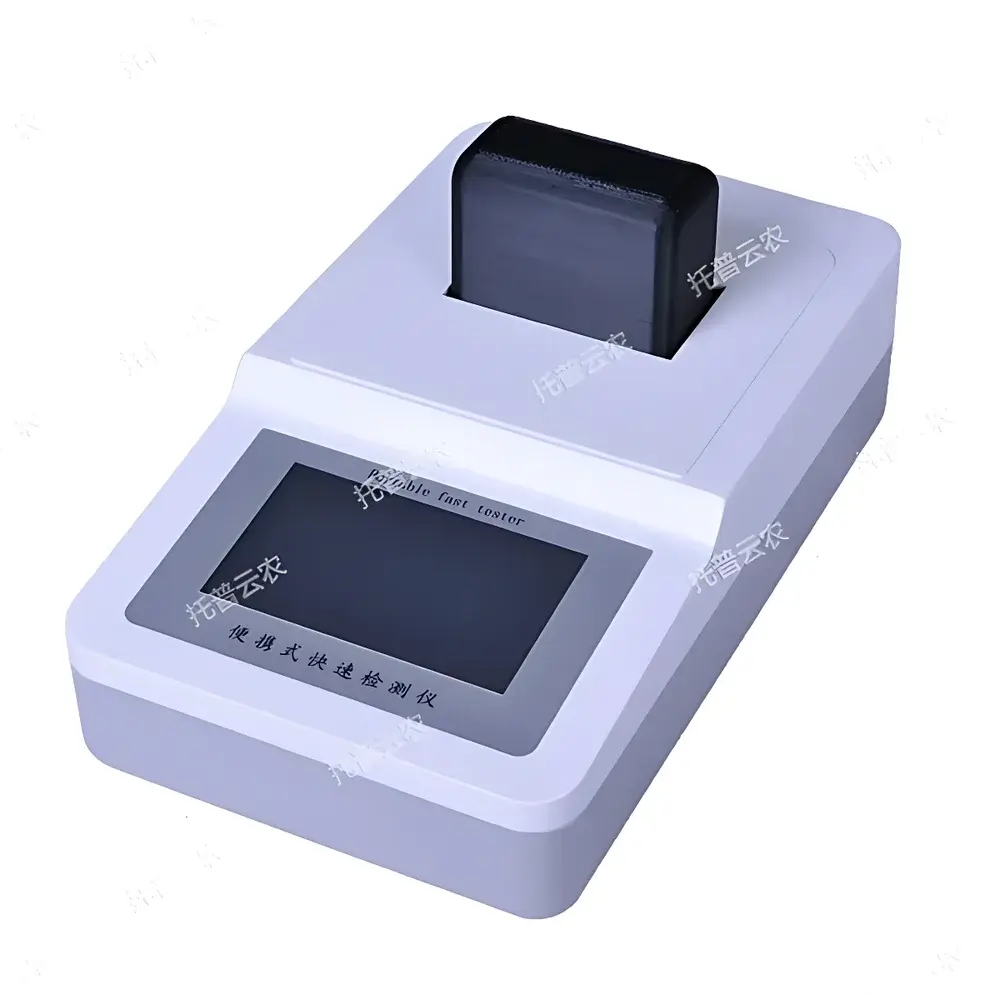
Top Cloud-agri TPSZ-20D Portable Multi-Parameter Water Quality Analyzer
| Brand | Top Cloud-agri |
|---|---|
| Origin | Zhejiang, China |
| Manufacturer Type | OEM/ODM Manufacturer |
| Country of Origin | China |
| Model | TPSZ-20D |
| Instrument Type | Portable Spectrophotometric Water Quality Analyzer |
| Detection Parameters | Ammonia-N, Total Cyanide, COD, Fluoride, Chlorine Dioxide, Sulfide, Cyanide, Cadmium, Mercury, Aluminum, Lead, Nitrate-N, Residual Chlorine, Total Nitrogen, Total Phosphorus, Total Chlorine, Turbidity, Color, Nitrite, pH |
| Display | 4.3-inch Color TFT Touchscreen |
| Absorbance Range | 0.000–4.000 |
| Transmittance Range | 0.00–100.00% |
| Transmittance Resolution | 0.01% |
| Absorbance Resolution | 0.001 |
| Photometric Accuracy | ±2.0% T |
| Photometric Repeatability | ≤0.2% T |
| Baseline Stability | ≤0.3% T (3 min) |
| Interface | USB |
| Power Supply | AC 220 V |
Overview
The Top Cloud-agri TPSZ-20D Portable Multi-Parameter Water Quality Analyzer is a field-deployable, benchtop-capable spectrophotometric instrument engineered for quantitative analysis of up to 20 critical water quality parameters in situ and in fixed laboratory environments. It operates on the principle of visible-light absorbance spectroscopy—applying standardized colorimetric methods (e.g., Nesslerization for ammonia-N, iso-nicotinic acid–barbituric acid for total cyanide, dichloramine-T for residual chlorine, and ascorbic acid–molybdate for total phosphorus) in accordance with internationally referenced analytical protocols including GB/T 5750.5–2006, HJ 484–2009, HJ/T 339–2007, and ISO 7027 for turbidity. Designed for environmental monitoring agencies, municipal water utilities, industrial effluent management teams, and third-party testing laboratories, the TPSZ-20D delivers trace-level detection sensitivity, calibrated photometric stability, and method-locked assay reproducibility without requiring external calibration standards for routine operation.
Key Features
- Integrated 4.3-inch full-color TFT touchscreen interface with intuitive Chinese-language GUI—designed for rapid method selection, real-time spectral preview, and guided workflow navigation under variable ambient lighting conditions.
- Pre-loaded calibration curves for all 20 target analytes, each validated against national standard methods; users may import or modify curves via USB while maintaining audit-trail integrity.
- Onboard thermal printer enabling immediate hard-copy generation of test reports—including sample ID, measurement timestamp, operator ID, method reference, raw absorbance values, calculated concentration, and pass/fail flags per regulatory thresholds.
- Embedded data management system supporting automatic storage of ≥10,000 test records with time-stamped metadata; searchable by parameter, date range, location tag, or batch ID.
- USB-host interface for firmware updates, method library expansion, and secure data export in CSV or PDF format compatible with LIMS integration.
- Ruggedized housing rated IP54 for dust and splash resistance; optimized thermal design ensures optical path stability across 5–40 °C operating ambient range.
Sample Compatibility & Compliance
The TPSZ-20D accepts liquid samples from diverse matrices—including potable water, surface water, groundwater, treated wastewater, and industrial effluents—following standardized pretreatment protocols (e.g., filtration for turbidity-sensitive assays, digestion for total nitrogen/phosphorus, pH adjustment for cyanide stabilization). All embedded analytical methods conform to Chinese national standards (GB and HJ series), with direct method equivalency to ASTM D1426 (ammonia), ASTM D3371 (cyanide), ISO 6060 (COD), and EPA 180.1 (turbidity). While not certified to FDA 21 CFR Part 11 out-of-the-box, the device supports GLP/GMP-aligned operational practices through mandatory user login, immutable result logging, and electronic signature-ready reporting templates.
Software & Data Management
Firmware v3.2+ provides role-based access control (administrator/operator modes), configurable auto-save intervals, and encrypted local database storage. Raw photometric data (absorbance at specified wavelengths) and derived concentrations are timestamped and stored with checksum validation. USB export generates ISO 8601-compliant CSV files containing column headers aligned with WHO Water Quality Monitoring Framework metadata conventions. Optional cloud synchronization (via optional LTE module) enables remote dashboard viewing and automated alerting upon threshold exceedance—fully compliant with IEC 62443-3-3 cybersecurity baseline requirements for field instrumentation.
Applications
- Routine compliance monitoring of drinking water distribution systems per GB 5749–2022 (Sanitary Standard for Drinking Water).
- Field verification of wastewater discharge permits under China’s “Blue Sky & Clear Water” initiative (MEP Order No. 48).
- Emergency response screening during chemical spills or algal bloom events—enabling rapid triage of ammonia, nitrite, and residual chlorine levels.
- Source water vulnerability assessment in rural watersheds, particularly for heavy metals (Pb, Cd, Hg) and nutrient loading (TN, TP, NO₃⁻).
- Educational use in university environmental science labs for method validation exercises and inter-laboratory comparison studies.
FAQ
Is the TPSZ-20D suitable for regulatory reporting under Chinese environmental law?
Yes—its built-in methods align with GB/T and HJ-series standards cited in MEP enforcement guidelines; however, formal accreditation requires laboratory-specific validation per CNAS-CL01:2018.
Can custom calibration curves be uploaded?
Yes, via USB in .csv format; curve metadata (wavelength, reagent lot, expiry) is logged and displayed during method selection.
Does the instrument support battery operation?
No—it requires AC 220 V input only; field deployment necessitates a portable power station or generator with stable sine-wave output.
What is the wavelength accuracy of the optical system?
Fixed-wavelength LED sources (420 nm, 470 nm, 520 nm, 590 nm, 610 nm, 630 nm, 700 nm) with ±2 nm tolerance, verified during factory calibration using NIST-traceable filters.
How is data integrity maintained during power interruption?
All measurements in progress are buffered in non-volatile RAM; unsaved results persist and resume upon reboot without loss.







